
The exact stall: they accept, engage once, then disappear
It’s the “almost hired” moment. The thread doesn’t die because they’re not interested. It dies because the buyer didn’t feel safe enough to keep talking.
You post something real about pipeline quality or positioning. A founder likes it. Maybe they comment. They accept your connection. You send a clean follow-up. They even reply once.
Then… nothing.
Not because the problem vanished. Because the moment you angle toward a “strategy call,” their risk radar spikes. They’ve been sold to by agencies who sound confident, promise outcomes, then deliver decks and a handoff to juniors. So when you ask early, they read it as: this is about to turn into a pitch.
For fractional CMO work, that’s fatal. You’re selling leadership in a messy, political zone: board pressure, CAC payback scrutiny, tool churn, hiring hesitation, internal blame between Sales and Marketing. The buyer often can’t articulate the real constraint yet—and doesn’t want to admit it in writing to someone they just met on LinkedIn.
The hidden cost isn’t one missed meeting. It’s weeks of latent intent going cold while you’re busy delivering for current clients. So you compensate with more posting, more connecting, more “following up.” Pipeline stays lumpy. Calendar fills with “maybe next quarter.”
What a real progression looks like (and why it works)
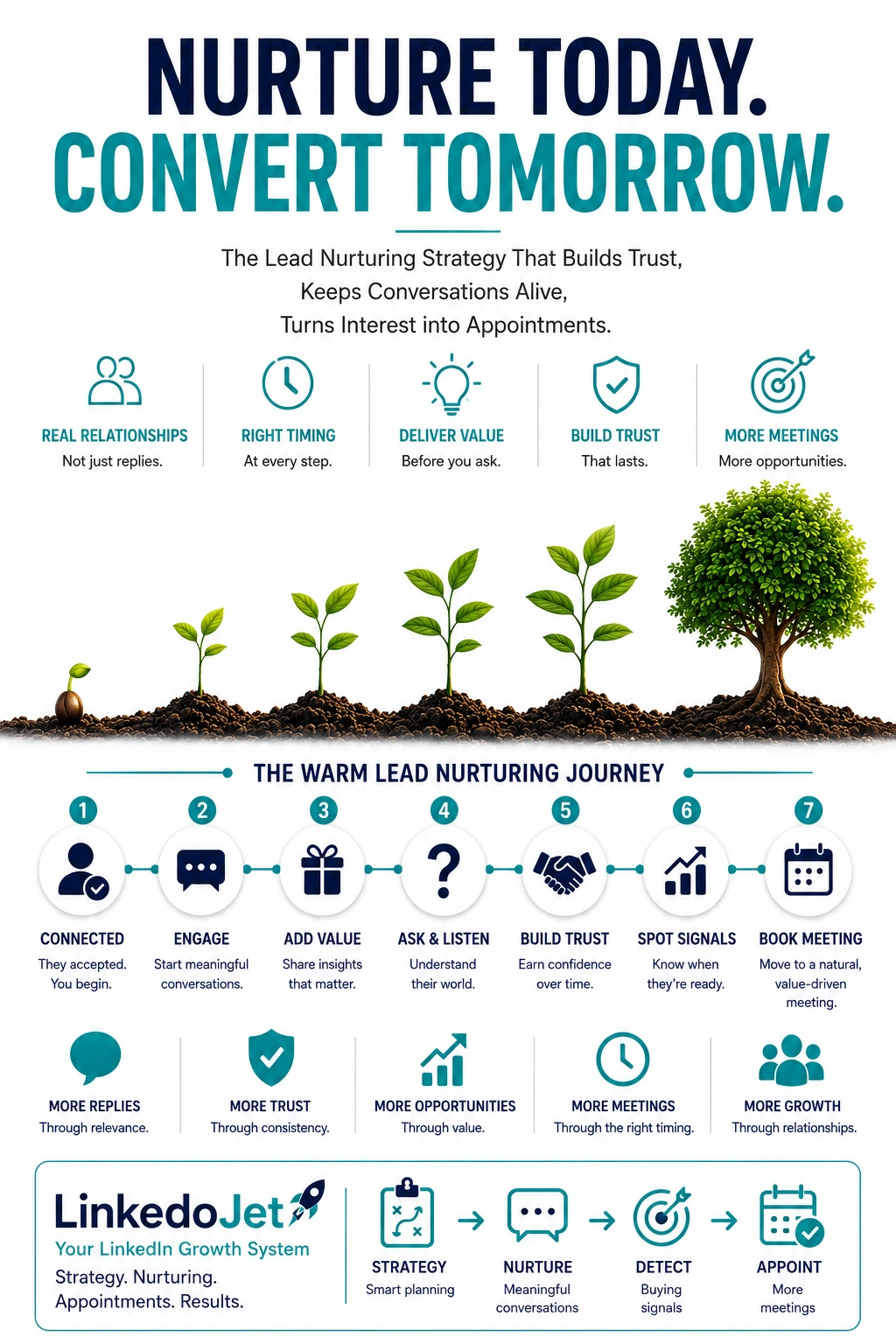
Warm lead nurturing isn’t persistence. It’s reducing uncertainty in a sequence the buyer can tolerate.
If you treat every warm lead like they’re one good message away from booking, you force a decision before they’ve made one internally: Is this a leadership gap, a channel problem, or just noise?
A progression that converts for fractional retainers usually moves like this:
- Light intent → you earn a second exchange without asking for time.
- Shared context → you attach to a real business constraint (targets, timeline, handoffs, team bandwidth).
- Clarified constraints → you help them name the tradeoff (volume vs quality, growth vs efficiency, hire vs fractional, paid vs organic dependency).
- Low-friction call → a short, scoped conversation that produces decision clarity, not a pitch.
The mindset shift: each touchpoint should move one decision forward. Not “checking in.” Not sending a long essay. One question, one lens, one next step.
Fractional CMO buyers don’t want more marketing ideas. They want to know you can walk into the mess, diagnose fast, and stop wasted motion. Your follow-up has to sound like that.
Where warm leads actually come from in fractional CMO deals
Warm isn’t a vibe. It’s observable behavior that hints at timing, risk, and internal constraints.
For fractional CMOs, warm leads often show up sideways. Not as “we want to hire you,” but as small signals that they’re circling a problem:
- Profile visits after you comment on pipeline, ICP, positioning, attribution, or Sales/Marketing alignment.
- Engagement on operator posts (quarter planning, CAC payback, pipeline math, handoffs, “why MQLs aren’t turning into SQLs”).
- Replies that contain symptoms: “lead quality is down,” “Sales says the leads are trash,” “we’re stuck at X demos/month.”
- Influencer engagement from CRO/COO/RevOps (often the person who will bless or block the fractional route).
- Second-degree investor/advisor adjacency: they engage because you’re in the same operator orbit.
- Hiring signals: “we’re looking for a Head of Marketing,” “between CMOs,” “need someone to own marketing.”
- Tool churn mentions: HubSpot/Salesforce changes, attribution debate, paid spend scrutiny, “we don’t trust the numbers.”
Now put a simple temperature model on top—based on what they do, not what you hope they mean:
| Temperature | What you can observe on LinkedIn | Your goal for the next 1–2 touches |
|---|---|---|
| Low-warm | Accepted connection, polite replies, vague “makes sense,” no specifics | Earn context: one narrow question tied to their role/category |
| Mid-warm | Comments on GTM posts, asks a process question, multiple engagements over a week | Surface constraints: timing, targets, handoffs, team bandwidth |
| High-warm | Shares numbers/targets, mentions board/investors, hiring/budget, “need someone to own this” | Offer a low-friction call framed around scoping and decision clarity |
This is the difference between “I’ll follow up next week” and “I know exactly what to say next, and why.”
10 examples that move the thread forward (without sounding like an agency)
Short. Human. Operator-to-operator. Each one creates a decision point.
-
First warm follow-up after connection acceptance
“Appreciate the connect. Your comment on pipeline quality hit a nerve—most teams aren’t short on activity, they’re short on fit. Curious: is the gap showing up more at top-of-funnel volume, or later (handoff/close rate)?”
-
Follow-up after a prospect replies
“Got it. When you say ‘lead quality,’ do you mean poor-fit demos, or deals stalling after discovery because the problem isn’t clear? First thing I usually look at is where the story breaks between ad/copy → SDR pitch → AE discovery—one weak link makes everything feel like a lead problem.”
-
Educational nurturing message (small framework)
“Quick sanity check I use with founders: pipeline math in three lines—(1) target revenue, (2) assumed win rate, (3) needed qualified pipeline. If the math demands 3× more SQLs than the team can generate, the fix is rarely ‘more content.’ If you want, I can send the one-page version I use.”
-
Insight-based follow-up tied to their world (planning/board/hiring)
“Heading into planning season, I’m seeing a split: some teams are being pushed on CAC payback, others on net-new pipeline. Which pressure is louder for you this quarter—efficiency or growth?”
-
Case-story nurturing (believable, early decisions)
“We worked with a B2B SaaS team that felt ‘lead quality’ was the issue. In the first 30 days, the biggest change wasn’t a new channel—it was aligning SDR/AEs on what counts as qualified, tightening the ICP language on the homepage, and fixing attribution so the CEO could trust the pipeline review again. If you’re open, tell me what your pipeline review looks like right now—clean numbers, or lots of debate?”
-
Soft question to reopen when they go quiet
“Quick one—are you still thinking through fractional leadership vs an in-house hire, or did priorities shift? Totally fine either way.”
-
Buying-signal response (targets/budget/hiring/launch)
“That helps. If you need someone to ‘own marketing’ ahead of the launch and the board wants clearer pipeline coverage, the constraints matter: who’s executing day-to-day, what’s the current stack, and what has already been tried? If you want, we can do 15 minutes to map what ‘good’ looks like for the next 90 days and what has to change first.”
-
Soft meeting request (two options, clear outcome)
“Would it be useful to talk this through quickly? Two options: (a) 15-min GTM triage to pinpoint the constraint, or (b) a deeper 35-min session if you want to walk through the funnel and handoffs. Either way, you’ll leave with a short diagnosis and 2–3 next-step paths. If timing’s off, no stress.”
-
Dormant lead revival after 30–90 days (relevant trigger, concrete offer)
“Circling back because I’m seeing a common failure mode in your category: teams push more spend, but the homepage still speaks to ‘features’ instead of the buyer’s problem, so Sales eats the gap. If you want, I can send a one-paragraph teardown of your homepage message from a pipeline point of view—no deck, just the blunt version.”
-
Final polite close-loop (preserve relationship + timing)
“I’m going to pause on my side so I’m not another notification. If marketing leadership becomes a priority again, want me to circle back around planning season / after the launch? Easy yes/no.”
Notice what’s missing: “checking in,” long links, and performative value drops. You’re guiding them toward clarity, not trying to win an argument in DMs.
Why warm leads go silent (and what to do instead)
Silence is usually a risk response, not a rejection.
Here’s what kills fractional CMO conversations fast:
- You ask for a call before they’ve said what’s broken. They’re still forming the problem statement.
- You send long “helpful” essays. Founders read it as time debt. They won’t sign up for more.
- You share generic content. Random podcasts and broad marketing takes feel like an agency nurture sequence.
- You act like a vendor while selling leadership. Fractional is trust + judgment, not a list of deliverables.
- You ignore the real comparison set. They’re weighing: hire a Head of Marketing, keep the current agency, do nothing, or go fractional.
- You don’t address the “decks” fear. They assume they’ll pay for slides while execution stays messy.
What works instead is less glamorous:
- Shorten everything. One lens. One question. One next step.
- Make each touch about a decision. “Which part is breaking?” beats “want to chat?”
- Show you diagnose before prescribing. Clarify whether it’s ICP, offer, channel focus, handoffs, or instrumentation.
- Use timing triggers like an operator. Planning, board meetings, pipeline reviews, launches, hiring cycles.
When you do this, the founder doesn’t feel chased. They feel remembered.
Meeting readiness, negative signals, and when to pause
Stop guessing. You’re not trying to “get replies.” You’re trying to catch the moment decision-making starts.
Meeting-readiness signals for fractional CMO retainers tend to look like this:
- They share numbers: revenue targets, demo targets, win rate, CAC payback, pipeline coverage.
- They reference time pressure: board meeting, next quarter plan, launch date, fundraising timeline.
- They ask how you’d work with their existing team/agency (translation: “this is political”).
- They say the quiet part out loud: “We need someone to own marketing.”
- They ask process questions: “What do you typically do first?” or “How do you approach the first 30 days?”
When those show up, your job is to summarize their situation in their words and offer a scoped call that reduces risk: clarify constraints, map the first 30–90 days, and identify the few decisions that will actually change the outcome.
Negative signals (where you should slow down or pause):
- They fish for free strategy but refuse to share context (“can you send me your playbook?”).
- They stay purely tactical (“what subject line works?”) and avoid ownership or outcomes.
- They keep replying with “interesting” but never answer a concrete question.
- They’re clearly in “information gathering” mode with no internal sponsor.
Pausing is a power move when it’s clean and respectful. It protects your time and keeps the relationship intact for when timing becomes real.
How LinkedoJet runs warm-lead progression as a system (not a hustle)
Most tools send messages. The hard part is knowing why someone went warm, what to say next, and when a call is actually earned.
If you’re a fractional CMO, your attention is the constraint. You’re delivering for current clients, managing stakeholder drama, and trying to keep your own pipeline alive. Warm leads slipping isn’t a character flaw—it’s a missing operating system.
LinkedoJet is built to manage this progression end-to-end:
- ICP and targeting setup so you’re consistently in front of CEO/CRO/COO profiles that actually buy fractional leadership (not just “marketing people”).
- Sales Navigator list building that reflects how fractional deals happen: founder-led, investor-adjacent, and operator-influenced.
- AI-assisted personalization that stays grounded in real context (what made them warm, what they engaged with, what their company is likely dealing with) without turning into robotic compliments.
- Outreach execution with the right pacing, plus warm lead tracking that tags the source of intent (post engagement vs reply vs profile visit vs influencer engagement).
- Reply handling and nurturing so threads don’t die in your inbox while you’re in client calls. The goal is clean, operator-to-operator progression—not spam.
- Meeting-readiness flags that surface when they mention targets, hiring, budgets, launches, or “we need someone to own this,” so you ask for time at the right moment.
- Campaign visibility through dashboards, so you can see what’s warming up, what’s stuck, and what needs refinement.
- Ongoing refinement based on what’s actually converting into qualified conversations and appointments.
For fractional CMO offers, this matters because you’re not selling a one-off project. You’re asking a founder to trust you with decision-making. LinkedoJet helps you earn that trust with consistent, context-aware follow-up—without you living in LinkedIn all day.
FAQ
How often should I follow up with a CEO on LinkedIn without coming off pushy?
Anchor follow-ups to temperature and timing, not a fixed cadence. If they’re low-warm (accepted, vague), space touches out and earn context with one narrow question. If they’re high-warm (targets, hiring, board pressure), respond faster and offer a scoped next step. The fastest way to feel pushy is “just checking in” with no new decision point.
What are the best warm signals for a fractional CMO retainer on LinkedIn?
Signals that indicate a leadership gap and decision timing: they share numbers/targets, mention board/investors, talk about hiring a Head of Marketing, say they’re “between CMOs,” describe handoff friction between Sales and Marketing, or ask “what do you typically do first?” Engagement on posts about pipeline math, positioning, and CAC payback is mid-warm; it becomes hot when they attach it to their reality.
How do I revive an inactive LinkedIn conversation after 30–90 days?
Don’t resurrect the old thread with guilt. Re-enter with a relevant trigger (planning season, launch, hiring, CAC pressure) and a concrete operator offer: one-paragraph homepage message teardown, a quick benchmark question, or a common failure mode you’re seeing in their category. One message, one prompt, graceful out.
What should I say when a founder is weighing fractional leadership vs hiring a head of marketing?
Make the tradeoff explicit without defending yourself. Ask what they need most in the next 90 days: decision-making and alignment (fractional shines), or pure execution capacity (hire/agency may be better). Then clarify constraints: existing team strength, who owns revenue targets, current stack, and how they’ll judge success. That conversation naturally leads to a small call because it reduces risk.
How do I respond when a prospect asks “what do you typically do first?” without pitching?
Answer with a tight sequence and the decisions it unlocks, not a menu of services. Example: align on the revenue target and pipeline math, validate ICP/positioning against current funnel data, inspect handoffs (SDR→AE) and instrumentation, then pick one primary motion for the next 30 days. Keep it concrete and invite a quick scoping call only if they want help applying it to their numbers.
See how LinkedoJet turns warm interest into qualified appointments
This isn’t a vague “strategy chat.” It’s a working session to pressure-test your targeting and follow-up progression—and show you exactly what gets delivered after onboarding.
If you’re already getting LinkedIn traction but threads keep stalling, the fix isn’t more activity. It’s a managed progression: capture why someone went warm, pick the right next message, and time follow-ups around real decision triggers (planning, board meetings, hiring, launches).
On the demo, we’ll walk through how LinkedoJet operationally runs this as an appointment system for fractional CMO offers:
- ICP + targeting setup: we define the exact decision-makers and “fractional-ready” signals (CEO/CRO/COO, investor-backed operators, hiring intent, pipeline accountability).
- Sales Navigator list building: we build and maintain prospect lists that match your retainer motion (founder-led, operator-influenced, right company stage).
- AI-assisted personalization: messages stay short and specific to the warm context (post engagement vs profile visit vs reply), so you sound like a peer—not an agency sequence.
- Outreach execution: LinkedIn outreach is executed with pacing that fits leadership sales cycles, not spammy bursts.
- Reply handling + nurturing: replies are routed, categorized by temperature, and progressed with the next best prompt so conversations don’t die while you’re delivering for clients.
- Warm lead tracking + readiness flags: we track warm signals (targets, hiring, launch dates, “need someone to own marketing”) and flag when a low-friction call is earned.
- Appointment generation support: we help move qualified threads into booked calls and keep visibility on what’s in motion.
- Dashboards + ongoing refinement: you can see what’s working, what’s stalling, and how targeting/messaging is being improved over time.
After onboarding, you don’t just get a tool. You get a managed outbound engine with targeting, list building, messaging, execution, follow-up workflows, and clear visibility into warm leads and booked meetings.
From identifying the right decision-makers to starting meaningful conversations and turning them into qualified appointments... LinkedoJet manages the entire outbound engine for your business.
Next step: stop letting warm intent die in your inbox
If your offer is senior, your follow-up has to feel senior. We’ll help you run nurturing as a system—so the right founders convert when timing becomes real.