
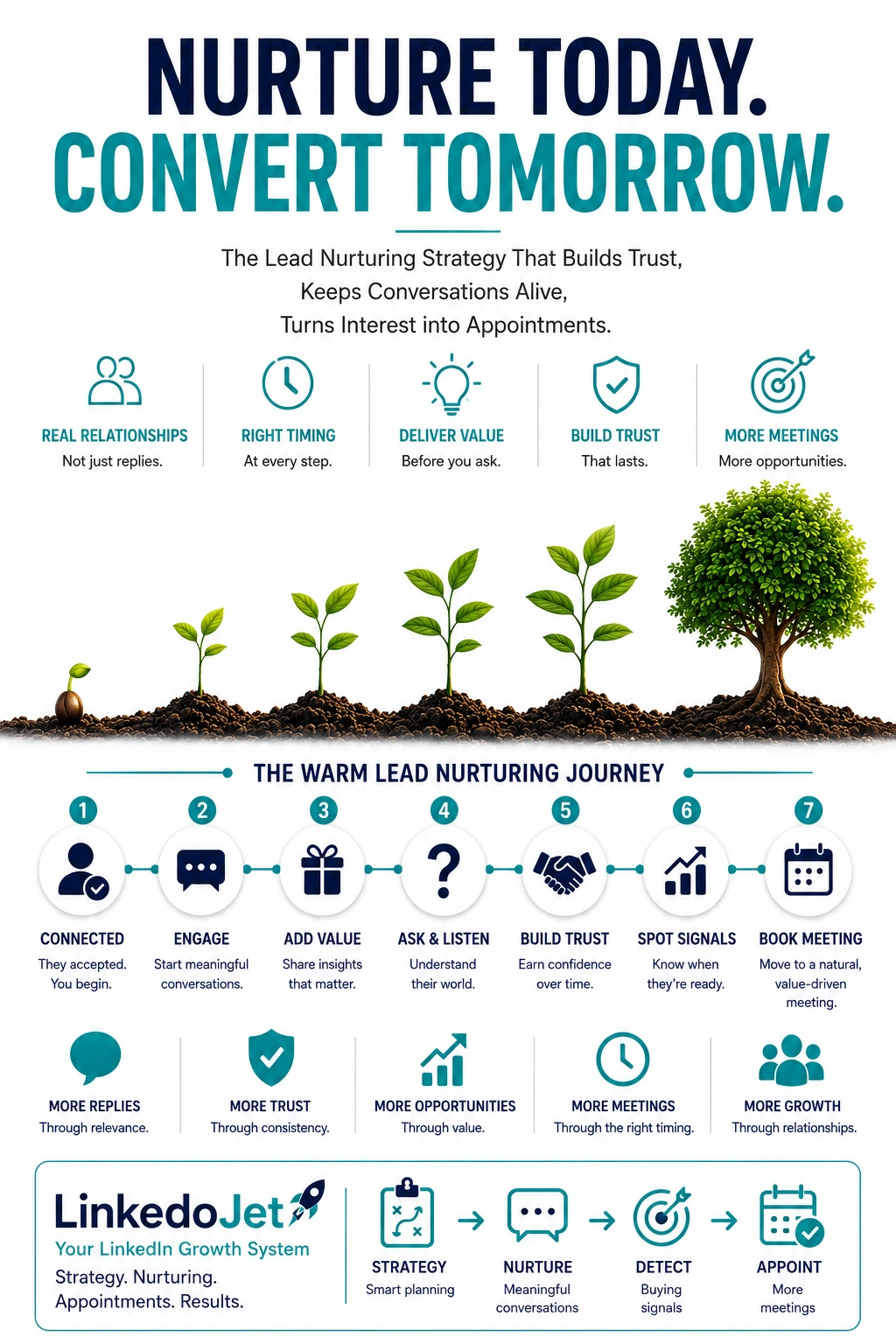
The pattern that kills retainer pipeline: accepted → one signal → silence
It’s not that founders aren’t interested. It’s that your window closes while you’re trying to “not be salesy.”
A founder accepts your request after a cash-flow post. They react. Maybe they even DM: “We’ve been meaning to fix reporting.”
Then month-end hits. Payroll week. A customer escalation. And your thread dies in the exact moment it was closest to becoming real.
The cost isn’t just a missed call. It’s the lumpy retainer pipeline that forces you back into referral-dependence, and the slow drip of unpaid pre-sales where you keep answering questions in DMs because you don’t have a clean way to qualify and progress.
Most fractional CFOs read that silence as a persuasion problem: “I should’ve been more compelling” or “I should follow up harder.” Both moves usually make it worse. Founders are guarded on LinkedIn now; “let’s hop on a call” is a red flag, and repeated nudges feel like a sales cadence, not a finance leader showing up with calm clarity.
The real issue is timing and context. Warm intent is time-bound. And in CFO work, it’s tied to pain cycles: close, board packs, lender questions, hiring, fundraising, a margin miss that suddenly becomes undeniable.
If you don’t have an operating system for the in-between moments, you default to two bad options:
- Silence (miss the window, watch interest decay)
- Neediness (chase with “checking in,” lose trust)
There’s a third option: progression that feels like CFO follow-through, not sales follow-up.
Define “warm” like a finance leader: triggers + lead temperature
“Warm” isn’t a vibe. It’s a set of observable signals—and each temperature has a different job.
In this market, warm signals show up quietly. A founder won’t say, “I’m in-market for a fractional CFO.” They’ll do something that indicates pressure is forming.
Common warm triggers for fractional CFO work:
- Profile view after you post about runway, AR aging, margin drift, or cash surprises
- Like/comment on a cash or pricing thread (especially if they ask a question)
- A quick reply: “Interesting,” “We’ve been meaning to fix reporting,” “Yep, cash is messy right now”
- They mention hiring, new locations, inventory buys, or “we’re fundraising later this year”
- They ask anything about process, timeline, or pricing (rare, but very warm)
I like to classify warmth in four temperatures that map to how founders actually buy finance help:
| Temperature | What it looks like on LinkedIn | What your next follow-up must accomplish |
|---|---|---|
| Curiosity | Light engagement, profile view, “interesting” | Earn permission to continue with a low-effort, useful next step |
| Concern | Admits pain: messy reporting, cash feels tight, “we don’t trust the numbers” | Clarify the problem with one sharp question (forecast vs close vs KPI visibility) |
| Urgency | Deadline pressure: board pack, lender request, payroll/runway, fundraising | Reduce perceived effort/risk and propose a calm, short diagnostic next step |
| Readiness | Asks about scope, retainer, timeline, “how do you work?” | Move to a 15–20 minute finance clarity call with clear outcomes |
A cadence that fits founder reality (and finance rhythms)
Daily follow-ups feel needy. Weekly “checking in” gets ignored. You need a rhythm that respects how founders pay attention.
Warm leads don’t need more touches. They need fewer touches with more relevance, timed around when finance pain is top-of-mind.
Here’s a rhythm that works well for fractional CFO retainers because it mirrors operational cycles:
- Day 0–1 (after the trigger): a short, contextual message that offers something concrete and low-stakes
- Day 3–5: one momentum question that narrows the problem (forecast vs close vs KPI visibility)
- Day 10–14: a micro-insight nurture (2–3 lines) tied to a common misunderstanding (profit vs cash, working capital drag, why growth can starve cash)
- Day 21–28: an event-tied follow-up (month-end, board week, hiring phase, quarter planning)
- Day 35+: reopen or close-loop—either re-enter with relevance or exit cleanly
Timing windows that consistently outperform random “checking in”:
- Right after month-end close (when reporting pain is loudest)
- 1–2 weeks before a board/investor meeting (when the story needs to be coherent)
- Early in a new quarter (when priorities reset and budget decisions get made)
- Immediately after a hiring decision (when payroll hits before revenue does)
The point isn’t to stalk their calendar. It’s to stop messaging them when they’re least able to respond, and start showing up when the problem is back on their desk.
Message examples that protect trust (by situation + intent)
Short. CFO-native. Easy to answer. Every touch earns its place.
1) After connection acceptance (intent: acknowledge trigger + offer low-stakes value)
“Thanks for connecting—saw you engaged with the cash-flow thread. If it’s useful, I can share the 3 numbers I look at first when a founder says cash feels tight—no deck, just a quick breakdown. Want me to send it?”
2) After they reply once (intent: keep momentum with one clean diagnostic question)
“Quick clarifier so I don’t guess: are you mostly trying to get forecasting under control, or is it the month-end close/reporting that’s causing the pain?”
3) Micro-insight nurture (intent: teach one thing, invite context)
“One pattern I see a lot: profit can be up while cash gets worse—usually AR stretch + paying vendors faster + payroll growth. A simple 13-week view makes that visible fast. Is your pressure more runway-related, margin-related, or just not trusting the numbers?”
4) Event-tied follow-up (intent: show timing awareness without being gimmicky)
“Heads-up since we’re near quarter planning: teams often see cash surprises right after they add headcount because payroll hits before the revenue does. Are you in a hiring phase this quarter, or trying to stabilize first?”
5) Proof mini-story (intent: demonstrate process + outcome, not hype)
“Worked with a founder-led services business where reporting lagged 6–7 weeks; we tightened the close, rebuilt a simple KPI pack, and their weekly decisions stopped being ‘bank balance driven.’ If you’re open, I can outline what that looked like in week 1 vs. week 4.”
6) Soft reopen prompt (intent: give them an easy reply without guilt)
“Quick pulse-check—are you still thinking about tightening reporting/forecasting, or did it drop off the priority list for now?”
7) Dormant revival around month-end (intent: re-enter with relevance + permission)
“You’d mentioned cash visibility was a headache—if it’s still on your radar post month-end, I can share the simple 13-week view I use with founders to stop surprises. Worth sending?”
8) Final close-loop (intent: exit cleanly and protect the relationship)
“I’m going to step back so I’m not noise in your inbox. If a trigger pops up—board pack pressure, lender questions, a hiring plan you can’t fund—feel free to ping me and I’ll share what I’d look at first. Either way, hope the quarter goes smoothly.”
Buying signals → calm qualification (without turning the DM into unpaid consulting)
Your job is to reduce ambiguity, not to diagnose their entire finance function in chat.
When a founder drops a buying signal, they’re usually testing two things: (1) do you “get it,” and (2) will engaging with you create a bunch of work and awkwardness.
The move is consistent: acknowledge the pressure, ask one scoping question, then offer a lightweight next step that’s framed as diagnosis—not a pitch.
If they say: “We need better forecasting.”
“Makes sense. Is the problem that the forecast isn’t accurate, or that it doesn’t connect to real weekly decisions (hiring, spend, pricing)? If you want, we can do 20 minutes to map what’s breaking and whether a 13-week cash view or a longer model is the right first fix.”
If they say: “Our books are a mess.”
“You’re not alone—this is more common than founders admit. Is the pain mostly speed (close takes forever) or trust (numbers change after the fact)? If it helps, I can walk you through the first-pass triage I use to stabilize close without stepping on your accountant.”
If they say: “We’re fundraising.”
“Got it. What’s the biggest risk right now—story (coherent metrics), predictability (forecast), or the actual reporting package? A short finance clarity call can tell us what needs to be in place before you spend weeks polishing a deck.”
If they say: “We’re missing margin targets.”
“That’s painful because it creeps. Is the miss coming from pricing/discounting, delivery efficiency, or mix? One question: do you have margin by product/service line that you trust, or is it blended?”
If they say: “Our controller is underwater.”
“That’s a real constraint. Is the controller buried in close and cleanup, or are they constantly getting pulled into ad-hoc requests? If you want, I can outline a simple cadence that protects close and still gives the CEO weekly visibility.”
If they say: “We need board reporting.”
“Understood. Is the issue the pack itself (format, narrative, KPIs), or that the underlying close isn’t stable enough to produce it on time? If you’re open, 15–20 minutes is enough to spot what’s missing and what a realistic first month looks like.”
A soft meeting request that doesn’t feel like a pitch
“If you want, we can do 20 minutes to map the problem and see whether it’s a forecasting issue, a close process issue, or just KPI visibility. If it’s not a fit, I’ll tell you straight. Want me to send a scheduling link?”
Why warm CFO leads go silent (and how your nurture removes friction)
Most “ghosting” is a self-protection move. Your follow-up should lower perceived risk, not raise it.
When founders disappear, it’s rarely because the problem vanished. It’s because engaging feels costly.
- They fear a lecture (“you need a full-time CFO”) when they’re trying to stay lean.
- They’re embarrassed about messy books, late reconciliations, or decisions made off gut feel.
- They’re overwhelmed and avoid anything that might create a new project.
- They’re worried about cost and don’t want to start a conversation that ends in a big retainer pitch.
- They already have an accountant and don’t understand the lane difference between compliance and decision support.
Your nurture has to do three things simultaneously:
- Normalize the mess without excusing it (“this happens at your stage”).
- Reduce effort (“one question” beats “tell me about your business”).
- Clarify the lane (forecasting, KPI visibility, working capital, board pack cadence) without stepping on their accountant.
One subtle shift that matters: stop asking founders to explain everything. Ask them to choose between two options. It’s easier to answer, and it gives you a clean branch for the next message.
FAQ
What counts as a “warm” LinkedIn lead for fractional CFO services?
A warm lead is anyone showing intent tied to a real finance trigger: they view your profile after a cash/runway post, engage with margin/forecasting content, reply even once with context (“reporting is messy”), or mention a timing event (board pack, lender ask, hiring, fundraising). Warm doesn’t mean ready to buy—it means the topic is on their desk.
How often should I follow up on LinkedIn without sounding salesy or needy?
Think in touches that earn attention: 1–2 touches in the first week after a trigger, then a slower rhythm (roughly every 10–14 days) with relevance—micro-insight, one question, or an event-tied note. If you’re sending weekly “checking in,” you’ll get ignored. If you’re messaging daily, you’ll lose trust.
What’s the best way to move from DMs to a discovery call for a CFO advisory retainer?
Don’t jump to “call” as the default. First narrow the problem (forecast vs close vs KPI visibility). Then offer a short “finance clarity” call with a clear outcome: identify what’s breaking, what a realistic first 30 days looks like, and whether it’s even a fit. Calm, optional, and specific beats urgent and salesy.
What should I send after someone replies once (so the thread doesn’t die)?
Ask one clean diagnostic question that gives them an easy choice: “Is this mostly forecasting, or month-end close/reporting?” or “Is the pressure runway, margin, or trust in the numbers?” One question keeps momentum without forcing a long explanation or a mini-consulting session.
How do I revive inactive LinkedIn conversations with founders around month-end or quarter planning?
Re-enter with relevance and permission, not guilt. Tie back to the original pain (“cash visibility,” “board reporting”) and offer a low-effort asset or framing: “If it’s still on your radar post month-end, I can send the simple 13-week view I use to stop surprises—worth sending?” If they don’t respond after a couple of high-signal attempts, close-loop politely and leave the door open for the next trigger.
If you want this to run like an operating system (not a hopeful habit)
LinkedoJet manages the targeting, outreach, nurturing, and handoff so your warm LinkedIn conversations turn into qualified clarity calls—without you living in DMs.
Most fractional CFOs don’t struggle to sound credible. They struggle to stay consistent while delivering for current clients. That’s where warm leads die: the “in-between” moments don’t get handled with timing, context, and follow-through.
What LinkedoJet operationally provides: we set up your ICP and targeting system, build Sales Navigator prospect lists (founders/CEOs, COOs, and finance leads at $2M–$30M revenue businesses), and run LinkedIn outreach execution with AI-assisted personalization that stays in a CFO voice—specific, discreet, and grounded.
How targeting and list building work: we translate your best-fit client profile into filters that actually match buying triggers (industry, headcount, growth stage, role, geography) and we continuously refresh lists so you’re not recycling the same tired pool. You get visibility into who’s being contacted and why.
How AI-assisted personalization is used: it’s not “{firstName}” fluff. We use context from their role, recent activity, and likely finance pressures to craft short openers that feel like a finance peer. You approve the voice and boundaries; we keep it consistent.
How lead nurturing and follow-up workflows operate: we track warm signals (profile views after relevant posts, replies, engagement, “not now”), assign temperature, and trigger the right follow-up at the right time—month-end, quarter planning, board cycles—so you’re not defaulting to either silence or “just checking in.”
How reply handling works: we help manage first-line responses and route real buying signals to you with a clear summary: what they said, what they likely need (forecast/close/KPI/board), and a suggested next question to qualify without turning the DM into free consulting.
What happens after onboarding: you get a running outbound engine—targeting, messaging, outreach, nurturing, and refinement—plus dashboards that show outreach volume, reply rates, warm lead stages, and booked appointments. We iterate weekly based on what the market is actually responding to.
What you receive: a steady flow of warmed conversations, clear qualification prompts, and appointment-generation support so you can focus on delivery and show up only when it’s time for a proper finance clarity call.
Why this is different from ordinary LinkedIn automation tools: tools send sequences. LinkedoJet runs the full system: targeting, list building, CFO-native messaging, ongoing follow-up tied to finance rhythms, warm lead tracking, and the handoff into booked calls—with visibility and refinement, not set-and-forget automation.
Next step: turn warm intent into booked clarity calls
You shouldn’t have to choose between protecting your reputation and progressing the conversation. This is the middle path: calm follow-up, finance timing, and clean qualification.
When LinkedoJet is running, you get an outbound system that keeps warm LinkedIn leads moving through the “in-between” moments—without you chasing founders, and without dropping threads when client work gets busy.
From identifying the right decision-makers to starting meaningful conversations and turning them into qualified appointments... LinkedoJet manages the entire outbound engine for your business.