
Why warm LinkedIn coaching leads stall (and the real cost of “busy pipeline, lumpy revenue”)
Executive coaching interest rarely shows up as a clean inbound. It shows up as small signals—and then disappears the moment the conversation feels even slightly salesy.
A CEO views your profile after you post about decision fatigue. A VP likes a comment on leading through change. A People leader replies “appreciate this” to a transition framework.
Then the thread stalls.
Not because you didn’t follow up “enough.” Because the buyer is quietly running a test: Is this person discreet? Do they have range? Will they make me regret engaging? The moment your follow-up reads like a sequence—or worse, a pitch—they protect their calendar by going silent.
For coaching firms, that silence is expensive in a specific way. Your CRM looks active. Partners feel productive. But revenue stays lumpy because the motion never crosses the threshold that matters: a confidential, sponsor-aware conversation with clear stakes.
Here’s what’s usually happening under the surface:
- The trigger passed. The reorg announcement, board meeting, or performance issue created urgency for a week. Then it got buried.
- The topic is sensitive. “I’m considering coaching” can feel like admitting weakness. Even when it’s actually a high performer protecting outcomes.
- They don’t know what kind of coach you are. Too “therapy-like” is a risk. Too “motivational speaker” is a risk. Generic is a risk.
- The sponsor dynamic is unresolved. The executive may want it. HR/People may pay for it. Or the executive may want it because HR is pressuring them—making the whole thing political.
The hidden cost isn’t just missed calls. It’s reputation and relationship capital. Senior leaders remember who handled the early conversation with restraint—and who pushed when they weren’t ready.
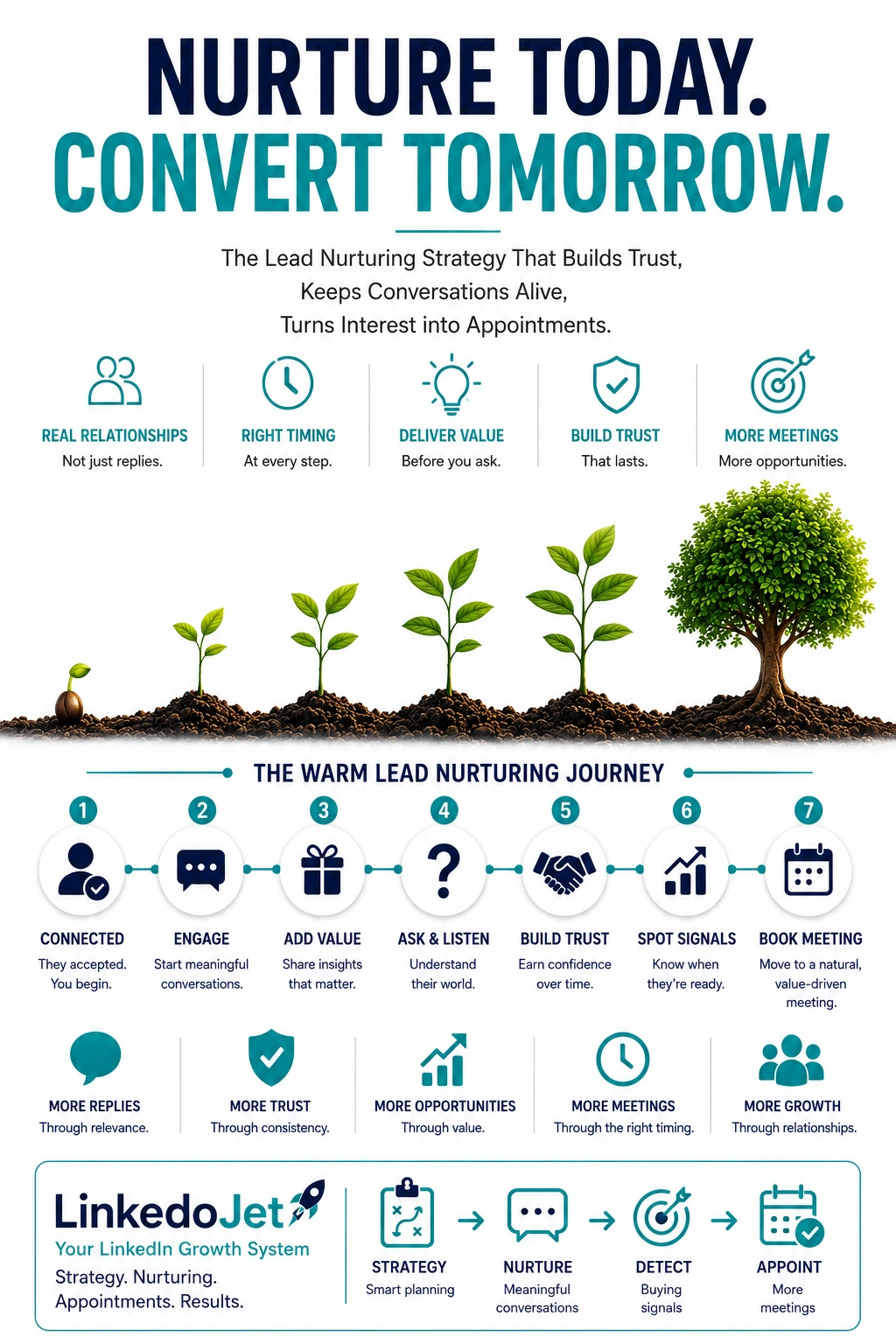
Conversation temperature model for executive coaching: Light → Curious → Active → Meeting-ready
Most firms treat warm follow-up like a messaging problem. It’s a trust-and-timing operating problem. You need a shared model so partners don’t improvise their way into ghosting.
| Temperature | What it looks like on LinkedIn | Your goal | Do | Avoid |
|---|---|---|---|---|
| Light | Connection accepted, profile view, like/comment, role-change announcement | Earn the right to stay in the orbit | One tight, contextual note; make a small observation tied to their world | “Want to hop on a call?” or sending a long article with no point-of-view |
| Curious | Short reply, asks a question, reacts to a specific insight, hints at a challenge | Convert curiosity into a defined problem frame | Mirror their language; ask one clarifying question; offer a discreet scoping lens | Therapy-style open-ended prompts (“How does that make you feel?”) in DMs |
| Active | Mentions stakes, transition, stakeholder pressure, performance themes, sponsor involvement, timing | Qualify quietly (sponsor, urgency, outcomes) | Ask 2–3 crisp questions max; propose a short confidential working session with an agenda | Over-sharing “proof,” name-dropping, or trying to coach them in chat |
| Meeting-ready | Asks about approach/cadence/confidentiality; asks for next steps; clear trigger event | Book a call that feels safe and useful | Offer a focused, confidential working session; confirm who should attend (exec vs sponsor) | Long calendar links, “discovery call” language, or pressure tactics |
What to nurture with: short, high-signal prompts that protect confidentiality (and respect the sponsor)
Coaching buyers don’t want more content. They want evidence of judgment—delivered with restraint.
The fastest way to kill a warm executive thread is to “add value” by dumping links or inspirational language. It reads like marketing. Worse, it creates risk: if they reply with something real, they’ve put sensitive details in writing.
Instead, nurture with assets and prompts that are small, specific, and discreet:
- One-paragraph pattern: “What we see when first-time VPs inherit a team with legacy loyalties…”
- De-identified vignette: Situation → tension → what changed. No names, no company, no over-claiming. Explicit confidentiality.
- Failure-mode framing: “Three ways leadership transitions go sideways in the first 60 days (even for strong operators).”
- Sponsor-ready angle (People/HR): “How we define success so coaching doesn’t become a feel-good project—and can be defended internally.”
- A single diagnostic question: crisp, non-invasive, easy to answer without oversharing.
Two audiences, two different fears:
- CEOs/VPs: “Will this person waste my time or expose me?”
- People/HR sponsors: “Will this vendor create risk, ambiguity, or unmeasurable outcomes?”
Your nurture content should answer those fears quietly—without trying to win the whole deal in a DM.
Cadence for senior leaders: fewer, better touches tied to triggers and buyer signals—not a schedule
Executives don’t experience “cadences.” They experience interruptions. Your job is to show up only when you have a reason.
If your follow-up plan is “touch them every 5 days,” you’re already on the wrong side of the relationship. For senior leaders, persistence without a reason reads as neediness—or automation.
A better approach is a reason-based cadence. You follow up when one of these is true:
- They signaled something: viewed, reacted, replied, posted about a relevant moment (new role, reorg, org change, hiring spree, board pressure).
- You have a new, relevant lens: a short pattern or framing that matches their role and likely situation.
- Timing windows opened: end-of-quarter, annual review cycle, leadership offsite season, post-funding, post-M&A integration.
- You’re clarifying sponsorship: the difference between “the executive wants help” and “HR is trying to de-risk a situation” changes the conversation.
Practically, that means some threads get two touches in ten days (because the trigger is hot), and others get one discreet nudge a month (because timing isn’t there yet).
The key is to reference what they did and make the next move small. “Saw your role change” beats “checking in.” A single, high-signal question beats a paragraph of context.
Message examples you can run tomorrow (10 templates)
These are written in an executive-coach voice: direct, grounded, and low-drama. Short on purpose.
-
First warm follow-up after connection acceptance
“Thanks for connecting, [Name]. Noticed you’ve been talking about scaling leadership capacity as the team grows. One pattern we see: the operating cadence that worked at 50 people quietly breaks at 150. Which part tends to be most painful for you right now—decision load, team alignment, or managing up?”
-
Follow-up after a prospect replies (mirror + one clarifier)
“That makes sense. When you say ‘alignment issues,’ is it mostly within the LT, or between the LT and the board/executives above them? I can share how we typically scope this without getting into anything sensitive in DMs.”
-
Educational nurturing message (compact framework + easy response)
“Quick framework we use in transitions: sponsor expectations vs stakeholder expectations. Misalignment there is where good leaders get labeled ‘difficult’ or ‘not strategic.’ In your world, is the sponsor more likely to be the CEO or People/HR?”
-
Insight-based follow-up tied to executive reality
“A lot of senior leaders are in ‘decision compression’ right now—too many calls, not enough clean inputs. When that happens, the team experiences it as inconsistency. Is that showing up for you, or is it more about prioritization across functions?”
-
Discreet proof vignette (de-identified, confidentiality explicit)
“Small, de-identified example (keeping confidentiality): we worked with a newly promoted COO who inherited a strong team with a weak escalation path. Over ~8 weeks we tightened decision rights + meeting cadence; escalations dropped materially and the CEO stopped getting pulled into ops. If you’re in a similar moment, I can outline the structure we used.”
-
Sponsor-aware note to a People/HR leader
“When People teams bring coaching in, the internal question is usually: ‘How do we make this defensible and measurable without turning it into a performance plan?’ If you’re open to it, I can share the success-definition template we use with sponsors (2–3 outcomes, observable behaviors, and check-in rhythm). Useful?”
-
Soft question to reopen the conversation (easy out + easy on-ramp)
“Circling back lightly—still a priority this quarter, or has the situation moved on? Either answer is fine; I’d rather not add noise if timing isn’t there.”
-
Buying-signal response (approach + calm bridge)
“Good question on how engagements are structured. Most work starts with a confidential working session to get clear on stakes, context, and what ‘success’ would change. If it’s a sponsor-led engagement, we align on outcomes and check-in cadence up front; if it’s exec-led, we keep sponsorship clean and explicit. If you tell me whether this is sponsor-driven or self-initiated, I can outline the most typical cadence.”
-
Soft meeting request (confidential working session + agenda + two windows)
“If it’s helpful, we can do a 25-minute confidential working session. Agenda is simple: (1) clarify the trigger and stakes, (2) define 2–3 outcomes worth paying for, (3) see if the fit is real. No prep. Would Tue 11:00 or Thu 16:00 work?”
-
Dormant lead revival (trigger-based, not ‘checking in’)
“Noticed annual review / planning season is kicking off for a lot of teams. One pattern: leaders get feedback like ‘strategic presence’ or ‘communication’ when the real issue is decision rights + stakeholder management. If that’s anywhere on your radar right now, I can share a 5-question diagnostic we use.”
Final polite close-loop message (when it’s gone cold)
“I’m going to close the loop on my side so I’m not peppering you. If timing changes, reply ‘revisit’ and I’ll pick it up. If it’s useful, here’s one short note I wrote on leadership transitions (one screen, no sign-up): ‘The first 60 days failure modes.’ Wishing you a clean quarter.”
Signals and qualification: move forward without turning DMs into a coaching session
Your DMs are not the container for the work. They’re the bridge to a container.
Warm threads die when coaches try to perform coaching in chat. It can feel intrusive (“Why are you asking me that here?”) and it creates risk for the buyer (“Now I’ve admitted something sensitive in writing.”).
Use signals to decide whether to advance, hold, or pause.
| Signal type | Examples | Best next move |
|---|---|---|
| Buying signals (exec) | Mentions transition/new mandate; references feedback themes; asks about cadence/confidentiality; says “I’m getting pressure from…” | Ask 1–2 clarifiers, then propose a short confidential working session with a tight agenda |
| Buying signals (sponsor) | Asks about outcomes, reporting, sponsor check-ins, what “success” looks like, how you avoid coaching becoming vague | Offer a sponsor success-definition template + propose a sponsor/executive alignment call |
| Warm but not ready | Engages with posts; says “good point”; reacts without details; avoids any stakes/timing | Send a short pattern + one binary question; then back off |
| Negative signals | Asks for price immediately with no context; keeps requesting generic content; clearly not a decision maker and won’t introduce sponsor; long delays with no re-engagement | Pause gracefully; offer a light re-entry later tied to a trigger; protect tone and dignity |
Qualification that works in this niche is quiet. Three questions, max:
- Trigger: “What changed that brought this to the surface now?”
- Stakes: “If nothing changes in 60–90 days, what gets harder?”
- Sponsorship: “Is this something you’d want your People leader involved in, or is it exec-led?”
Common mistakes that kill warm coaching conversations:
- Inspirational language as a substitute for specificity. Senior leaders read it as fluff.
- Pushing a call before earning confidentiality and relevance. You only get a few swings before they tune you out.
- Broad, therapy-like questions in public-ish channels. DMs still feel recordable.
- Long articles with no point-of-view. “Here’s a link” is not nurturing.
- Indiscreet name-dropping. In coaching, that’s not proof—it’s a red flag.
- Ignoring sponsor dynamics. Exec and HR buy for different reasons; treat them the same and you stall both.
How LinkedoJet runs this as an operating system: signal tracking, stage-based next moves, reply workflows, and appointment-setting support
The goal isn’t more messages. It’s consistent executive-level follow-up that keeps timing and trust intact—without putting partners in the weeds.
Most coaching firms don’t have a follow-up problem. They have an operating consistency problem.
Warm signals arrive every week—profile views after a leadership post, light replies, role changes, People leaders reacting to sponsor content—and they get handled ad hoc. Some are overworked. Some get ignored. The firm looks busy while the only reliable revenue comes from referrals and a few rainmakers.
LinkedoJet is built to run the full motion with the tone this niche requires:
- ICP and targeting setup: we define your decision-maker map (CEO/COO/VP, plus People/HR sponsors), seniority bands, and trigger-aware filters.
- Sales Navigator and LinkedIn prospect list building: we build and maintain lists that reflect real buying contexts (new role, growth stage, org changes), not just titles.
- AI-assisted personalization: we generate first-line context that references real signals (posts, role changes, stated priorities) while keeping your voice grounded and discreet.
- Outreach execution: connection + warm follow-up runs consistently, without turning into templated spam.
- Reply handling and nurturing: responses are triaged to the right next move—Light, Curious, Active, Meeting-ready—so threads don’t die in limbo.
- Warm lead tracking: we track engagement and conversation temperature so you know who is quietly heating up and who should be paused.
- Appointment generation support: when a lead becomes meeting-ready, we help convert it into a focused confidential working session with the right attendee set (exec vs sponsor).
- Campaign visibility through dashboards: you see what’s being sent, what’s working, and where conversations stall.
- Ongoing refinement: we adjust targeting, prompts, and follow-up logic based on real reply data—not opinions.
Most “LinkedIn automation tools” stop at sending. That’s the easy part. The hard part is the middle: reading signals, choosing the correct next move, and keeping the tone credible with high-status buyers.
FAQ
How do I nurture LinkedIn leads for executive coaching without sounding like I’m pitching?
Keep the moves small and contextual. Reference their specific signal (role change, a post they engaged with, a stated priority), offer a short pattern you’ve seen, and ask one easy-to-answer question. Avoid links with no framing, big claims, and any “want to hop on a call?” language until they’ve shown stakes, timing, or sponsor involvement.
What’s the right LinkedIn follow-up cadence for CEOs, VPs, and HR/People sponsors?
Reason-based, not schedule-based. Follow up when you have a reason: a trigger event, a new relevant lens, their engagement, or a sponsor qualification moment. For many executive threads, one strong touch every few weeks beats weekly nudges. When a trigger is active (new role, reorg, board pressure), you can tighten it—briefly—without sounding relentless.
What should I send as “value” in LinkedIn DMs for coaching—without sharing long content or sounding inspirational?
Send judgment in small doses: a one-paragraph pattern, a de-identified vignette with confidentiality stated, a failure-mode framing, or a sponsor-ready success-definition angle for People leaders. Pair it with a binary or simple question so they can respond without oversharing.
How do I move from LinkedIn chat to a discovery call for executive coaching while protecting confidentiality?
Don’t frame it as a sales call. Frame it as a short confidential working session with a tight agenda: clarify trigger and stakes, define outcomes worth paying for, and determine fit. Ask who should attend (exec vs sponsor), and explicitly signal discretion. The call becomes the container; the DM stays a bridge.
What are the most reliable LinkedIn buying signals for coaching services (and how should I respond)?
Reliable signals include: they reference a transition or mandate, mention feedback themes, ask about confidentiality/cadence/approach, ask how you work with People/HR sponsors, or imply urgency (“this quarter,” “before reviews,” “post-reorg”). Respond with a calm, specific answer, ask 1–2 clarifiers (trigger, stakes, sponsorship), then offer the confidential working session with two time options.
See what this looks like when it’s run for you (without turning your firm into a DM factory)
If you have warm signals but not enough confidential discovery calls, we’ll show you the operating system—targeting, prompts, follow-up logic, and reply workflows—built for senior-leader dynamics.
This isn’t a generic “discovery chat.” It’s a working session where we look at your current LinkedIn motion and rebuild the part that’s failing most coaching firms: the middle.
On the session, we’ll review:
- Your ICP split: executive buyer vs People/HR sponsor, and which triggers you should actually pursue.
- How your warm signals show up today (views, engagement, partial replies) and where conversations stall.
- Your follow-up language for confidentiality, relevance, and executive tone.
- A simple temperature model (Light → Curious → Active → Meeting-ready) mapped to next moves your team can run consistently.
What you’ll receive after onboarding with LinkedoJet:
- Targeting systems: ICP definition, Sales Navigator filters, and trigger-aware prospect list building—kept current.
- AI-assisted personalization: contextual first lines and follow-ups based on real LinkedIn signals, tuned to your voice (grounded, discreet, specific).
- Outreach execution: we run connection and follow-up workflows so partners aren’t stuck doing repetitive sending.
- Reply handling + lead nurturing: we triage replies, track warm lead temperature, and route the right next message so threads don’t die.
- Warm lead tracking + dashboards: visibility into what’s happening, what’s converting, and which prompts are producing meeting-ready signals.
- Appointment generation support: when a lead is ready, we help bridge to a focused confidential working session with the right parties (exec, sponsor, or both).
- Ongoing refinement: targeting and messaging get updated based on reply data and real buying cycles (reviews, offsites, reorgs), not guesswork.
Most LinkedIn automation tools send messages. They don’t manage the decision-maker map, the sponsor dynamic, the temperature model, or the follow-up logic that keeps credibility intact.
From identifying the right decision-makers to starting meaningful conversations and turning them into qualified appointments... LinkedoJet manages the entire outbound engine for your business.
Next step: turn “warm engagement” into a controlled path to confidential calls
You’ll leave with clear stages, discreet follow-up prompts, sponsor-aware qualification, and an operating rhythm your firm can run without damaging trust.