
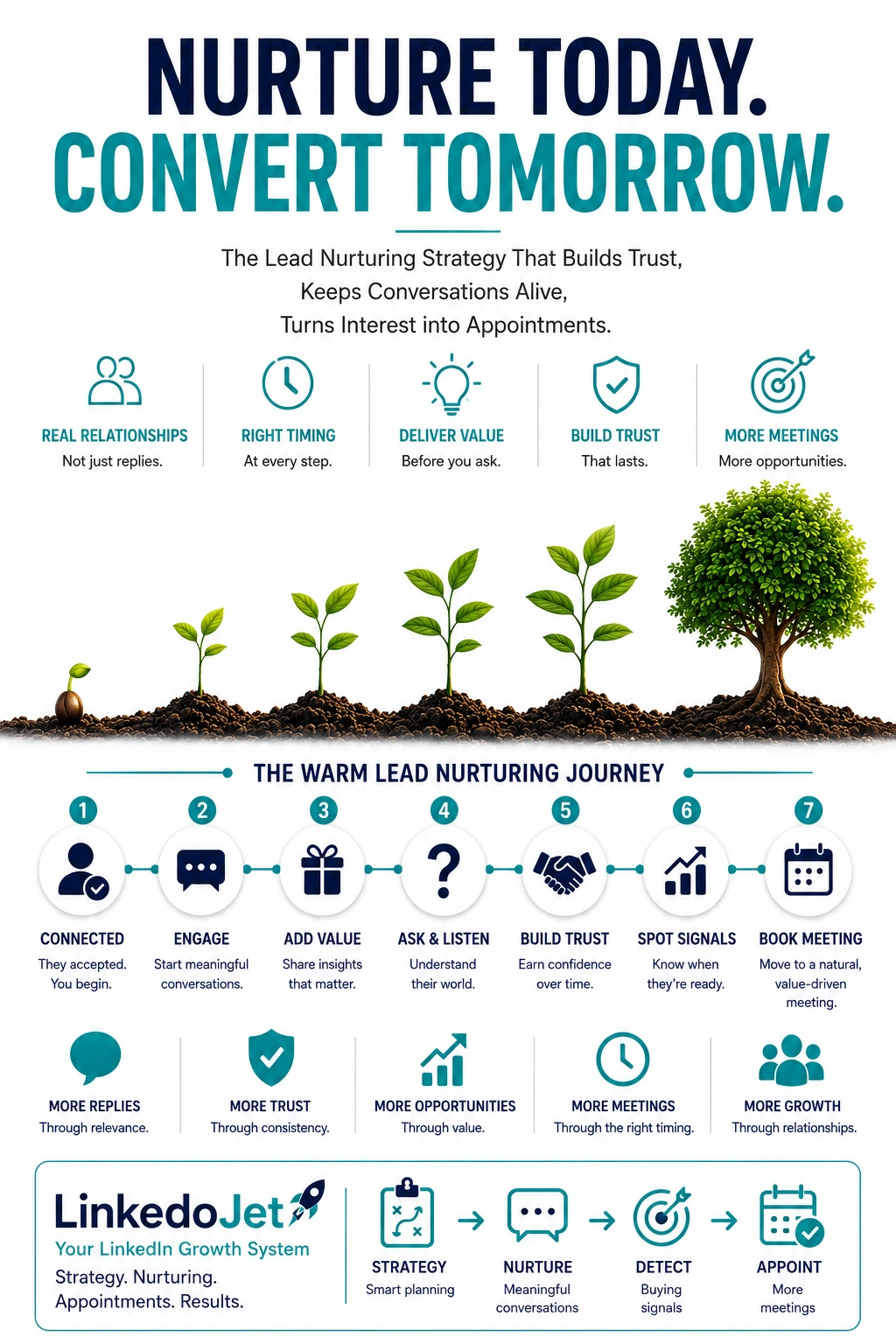
The quiet failure mode: they engage, they reply once, then the thread dies
Warm ESG interest doesn’t feel like rejection. It feels like you were almost credible enough, almost timely enough, and then you disappeared from their week.
You know the scenario.
A Head of Sustainability accepts your connection after a CSRD readiness post. A CFO replies politely—“we’re looking into it”—then goes quiet. Someone asks a quick Scope 3 question in DMs, gets a thoughtful answer, and the conversation stalls. Procurement visits your profile after you comment on assurance readiness. A double materiality thread gets likes from the right titles… and nothing turns into a meeting.
The problem isn’t lead volume. It’s momentum.
You end up with a pipeline full of half-open threads you can’t forecast. Partners burn time rereading chat history to remember context. Follow-up becomes inconsistent across consultants. And the worst part: when a real trigger hits (board question, audit trail concern, supplier questionnaire spike), you’re not the firm that stayed relevant—you’re the firm they vaguely remember from weeks ago.
In ESG advisory, pushing early backfires for a simple reason: most buyers aren’t shopping for inspiration. They’re managing internal risk. If your second message is “want to hop on a call?”, you’re asking them to create meeting risk before they’ve created internal safety (scope, owners, defensibility, who needs to be involved).
So they do the polite thing. They go quiet.
How ESG buyers actually decide: “Can I defend this internally?” comes before “Who should we hire?”
Your follow-up has to help them build alignment across stakeholders—not win a one-to-one conversation.
Most ESG deals don’t die because you failed to persuade the sustainability lead. They die because nobody can safely move the decision forward.
CSRD/ESRS, ISSB, Scope 3, assurance expectations, procurement reviews—these aren’t one-person decisions. They’re coordination problems. And the hidden question behind almost every “we’ll get back to you” is: “If I take this meeting, will I be forced into a scope I can’t defend?”
Here’s the stakeholder map your nurturing has to respect:
- Sustainability / ESG team: wants framework interpretation that matches reality, a workable workload, and language they can carry across the org without getting embarrassed. They’re allergic to generic sustainability theatre.
- Finance: cares about controls, audit trails, and whether reported numbers can be explained without hand-waving. They’ll ask “what evidence exists” long before “what’s the narrative.”
- Risk / Legal: thinks in exposure—claims risk, greenwashing scrutiny, contractual commitments, and whether disclosures create future liabilities.
- Operations / data owners: worry about who has the data, who will be blamed when it’s missing, and how supplier engagement will actually work.
- Procurement: needs a scope that can be compared, budgeted, and risk-assessed. Vague phases trigger process drag.
- Leadership / board: wants a defensible posture: progress, gaps, and a plan they can stand behind.
Warm follow-up that works in this environment does one thing consistently: it reduces decision risk. Short messages. Specific observations. A low-friction next step that helps them think without forcing them to “buy.”
Reading warm intent without guessing: what LinkedIn signals mean in ESG work
Not every “like” is interest. But certain patterns are rarely accidental—especially when frameworks and defensibility show up.
ESG buyers don’t always comment “we need help.” They do quieter things: they watch, they sanity-check, they test for substance, then they disappear into internal meetings.
Warm signals worth treating as real intent (even if they’re not ready):
- Engagement on framework-specific posts (CSRD/ESRS interpretation, ISSB alignment, double materiality governance). This often means they’re trying to make sense of requirements, not pick a vendor.
- Profile visits after you mention assurance readiness, controls, or evidence ownership. That’s usually a finance/risk lens creeping into the conversation.
- Partial replies like “we’re still figuring it out,” “early days,” “next year.” In ESG, that can mean internal politics, unclear ownership, or fear of committing to scope.
- Questions that seem small (“Which Scope 3 categories do you start with?”). These are rarely small internally. Categories imply boundaries, data confidence, and who gets dragged into the work.
- Procurement or vendor-risk titles viewing your profile after content about phased delivery or “readiness sprints.” That’s often a sign someone asked, “Can we make this defensible without signing up for a huge program?”
Practical interpretation (so your team stops overreacting):
| Signal | What it often means | Best next move |
|---|---|---|
| Connection accepted after CSRD/ISSB post | They’re tracking sources; low commitment | Ask a single, binary stage question |
| “We’re looking into it” from CFO / risk | They need defensibility and scope clarity | Offer a quick gap-scan structure, not a pitch |
| Scope 3 question in DMs | Boundary/data confidence debate happening | Share one concrete pitfall + one clarifying question |
| Likes on assurance/evidence content | Audit trail anxiety; internal review looming | Offer an evidence-owner mapping template |
| Profile view from procurement | Vendor comparison, budget timing, process starting | Send a short “what a first phase looks like” note |
Stage-matched nurturing: stay useful in the weeks that decide whether you ever get a meeting
Think in three buyer modes—not in “day 1 / day 3 / day 7” sequences.
Warm follow-up fails when your cadence is based on your calendar, not theirs.
In ESG advisory, most warm leads sit in one of three modes:
- Curious and learning: they’re absorbing CSRD/ESRS and ISSB implications, watching peers, and trying not to look uninformed internally.
- Quietly benchmarking: they’re testing providers, scoping options, and trying to understand what a sensible first phase is without triggering procurement too early.
- Under deadline pressure: a board ask, assurance conversation, supplier questionnaire spike, tool selection, or reporting timeline has created urgency.
Match your follow-up pacing to the mode:
- Learning: light touches every 2–3 weeks. One insight, one offer, zero pressure. Your goal is “I help you think.”
- Benchmarking: weekly-ish, but only if each message reduces scope risk. Ask clarifying questions that let them answer safely. Offer a short outline of a readiness sprint or gap scan.
- Deadline pressure: faster response, clearer paths. Provide a working session option with a concrete outcome (gap scan, stakeholder map, evidence plan). Keep it calm.
Notice what’s missing: “checking in” messages. ESG stakeholders don’t reward persistence. They reward relevance.
A simple rule: if your next follow-up doesn’t contain a new, specific reason to exist in their inbox, don’t send it.
Message blocks you can actually send (ESG-specific, low-friction, no theatre)
Each note has a job: diagnose stage, reduce scope risk, or open a clean path to a working session.
| When to use | Message |
|---|---|
| First warm follow-up after connection acceptance Use when they accepted after a CSRD/ISSB post or comment thread. | “Thanks for connecting, [Name]. I work with teams who are trying to make CSRD/ESRS (or ISSB) reporting feel less chaotic—especially the data-owner and evidence side. Out of curiosity, are you closer to ‘scoping and materiality’ right now, or already in the ‘data gathering and controls’ phase?” |
| Follow-up after a prospect replies once (and then stalls) Use when you got a polite response like “still figuring it out.” | “That makes sense. When you say ‘we’re still figuring it out internally,’ is the friction more about agreeing what’s material, or about getting reliable data from functions/suppliers? I’m asking because the next steps look very different depending on which one is the bottleneck.” |
| Educational nurturing message (lightweight, genuinely useful) Use when they’re in learning mode and you want to stay helpful. | “One thing I’ve seen trip teams up is underestimating internal review time—especially when finance/risk need to sign off on what’s ‘defensible.’ If it’s helpful, I can share a simple way to map evidence owners so you’re not chasing people in week 10. Want it?” |
| Insight-based follow-up tied to frameworks and real-world constraints Use when Scope 3 is in play, but you suspect boundary and data confidence aren’t aligned. | “Quick observation from recent projects: a lot of ‘Scope 3 plans’ fail because categories are chosen before boundaries and data confidence are agreed. If you’re touching Scope 3 this year, are you aiming for a best-effort estimate or something you’d feel comfortable taking toward assurance later?” |
| Case-study/proof-based nurturing message (modest, specific, non-hype) Use when they’re benchmarking and need to picture a realistic first phase. | “We supported a mid-market manufacturer where sustainability owned the narrative, but finance needed an audit trail. We ran a short readiness sprint to identify evidence gaps and assign owners before the full reporting work kicked off. It wasn’t glamorous, but it stopped the late-stage scramble. If you’re in a similar spot, I can outline what that sprint included.” |
| Soft question to reopen the conversation after no response Use when the thread is quiet but you have a reason to believe it may resurface. | “Not sure if this is on your plate right now, but I’m seeing more teams getting pulled into customer sustainability questionnaires even when formal reporting is ‘next year.’ Is that showing up for you yet, or is it still mostly internal planning?” |
| Buying-signal response Use when they mention deadlines, assurance, tool selection, board pressure, supplier requests. | “If you’re being asked for board-ready progress (or assurance-ready evidence) on a specific timeline, it usually helps to do a fast gap scan before committing to a full program. Would it be useful to compare what you have today against what the sign-off stakeholders will expect? I can suggest a simple structure.” |
| Soft meeting request (calm, specific, low-pressure) Use when they’re warm but hesitant—give a contained meeting with a clear output. | “If it’s easier to talk this through, I’m happy to do a 20-minute working session. We can map where you are (materiality vs data vs controls), who needs to be involved, and what a sensible first phase would look like. If it’s not the right time, no problem—I can send the notes instead.” |
| Dormant lead revival message (after weeks/months) Use when budgeting/audit season tends to resurrect dormant ESG work. | “Hi [Name]—circling back because a few clients have had CSRD/ESRS planning resurface as soon as budgeting and audit conversations start. Has anything changed on your side since we last spoke, or is it still parked? If it’s parked, I’ll leave you alone; if it’s live again, I can share what ‘good first steps’ look like without committing to a huge program.” |
| Final polite close-loop message Use when you want to protect brand trust and stop the awkward drip. | “I don’t want to keep tapping your shoulder. I’ll close the loop for now. If CSRD/ISSB/Scope 3 work becomes urgent later, feel free to reply with ‘pick this up’ and I’ll send a short set of options for a first phase.” |
These messages work because they do two things most follow-ups don’t: they make it easy to answer, and they don’t force a premature buying posture.
What not to do in ESG follow-up (and why stakeholders disengage)
The fastest way to lose a warm lead is to sound like you’re running a sequence instead of holding a professional conversation.
- Sending long messages that read like a whitepaper. Senior sustainability and finance leaders skim. If they see a wall of text, they postpone it. Postponed becomes forgotten.
- Over-indexing on sustainability buzzwords. CSOs and Heads of Sustainability hear it all day. If your follow-up lacks specificity (boundaries, evidence, owners, review cycle), you get categorized as “vendor noise.”
- Pushing a proposal before internal ownership exists. If they haven’t agreed who owns data and controls, a proposal creates politics. They go silent to avoid escalating internally.
- Acting like everyone has the same deadline. “CSRD is coming” is not a reason to meet. Some firms are phased, some are out of scope, some are prioritizing customer questionnaires, some are dealing with tool selection.
- Ignoring finance/risk/procurement realities. If your follow-up doesn’t acknowledge defensibility, audit trails, and scope clarity, the sustainability lead can’t safely champion you.
- Aggressive cadence. Three nudges in a week makes you look like you’re managing your pipeline, not their risk. ESG buyers punish that by disengaging entirely.
The underlying failure is always the same: you made the conversation about you (your service, your meeting, your deck) when the buyer is trying to manage internal safety.
FAQ
Why do warm LinkedIn leads go quiet in CSRD/ESRS, ISSB, and Scope 3 work even after a positive reply?
Because the reply often reflects interest, not readiness. They’re usually juggling internal alignment (materiality, boundaries, data owners, controls) and stakeholder risk (finance, risk/legal, procurement). If your next step forces a meeting before they can defend scope internally, silence is the safest move.
What follow-up cadence works for ESG consulting without sounding like a vendor chasing pipeline?
Cadence should mirror buyer mode. For learning: a light, useful touch every 2–3 weeks. For benchmarking: weekly-ish, but only if each message reduces scope risk or clarifies a decision path. For deadline pressure: faster and more direct, with a contained working session option and a clear output.
How do I convert LinkedIn conversations into meetings when procurement, finance, and risk need to be involved?
Stop asking for a “chat” and offer a low-risk working session with an outcome stakeholders care about: a gap scan, evidence-owner map, or a simple first-phase plan that finance/risk can sign off. Your follow-up should also help the sustainability lead invite others without losing face—short, defensible language beats big promises.
What are the most reliable ESG buying signals to watch for on LinkedIn (deadlines, assurance, tool selection, board pressure, supplier requests)?
Direct signals: mention of reporting timelines, assurance expectations, board questions, customer questionnaire spikes, tool evaluations, or supplier data engagement. Indirect but strong signals: questions about deliverables, staffing, “what a readiness phase looks like,” and engagement with posts about auditability, governance, controls, or evidence gaps.
How do I revive an inactive LinkedIn conversation without using a generic “just bumping this” message?
Reopen with relevance, not persistence. Reference a trigger that plausibly resurfaced the work (budgeting, audit conversations, customer questionnaires) and give them an easy out. A good revival message includes: one reason you’re reaching out, one question they can answer in a sentence, and explicit permission to park it.
If you want this running consistently, we can build and operate it with you
LinkedoJet isn’t a “sequence tool.” It’s a managed outbound and nurturing system designed for long, credibility-led buying cycles like ESG advisory.
On the session, we’ll look at your current warm-signal flow (accepted connections, post engagement, profile visits, partial replies) and where momentum is dying. Then we’ll map a practical follow-up system that fits how CSRD/ESRS, ISSB, Scope 3, and assurance-readiness decisions actually move through sustainability, finance, risk/legal, ops, and procurement.
If we’re a fit, here’s what LinkedoJet operationally provides after onboarding:
- ICP and targeting setup for ESG advisory offers (who to reach, which functions, which regions/segments, and how to avoid low-fit titles that waste partner time).
- Sales Navigator + LinkedIn prospect list building so you’re not guessing who sits in the approval path (CSO/Head of Sustainability, CFO/Finance, Risk/Legal, Procurement, Ops/data owners).
- AI-assisted personalization that stays conservative and credible—framework-aware notes that reference what they engaged with, without sounding templated or overfamiliar.
- LinkedIn outreach execution with stage-matched pacing (learning vs benchmarking vs deadline pressure), so you stay present without becoming noise.
- Lead reply handling and nurturing to keep threads alive, ask the right clarifying question, and move the conversation toward a low-risk next step.
- Warm lead tracking so “quiet interest” doesn’t get lost across consultants; you’ll know who engaged, what they responded to, and what to send next.
- Appointment generation support that turns buying signals (deadlines, assurance, tool selection, board pressure, supplier requests) into booked working sessions with a clear agenda.
- Campaign visibility through dashboards so you can see activity, response patterns, warm leads, and booked outcomes without chasing updates.
- Ongoing campaign refinement as frameworks shift and your market reacts—messaging, targeting, and nurture angles get adjusted based on real replies, not theory.
Ordinary LinkedIn automation tools send messages. LinkedoJet runs the operating system: targeting, lists, personalization, execution, reply handling, nurturing, tracking, and the handoff into booked conversations when the buyer is actually ready.
You’ll leave with clarity either way: what’s currently causing stalls in your follow-up, what to change in the next 14 days, and what a managed conversation system would look like for your consultancy.
Next step: stop letting warm ESG interest decay in your inbox
You don’t need more activity. You need a managed system that keeps you useful until timing turns—then converts the moment into a booked working session.
From identifying the right decision-makers to starting meaningful conversations and turning them into qualified appointments... LinkedoJet manages the entire outbound engine for your business.