
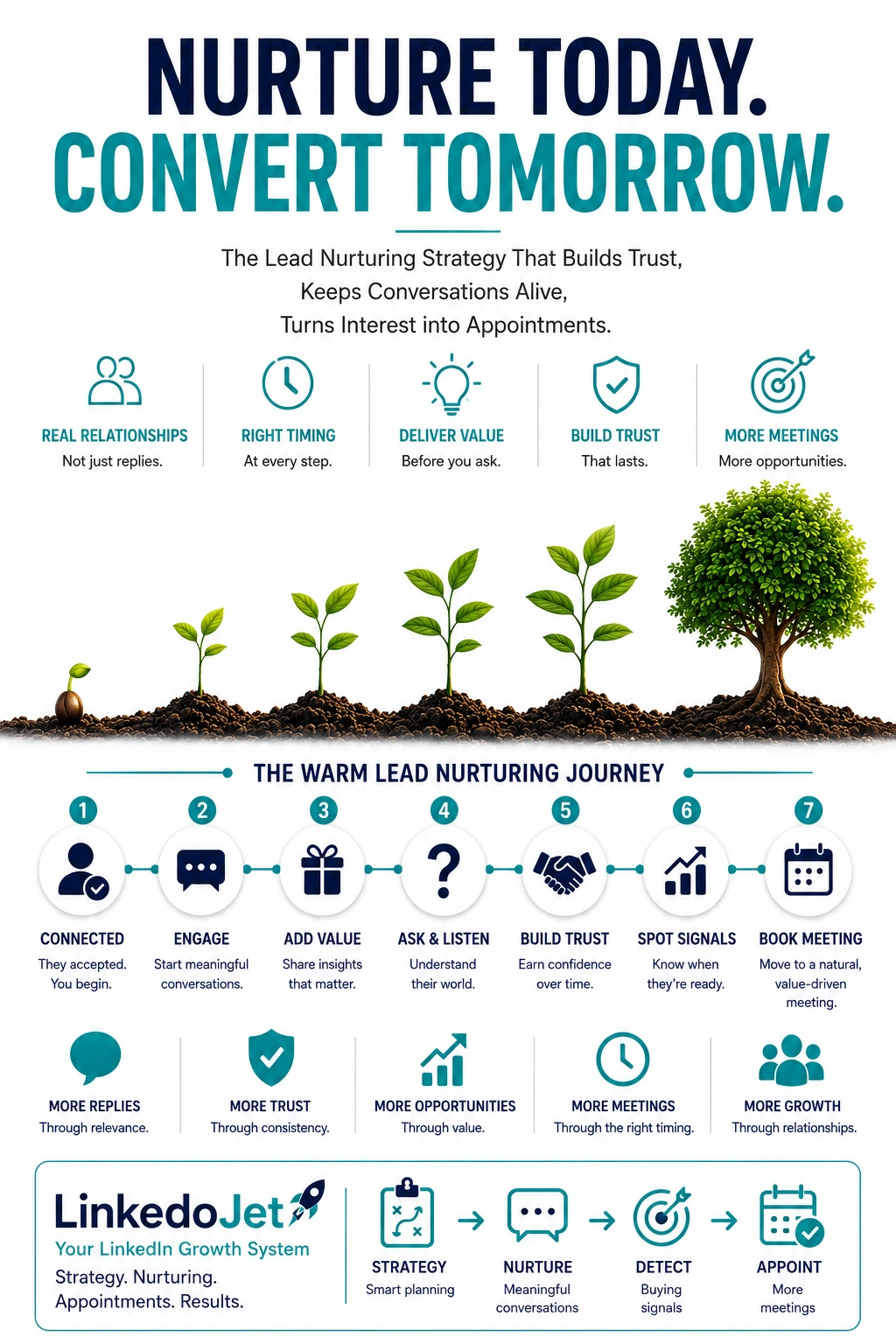
Where warm ERP/CRM leads come from (and why they die in the quiet gap)
You’re not losing deals because your outreach is bad. You’re losing them after the first signal—when internal reality shows up.
A COO likes your post about order-to-cash bottlenecks. A RevOps lead reacts to a thread on CRM cleanup. An IT manager views your profile after you mention integrations. A CFO replies with one polite line about forecasting accuracy.
That’s a warm lead in ERP/CRM land.
And then it disappears—not because they weren’t interested, but because the middle of these buying cycles is messy: quarter-end hits, a fire drill steals the champion’s attention, IT asks for security and integration details, Finance asks for a cost range, and nobody wants to be the person who sponsors “another painful rollout.”
The quiet gap is where momentum bleeds out. You can feel it when a thread goes cold. You’re sitting on real signal, but without a calm, implementation-aware next step, the prospect can’t safely move the conversation forward internally.
Most follow-up makes it worse. The moment you push a meeting before the problem is defined, you add two things cautious champions hate: pressure and ambiguity.
- Pressure (“hop on a call?”) when they’re still building internal cover.
- Ambiguity (“we implement Dynamics/Salesforce/HubSpot”) when what they need is clarity on ownership, data, and adoption risk.
Your job in this phase isn’t to be memorable. It’s to help them build a narrative that survives the CFO/COO/IT room: what’s broken (process vs tooling), what the risks are, who has to be involved, and what a sane first step looks like.
A simple lead-temperature model that matches how ERP/CRM projects actually get approved
If you treat every warm signal like a closable deal, you’ll keep “winning replies” and losing revenue.
ERP/CRM buyers don’t move in a straight line. They move in loops: someone spots a problem, tests ideas quietly, tries to align stakeholders, hits a constraint (data, IT, bandwidth), then goes quiet until the next forcing function.
A temperature model keeps you from asking for the wrong thing at the wrong time.
| Temperature | What you’ll see on LinkedIn | What’s happening internally | What to do next |
|---|---|---|---|
| Curious | Post reactions, profile views, connection accept, short “thanks” reply | They’re sensing if you’re credible and safe | Micro-insight + a low-friction diagnostic question |
| Problem-aware | They name pain: duplicate records, reporting chaos, pipeline trust, handoff issues | They’re trying to describe the problem without triggering a massive project | Tighten the problem definition; offer a small framework/checklist |
| Project-aware | They mention migration, integrations, adoption, timeline, “we tried before” | Stakeholders are circling; risk is the main blocker | Risk framing + stakeholder alignment language; propose a scoped discovery |
| Decision-in-motion | They ask scope/budget range, user count, stack constraints, internal owners | They’re preparing for a real decision and want to avoid embarrassment | Book the call with a clear agenda and required attendees |
The trap: “Curious” feels like interest, so you treat it like intent. But most curiosity is just quiet evaluation. When you ask for a meeting too early, you force a decision they can’t defend yet.
The better move is to match your next message to the internal step they’re trying to complete.
Nurture cadences by temperature: what to send, when to send it, and what to avoid
Nurturing isn’t “checking in.” It’s advancing the internal story, one low-pressure step at a time.
Cadence should feel like a competent practitioner staying helpful, not a rep chasing a quota. And in ERP/CRM, relevance beats frequency—especially when the prospect is juggling data mess, IT capacity, and leadership expectations.
| Stage | Timing | Message type | What to avoid saying |
|---|---|---|---|
| Curious | Day 0–3 | Context acknowledgement + micro-insight | “Want a demo?” “We do implementations.” |
| Curious | Day 7–10 | One diagnostic question + optional short checklist offer | “Just bumping this.” |
| Problem-aware | Weekly (2–3 touches) | Framework: definitions/ownership/adoption; small example | Platform recommendation before process is mapped |
| Project-aware | Every 7–14 days | Risk framing (migration downtime, reporting trust, change mgmt) + next step | Overpromising timelines or “easy” rollouts |
| Decision-in-motion | Same day / 48 hours | Direct scheduling with an agenda and attendee list | Vague “chat” with no outcome |
One more nuance: ERP/CRM leads often go quiet right after they ask a small question. That doesn’t mean “not interested.” It often means they forwarded your answer internally and are waiting for feedback from Finance or IT.
Consultant-grade LinkedIn message examples that respect implementation reality
Short. Specific. Calm. Written for people who’ve lived through messy rollouts.
First warm follow-up after connection acceptance
When to use: They accepted the connection after engaging with ops/process content, or you have a clear role-based reason they’re relevant.
Message:
“Thanks for connecting, <Name>. I work with Ops/RevOps teams when the CRM stops matching what actually happens in the business (handoffs, stages, fields that mean different things to different reps). If you’re ever sanity-checking reporting accuracy vs process reality, happy to share what we look at first.”
Follow-up after a polite, non-committal reply
When to use: They answered, but it’s soft: “yeah we’ve had issues” / “we’re looking at it” / “maybe later.”
Message:
“Helpful. When teams say ‘pipeline isn’t reliable,’ it’s usually one of three things: stages don’t map to actual steps, definitions aren’t enforced, or downstream reporting is built on dirty inputs. Which one is closest in your case?”
Educational nurture (field governance / ownership / adoption)
When to use: They’re problem-aware, but there’s no active project thread yet.
Message:
“Quick one that saves a lot of rework: before touching automations, get agreement on who owns each key field (source of truth) and what triggers a stage change. Otherwise the system looks ‘configured’ but nobody trusts it.”
Insight-based follow-up (buying psychology + internal constraints)
When to use: You sense they’re stuck in “we know it’s broken” but can’t get bandwidth to define requirements.
Message:
“I’ve noticed a pattern: CRM projects stall less on the tool choice and more on ‘who has time to define the process.’ If you’re in that zone, a short requirements workshop can unblock it without committing to a big rollout.”
Proof-based nurture (non-braggy, specific win)
When to use: They’re cautious and want evidence you understand reality, not just platforms.
Message:
“On a recent cleanup + reporting project, the win wasn’t a new dashboard—it was agreeing on three stage definitions and removing duplicate fields that were driving conflicting reports. Once that was fixed, forecast calls got shorter and less political.”
Soft question to reopen the conversation
When to use: They went quiet; you want a low-friction re-entry that respects timing.
Message:
“Out of curiosity, is this a ‘fix the current CRM’ quarter or more of a ‘revisit the whole process/system’ conversation for you?”
Buying-signal response (timeline, migration, integrations)
When to use: They mention migration, integrations, licensing, user count, or stakeholder alignment.
Message:
“If migration is on the table, the fastest way to reduce risk is a 30-minute walkthrough of data sources + integrations (what feeds what). I can share the exact questions we use to surface hidden dependencies—want me to send them here, or would a quick call be easier?”
Soft meeting request (clarity + scoping, not a pitch)
When to use: Project-aware or decision-in-motion. They have a real thread, but don’t want to be sold.
Message:
“If it’d help, we can do a short discovery call to map the current workflow (lead-to-cash / case-to-resolution), what’s breaking, and what ‘good’ looks like. Even if you handle the build internally, you’ll leave with a clearer requirements outline.”
Dormant lead revival (relevance + reason)
When to use: 30–60+ days quiet. You need to justify resurfacing.
Message:
“Circling back because I keep seeing the same issue in ERP/CRM rollouts: teams underestimate the time it takes to get clean definitions across Sales/Ops/Finance. If you’re still dealing with reporting inconsistencies, I can share a 1-page checklist we use before any migration work starts—worth sending?”
Final close-loop (goodwill preserved)
When to use: You’ve followed up enough. You want to stop chasing without burning the bridge.
Message:
“I don’t want to keep bumping this if priorities shifted. If CRM/ERP cleanup or a rollout comes back onto the roadmap later, feel free to nudge me and I’ll share what we’ve seen work. Either way, appreciate the conversation.”
Why ERP/CRM warm leads go quiet—and how not to make it worse
Silence is often an internal meeting you weren’t invited to.
Warm leads go quiet for boring reasons that have nothing to do with your credibility:
- Internal politics: the champion can’t pick a direction without stepping on Sales leadership, IT, or Finance.
- IT constraints: integrations, permissions, security reviews, and “we can’t touch production right now.”
- Data reality: duplicates, shadow spreadsheets, conflicting definitions, and no owner for source-of-truth fields.
- Rollout trauma: they’ve been through a “simple CRM upgrade” that became six months of pain and adoption failure.
- Scope fear: the moment it feels big, everyone backs away until there’s a forcing function.
Here’s how consultants accidentally contribute to the stall:
- Recommending Dynamics vs Salesforce vs HubSpot (or NetSuite vs Odoo) before process mapping is even agreed.
- Talking features instead of ownership, adoption, and integration dependencies.
- Sending generic “we implement X” blurbs that make you sound interchangeable.
- Ignoring the CFO’s question hiding under every CRM thread: “What’s the cost of being wrong?”
- Pretending scope and change management are simple.
When you nurture well, you reduce perceived risk. You give them language they can repeat internally without overcommitting.
Try framing in terms they can take to a stakeholder meeting:
- “Before we change tools, we need agreement on stage definitions and field ownership.”
- “We should map integrations and data sources so we don’t break downstream reporting.”
- “Let’s run a short workshop to define requirements; tool choice comes after.”
- “We can phase this so adoption and data cleanup don’t collide.”
Turning chat into an approved discovery call: triggers, agenda, and the right people in the room
A discovery call only works when it has a job to do—and when the champion can justify it.
In ERP/CRM work, “let’s chat” is a red flag. It produces vague calls, vague notes, and a quiet thread two weeks later. Instead, wait for (or create) a trigger that makes a short call feel like risk reduction.
Good triggers that naturally justify a call
- A reporting deadline: board pack, quarter-end forecast, pipeline review credibility.
- A forcing function: new leadership, new sales motion, merger, territory change.
- Migration talk: “we might move off <system>” or “we’re consolidating tools.”
- Integration pain: CPQ/ERP/billing/helpdesk not matching CRM reality.
- Adoption pain: “reps don’t use it” or “everyone has their own spreadsheet.”
A discovery agenda that gets approved
Keep it short and concrete. A useful first call is usually 25–35 minutes and produces a tangible output.
- Workflow: pick one (lead-to-cash, quote-to-cash, renewal-to-expansion, case-to-resolution) and map where it breaks.
- Definitions: what “qualified,” “stage change,” and “closed” actually mean in practice.
- Data + integrations: what feeds what, where truth lives, and what can’t break.
- Adoption reality: who will do the work, who will enforce it, and what will be resisted.
- Next step: requirements workshop, integration review, cleanup plan, or phased rollout outline.
Who to invite (so the project doesn’t reset later)
You don’t need a committee. You need the minimum set of people who prevent rework:
- Ops/RevOps owner: process and definitions.
- Sales leader or proxy: adoption and stage enforcement.
- IT/Systems: integrations, security, and feasibility.
- Finance/CFO (optional early): if cost range or ROI scrutiny is already present.
If the champion can’t get those stakeholders yet, don’t force the call. Send the champion stakeholder-ready language and a one-page checklist so they can earn the meeting internally first.
How LinkedoJet runs warm-lead nurturing and appointment setting for ERP/CRM work (a system, not a tool)
Most “automation” products can send messages. They can’t keep context, interpret intent, or carry the thread through internal alignment.
LinkedoJet is built for the messy middle: the weeks where your prospect is interested, but cautious, and the decision lives inside stakeholder alignment—not inside your inbox.
Operationally, we run a full outbound engine tailored to ERP/CRM consulting and implementation work:
- ICP and targeting setup: we define your buyer roles (COO/CFO/RevOps/IT/Operations), the operational triggers, and the “likely pains” that map to real projects.
- Sales Navigator prospect list building: we build segmented lists by role, system context, and intent signals (migration talk, reporting deadlines, integration-heavy environments).
- AI-assisted personalization: used to create specific, restrained openers and follow-ups that reference operational reality—without sounding templated or overeager.
- LinkedIn outreach execution: connection + message workflows that create warm signals consistently, not random spikes.
- Reply handling and nurturing: we categorize replies by temperature and move the conversation forward with diagnostic questions, risk framing, and stakeholder-ready language.
- Warm lead tracking: we track what pain was mentioned, what constraints showed up (data/IT/adoption), who the stakeholder is, and what the next nudge should be.
- Appointment generation support: when the trigger hits, we shift to a clear meeting ask with an agenda and attendee guidance so the call is scoping-focused, not salesy.
- Campaign visibility: dashboards show volume, replies, warm threads, and booked meetings—so you’re not guessing what’s working.
- Ongoing refinement: we adjust targeting, messaging, and cadences based on which roles are moving and which objections are showing up.
The difference is simple: we don’t just “send follow-ups.” We run a lead-temperature system that keeps your best threads alive until the prospect can actually get a discovery call approved.
FAQ
What’s the difference between cold LinkedIn outreach and warm lead nurturing for ERP/CRM work?
Cold outreach is about earning the first response. Warm nurturing is what happens after the signal—when the buyer is evaluating quietly and trying to align stakeholders. In ERP/CRM, the second phase is where most revenue is won or lost, because the project depends on risk management (data, integrations, adoption), not excitement.
How do I know when a warm LinkedIn lead is ready for a discovery call vs still internal-aligning?
They’re ready when their language shifts from pain to coordination: timeline, migration, integrations, user count, licensing constraints, “who needs to be involved,” budget range, or “we tried before.” If they’re still speaking in generalities (“our CRM is messy”), you’ll get better results tightening definitions and giving stakeholder-ready framing before asking for time.
What should I say when a prospect replies politely but avoids committing to a meeting?
Don’t re-ask for the meeting. Reduce ambiguity. Offer a short framework and ask a single diagnostic question that helps them name the real issue (definitions, enforcement, dirty inputs, integration breakpoints). Polite replies usually mean: “I’m interested, but I can’t sponsor this internally yet.”
How do you handle stakeholder dynamics (CFO/COO/RevOps/IT) when the champion is interested but cautious?
We give the champion language that de-risks the conversation: scope control, phased rollout, integration walkthrough, field ownership, adoption plan. Then we time the meeting ask around a trigger (reporting deadline, migration discussion, leadership change) and suggest the minimum stakeholder set so the project doesn’t reset after the call.
What’s a sensible follow-up cadence for ERP/CRM leads without sounding like a sales rep?
Early: 1–2 light touches in the first 10 days (micro-insight + one diagnostic question). Then: weekly or biweekly messages that are specific and implementation-aware. If they go quiet, revive with a relevant checklist or risk observation, not “checking in.” If there’s no traction after a few attempts, close the loop politely and leave the door open.
Book a working session: we’ll show you the nurture system—and what we run for you
If you’re already getting warm signals on LinkedIn, this is about turning them into stakeholder-aligned discovery calls and scoped implementation work.
This isn’t a generic “discovery chat.” We’ll look at how your warm leads are currently falling into the quiet gap, then walk you through the exact operating system LinkedoJet runs to keep those threads moving without pushing too early.
In the session, we’ll review:
- Your ICP by role (COO/CFO/RevOps/IT/Operations) and the operational triggers that create real projects
- How you’re currently capturing warm signals (engagement, profile views, replies) and where context is getting lost
- A lead-temperature setup you can actually run (Curious → Problem-aware → Project-aware → Decision-in-motion)
- Message angles that match implementation reality: ownership, definitions, integrations, adoption, rollout risk
- What a scoped discovery call should produce (requirements outline, integration questions, cleanup plan, phased rollout next step)
What you receive if we’re a fit: LinkedoJet doesn’t hand you templates and walk away. After onboarding, we build and run the outbound engine with you:
- Targeting systems: ICP and role segmentation, plus Sales Navigator list building for your exact buyer set
- Outreach workflows: connection + messaging sequences tuned to your niche (Dynamics 365 / Salesforce / HubSpot / NetSuite / Odoo environments as relevant)
- AI-assisted personalization: used to create specific openers and follow-ups while keeping your voice and restraint
- Reply handling + nurturing: we track the thread, categorize temperature, and send the next best message based on intent and constraints
- Warm lead tracking: dashboards for replies, warm conversations, and which accounts are moving toward a call
- Appointment generation support: when the trigger hits, we help convert the thread into an approved, scoped discovery call with the right stakeholders invited
- Ongoing refinement: targeting and messaging adjustments based on what’s actually getting traction
How targeting and list building works: we don’t spray titles. We build lists around role + context (systems, likely triggers, integration-heavy stacks) so your messages can be specific without guessing. That’s how you get warm signals you can nurture into real projects.
How nurturing and follow-up works: we don’t “check in.” We send implementation-aware touchpoints that help the champion align stakeholders—risk framing, diagnostic questions, and short artifacts they can forward internally.
How warm leads and appointments are tracked: every warm thread is tagged by role, pain, constraints, and next step so you’re not rebuilding context each time priorities shift.
Why this is different from ordinary LinkedIn automation tools: tools send sequences. LinkedoJet runs the process—targeting, personalization, execution, reply handling, nurturing, visibility, and appointment support—so warm interest doesn’t die when the buyer goes quiet.
Next step: turn warm LinkedIn signals into scoped discovery calls you can actually deliver on
You should know, week to week, which conversations are warming up, what they need to hear next, and when a meeting ask will land clean.
From identifying the right decision-makers to starting meaningful conversations and turning them into qualified appointments... LinkedoJet manages the entire outbound engine for your business.