
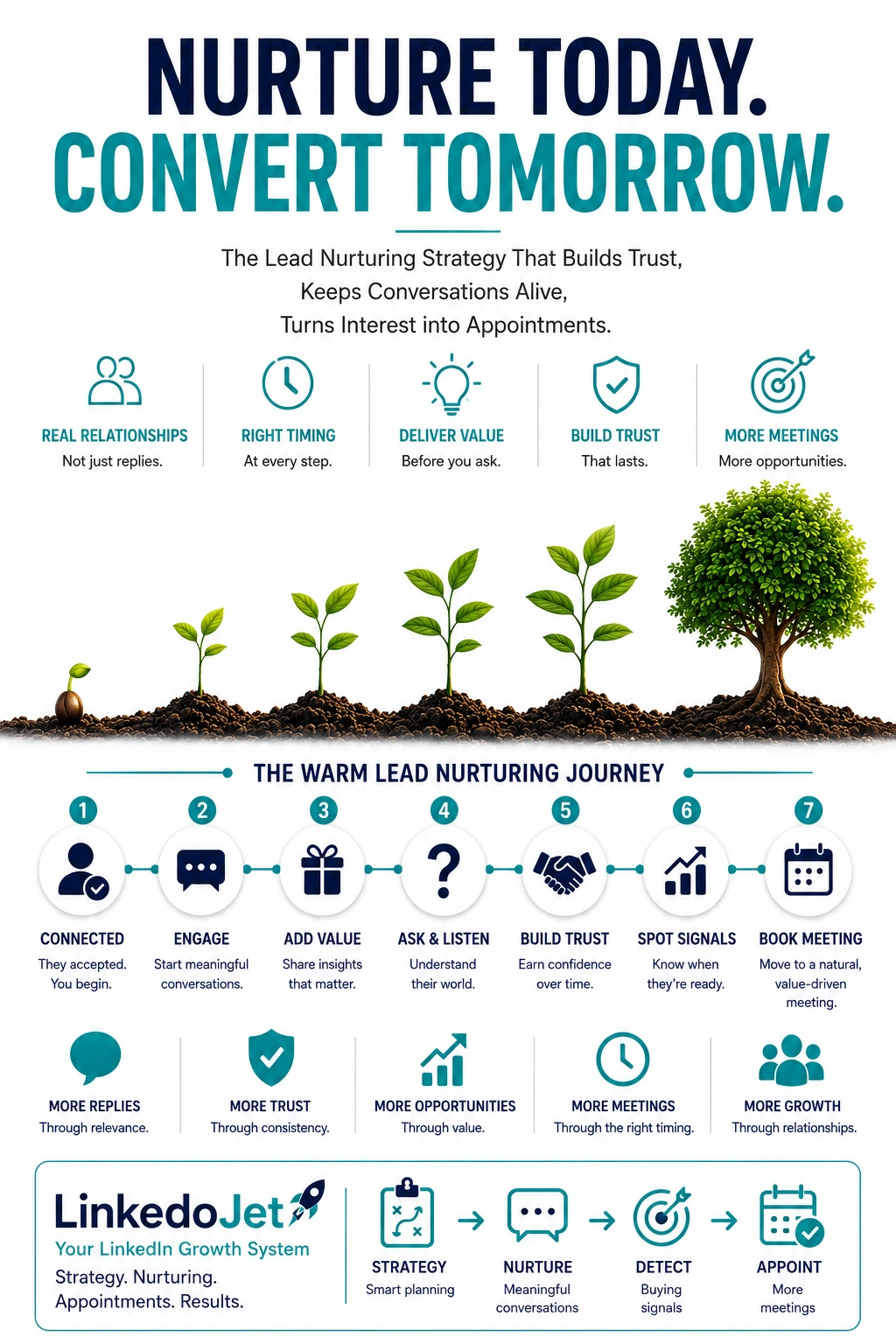
They engaged once. Then it goes quiet. And it’s rarely about your copy.
If you sell EVP, careers sites, recruitment marketing, or employer brand measurement, you don’t have a “starting conversations” problem. You have a “polite interest goes nowhere” problem.
It’s the most frustrating kind of silence because it comes after proof of life.
They accepted the connection. They reacted to a post about stakeholder alignment. They viewed the founder profile after an EVP teardown. They even said, “Do you have examples?”
Then… nothing.
Not because your message was wrong. Because employer brand work almost never becomes urgent on a random Tuesday. It becomes urgent when something forces it: a hiring wave, a new People leader, a re-org that breaks the story, Glassdoor noise, offer acceptance wobbling, or recruiters asking for content because they don’t trust the job posts anymore.
Until that trigger hits, your warm lead is usually stuck in a weird place:
- They’re interested, but they don’t own the initiative yet (or can’t admit the EVP isn’t landing).
- They’re busy doing operational firefighting—backfills, approvals, ATS issues, agency brief reviews.
- They’re political about it. TA feels symptoms first, but Comms/Marketing/HR leadership influences budget and timing.
So you end up doing the worst trade: you spend on content, founder visibility, and outbound activity… then lose the conversion in the messy middle. Pipeline stays lumpy. Your team gets edgy at month-end. And you keep replaying the same stall: “This is interesting… just not urgent.”
Warm follow-up fails when you treat timing like a messaging issue.
Most agencies either over-chase and create vendor fatigue, or under-follow-up and disappear right before the window opens.
HR and Talent buyers aren’t ignoring you. They’re protecting their attention.
They get hammered by recruitment tech pitches, generic “thought leadership,” and agency DMs that all sound like a deck request. If your follow-up feels even slightly vendor-ish, you’ll get parked as “another agency” until a procurement cycle forces a decision.
What actually breaks conversion is two things most teams don’t systemize:
- Lead temperature (what signals mean they’re exploring vs. owning vs. actively moving)
- Conversation ownership (who you’re talking to vs. who can greenlight a project)
In employer brand, the person liking posts is often the person doing the emotional labor internally—seeing the cracks, hearing recruiter complaints, sensing candidate skepticism—but they may not have the mandate (yet) to start “an EVP project.”
If your next move is “Want to jump on a call?” you force them into a position they can’t justify. They go quiet to avoid an awkward no.
A simple lead-temperature model for employer brand deals (and how it changes cadence)
Your follow-up should match what the buyer is actually doing internally, not what you wish they were ready for.
| Temperature | What you’ll see on LinkedIn | What it usually means in employer brand | Cadence that doesn’t feel needy |
|---|---|---|---|
| Warm 1: Engaged, not problem-owned | Likes/comments, profile view after an EVP/careers post, accepts connection with no message | They agree with the topic, but no internal mandate. Often TA/EBM sensing an issue but not framing it yet. | Every 10–14 days. One observation or question; no meeting ask. |
| Warm 2: Curious and exploring | “Interesting,” “Thanks,” “Do you have examples?” “We’ve been talking about our careers site…” | They’re testing whether you’re credible and safe. They want to borrow language, not start procurement. | Weekly for 2–3 touches, then every 10–14 days. Move toward a light diagnostic. |
| Warm 3: Problem-owned | Mentions symptoms: candidate quality, drop-off, inconsistent messaging, leadership pressure, Glassdoor | They’re building internal narrative: “We have a real issue.” Now they’re mapping stakeholders. | Every 5–7 days with focused moves: one question, one insight, one proof point. |
| Warm 4: Active initiative | Hiring wave, careers site rebuild, new People leader, “We’re comparing agencies,” “Need alignment between TA & Comms” | Budget/timing is opening. They’re looking for a path that won’t blow up politically. | 2–3 touches in 7–10 days, then ask for a short working-session call. |
The point isn’t to message more. It’s to message with memory: what they reacted to, what they asked for, what role they’re in, and what the last “signal” suggested about timing.
When you run this as a process, follow-up stops feeling like chasing. It starts feeling like staying relevant until the window opens.
A week-by-week conversation arc that earns an intro call
Rapport → diagnostic → reframing insight → de-risking proof → “compare notes” invite.
Week 1: Confirm why you’re connected (without pitching).
You’re not “checking in.” You’re anchoring context: EVP, careers site conversion, recruiter enablement, measurement, stakeholder alignment.
Week 2: Ask one diagnostic question that shows you know the politics.
Good questions in this niche aren’t “What are your goals?” They’re: Who owns the story? Where does it break? Who has veto power?
Week 3–4: Share one reframing insight they can repeat internally.
Example: “Most EVP work doesn’t fail in the workshop. It fails when the approval loop sands off the voice, then recruiters stop using it.” That’s useful. It also quietly positions you as an operator, not a vendor.
Week 4–6: De-risk with proof that sounds like deliverables, not bragging.
Stakeholder workshops, narrative pillars, content operating model, recruiter toolkit, careers site wireframes, measurement plan. HR/TA buyers buy process and safety as much as outcomes.
Week 6–8: Invite a low-pressure working session.
Not “a demo.” Not “a discovery call.” A short sanity check that helps them think clearly and gives them something they can use.
This arc works because it mirrors how employer brand decisions actually happen: curiosity first, then internal problem framing, then timing triggers, then alignment, then budget.
Message examples for HR/TA and Employer Brand buyers (short, human, situational)
These aren’t “templates.” They’re examples of what the message should feel like when you’re acting like a peer.
After connection acceptance (context + small observation)
“Thanks for connecting — I noticed you’ve got a lot of hiring across a few job families right now. Quick question: does the messaging stay consistent between LinkedIn posts, job ads, and the careers site, or does it drift depending on who writes it?”
When they reply “thanks” / “interesting” (narrow the conversation)
“Appreciate it. When employer brand work comes up internally for you, is it usually owned by Employer Brand/Comms, or does TA end up carrying it? Only asking because the follow-through looks very different depending on who has the pen.”
When they say “send examples” (give value, don’t push a meeting)
“Yep — happy to. Before I send anything, what’s closer to your world right now: (1) EVP refresh / story alignment, (2) careers site that isn’t converting, or (3) recruiter enablement/content? I’ll send two relevant examples so you’re not wading through fluff.”
Educational nurture (quick lesson tied to an outcome)
“One thing we keep seeing: recruitment marketing bursts can spike traffic, but if the EVP ‘proof’ isn’t visible (managers, growth, flexibility, how work gets done), candidates self-select out later. Do you track where drop-off happens — apply start vs. completion vs. offer acceptance?”
Insight follow-up (market shift they’ll recognize)
“Curious if you’re seeing this too: candidates are getting more skeptical of ‘culture’ claims, especially around hybrid/RTO. The companies that win are the ones who get very specific about trade-offs. Has that forced any internal changes to how you tell the story?”
Proof without procurement alarms (process + outputs)
“When teams want this done without it turning into a branding debate, the sequence that tends to work is: stakeholder alignment workshop → narrative pillars → content guardrails for recruiters/hiring managers → careers site wireframe changes → a lightweight measurement plan. If you ever need a sanity check on which piece is the bottleneck, I’m happy to compare notes.”
Soft reopen (easy exit)
“Not sure if employer brand is on the front burner for you right now, or more of a ‘when hiring ramps’ topic. Either way is fine — just tell me which, and I’ll time my follow-up accordingly.”
Soft meeting ask (working session framing)
“If it’s useful, happy to do a 20-minute sanity check on where the story breaks between LinkedIn, the careers site, and job posts — no prep needed. Even if you don’t hire anyone, you’ll walk away with a clearer problem statement.”
What counts as a buying signal in employer brand (and how to respond without triggering defense mode)
The fastest way to kill momentum is to act like you just heard “budget approved” when they only admitted “we have a problem.”
Signals that usually mean “window opening”
- “We’re refreshing the EVP.”
- “Leadership wants a stronger story / we need consistency.”
- “Our careers site needs work.”
- “Recruiters keep asking for content.”
- “Glassdoor is becoming a thing.”
- “We’re hiring in new regions / scaling headcount.”
- “We’re comparing agencies.”
- “We need TA and Comms aligned.”
How to respond (validate → scope lightly → offer a safe next step)
“That makes sense — those usually show up together. Quick one so I don’t guess: what triggered the conversation internally (hiring plan, leadership change, candidate feedback, site performance), and who needs to feel comfortable before anything moves?”
Then:
“If you want, we can do a short working session to map where the story breaks (LinkedIn → careers site → job posts → recruiter talk track) and what the smallest ‘fix’ looks like. It’s not a pitch call — it’s a way to get to a problem statement you can use internally.”
This keeps you out of procurement theater. You’re not asking them to “buy.” You’re helping them make the decision legible.
Dormant conversation revival that respects hiring cycles (and a clean way to close the loop)
Silence isn’t rejection in this market. It’s timing, re-orgs, and shifting priorities.
Employer brand work pauses for reasons that have nothing to do with you: headcount freeze then rehire, a new HRBP leader, a comms initiative that hijacks attention, a rebrand, a merger, a CHRO change.
The mistake is pretending none of that exists and sending “just bubbling this up” messages. HR/TA buyers have seen that movie. They stop replying because they don’t want to encourage a chase.
A respectful revival message (refer to the last real thread)
“Hey — last time we spoke you mentioned the careers site wasn’t telling the same story as LinkedIn. Not sure if this is on the front burner right now, but I saw you’ve started hiring again in [function]. Has anything shifted internally on the employer brand side, or is it still a ‘later in the year’ topic?”
If they don’t reply: a polite close-loop that preserves the relationship
“No worries if timing’s not right. Should I close the loop for now and check back after your next hiring plan/budget cycle? If you prefer, I can also just send the occasional employer brand observation when something genuinely relevant comes up.”
Give them options. You’re making it easy to be honest without feeling like they’re rejecting you.
FAQ
What counts as a warm LinkedIn lead for an employer branding agency?
A warm lead is anyone who’s already shown intent: they accepted your connection quickly, viewed your profile after an EVP/careers site post, engaged with a teardown or measurement insight, replied even briefly (“interesting”), asked for examples, or referenced a real symptom (candidate quality, drop-off, inconsistent messaging, recruiter content needs, Glassdoor). Warm means there’s a thread to pull—your job is to keep that thread intact.
How often should we follow up with HR, TA, and Employer Brand leaders without looking needy?
Tie cadence to temperature. If they’re only engaging with content (Warm 1), every 10–14 days is plenty. If they asked for examples or hinted at a project (Warm 2–3), weekly touches for a short stretch works—provided each message advances the conversation with one useful move (a diagnostic question, a reframing insight, or a small proof point). If they’re in active initiative mode (Warm 4), you can be more direct over 7–10 days because timing is already open.
What are the strongest buying signals for EVP, careers site, and recruitment marketing projects on LinkedIn?
Direct language beats vague engagement. Watch for: “refreshing the EVP,” “leadership wants a stronger story,” “careers site rebuild,” “agency review,” “hiring plan ramp,” “Glassdoor concern,” “we need recruiter content,” and “TA and Comms aren’t aligned.” Also watch for timing triggers: new People leadership hires, re-org announcements, layoffs followed by re-hiring, expansions into new regions, and visible spikes in recruiter/hiring manager posting activity.
How do you handle “send examples” or “interesting” replies without immediately pushing a meeting?
Use the reply to narrow. Ask one quick question so what you send matches their situation (EVP vs careers site vs recruiter enablement). Then send a compact set and follow with a lightweight diagnostic. The goal is to earn a problem conversation, not to “book time” off a polite response.
How do you restart a dormant LinkedIn conversation with a TA/HR prospect respectfully?
Reference the last specific topic (not “circling back”), acknowledge timing, and give them an easy exit. Tie it to something observable: hiring activity, a leadership change, a public culture statement, a careers site update, or a shift in the market (RTO, candidate trust, AI job post fatigue). End with a simple fork: “front burner or later in the year?” That reduces social friction and gets more honest replies.
If you want this run as a system (not a heroic effort), we’ll build it and operate it with you.
LinkedoJet isn’t a “send more DMs” tool. It’s an outbound operating layer that keeps warm employer brand interest moving—tracking signals, handling follow-up, and supporting appointment generation when timing opens.
What LinkedoJet operationally provides: we set up your targeting and outreach so your agency consistently turns the right LinkedIn attention into actual intro calls—without handing your brand voice to generic automation.
Onboarding outcome (what you receive)
- ICP + targeting setup tailored to employer brand buying committees (TA leadership, Employer Brand, People Ops/HRBPs, Internal Comms, and where relevant, Marketing).
- Sales Navigator / LinkedIn prospect list building with real inclusion/exclusion logic (industry, headcount bands, hiring signals, geo, seniority, function, recent leadership changes).
- Outreach workflows built around a warm-lead conversation arc (rapport → diagnostic → insight → proof → compare-notes invite), not a “pitch sequence.”
How personalization works without sounding fake
We use AI-assisted personalization to draft first-pass notes based on observable context (role, hiring patterns, public employer brand signals, content they engaged with). Then we apply your agency’s voice and guardrails so the message reads like an operator who understands EVP politics—not like someone who glanced at a LinkedIn headline.
How follow-up and nurturing actually runs
LinkedoJet tracks warm lead signals (accepted connection, “send examples,” profile views, engagement, symptom language) and assigns a clear temperature so cadence matches reality. We manage reply handling and lead nurturing so conversations don’t die in inbox chaos, and context doesn’t get lost across multiple reps.
How warm leads and appointments are tracked
You get campaign visibility through dashboards: who was targeted, what messages are live, which leads are warming, which conversations are in “problem-owned” vs “active initiative,” and what appointments were generated. We refine weekly based on what’s actually getting responses from HR/TA audiences.
Why this is different from ordinary LinkedIn automation tools
Tools send. LinkedoJet runs the messy middle: targeting systems, AI-assisted personalization, outreach execution, reply handling, nurturing workflows, warm lead tracking, and appointment generation support—so the process doesn’t collapse when your team gets busy delivering client work.
Next step: turn “polite interest” into a managed pipeline stage
You’ll leave with clear targeting, a temperature-based follow-up system, and a conversation arc your team can run consistently—without sounding like a vendor.
From identifying the right decision-makers to starting meaningful conversations and turning them into qualified appointments... LinkedoJet manages the entire outbound engine for your business.