
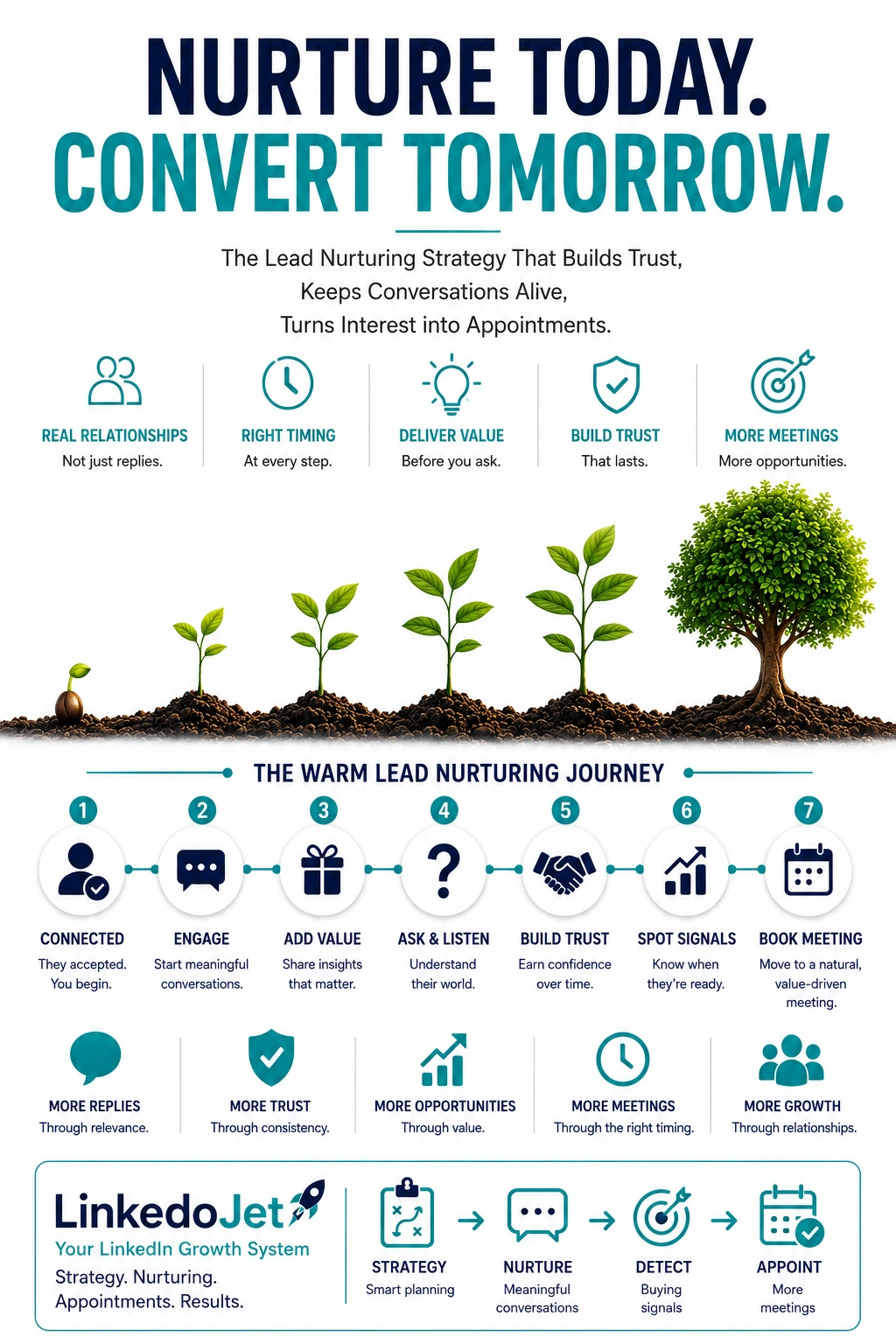
The thread dies after “we’re testing creative.” It’s not rejection.
It’s bandwidth, competing priorities, and risk avoidance. And it quietly wrecks your month.
You know the thread.
A founder likes your post about Meta CPM swings. They view your profile twice. They accept the connection. You send something reasonable. They reply once: “Yeah, we’re testing creative.” Then silence.
Most agency teams read that as a soft no. Or worse, they start questioning their positioning. “Maybe we’re not differentiated.”
What’s usually happening is more boring—and more dangerous: you caught a real problem at a moment when they weren’t ready to act. They’re juggling delivery fires, an incumbent who’s “fine for now,” internal politics around who owns performance, and a deep fear of buying another shiny proposal that doesn’t survive month two.
So they go quiet. Not because you’re wrong. Because replying means reopening a decision they don’t have the energy to make.
The cost isn’t just one lost call. It’s the lumpy pipeline pattern that forces you back into cold outbound and referral begging at the worst time. It’s the hidden tax on your senior team because founders end up doing follow-up between client Slack pings. It’s the slow drift into “we’ll just post more and hope inbound picks up.”
Warm LinkedIn interest is the easiest revenue you’ll ever earn. Not because it’s easy—because the intent already exists. Your job is to keep the conversation alive without forcing a decision too early.
Lead temperature for agencies: Engaged → Conversational → Problem-aware → Change-ready
Stop treating “warm” like a yes/no state. Treat it like commercial readiness.
Agency buyers don’t wake up and decide to hire you. They slide toward it. The difference between “polite” and “ready” is usually one internal trigger: missed targets, leadership pressure, attribution breaking, creative fatigue, churn risk, or a budget unlock tied to a new initiative.
Here’s a simple temperature model that works in the real world of retainers and slow decisions.
| Stage | What it looks like on LinkedIn | What to send | What to avoid |
|---|---|---|---|
| Engaged | Likes/comments, profile views after your ROAS/creative post, accepts connection | One low-effort question tied to the topic they engaged with; keep it specific | Meeting ask, service menu, “we help brands scale” positioning talk |
| Conversational | Short replies, a clarifying question, “we’re testing,” “we’re okay but…” | Reflect what they said, ask one sharp operator question, offer a small insight | Interrogation (“what are your goals?”), generic audit offer, case study dump |
| Problem-aware | Mentions ROAS inconsistency, lead quality complaints, tracking/reporting mess, creative stall | A relevant proof point or diagnostic outline (“what we’d check first week”) | Pitching a retainer before they trust your measurement and process |
| Change-ready | Replacing an agency, missed targets, new budget, hiring growth roles, internal push to fix performance | Clear next step: short working session to size the issue and map first 30 days | Long discovery, vague “strategy call,” forcing urgency when they already feel it |
This model gives your team permission to do the right thing: stay relevant in Engaged/Conversational, build credibility in Problem-aware, and only push to a call when the timing is real.
Signal-based follow-up cadence: earn the right to stay in their inbox
Cadence isn’t “every 3 days.” It’s spacing touches around signals.
Agencies lose warm threads because follow-up gets treated like an inbox chore. Either you chase too fast (and create resistance), or you wait too long (and miss the window when leadership pressure and budget align).
A practical cadence that matches how agency buying actually happens:
- After a meaningful reply (Conversational/Problem-aware): respond same day when possible. If they don’t answer your follow-up question, nudge in 3–5 business days with a new reason (not the same question).
- After passive engagement (Engaged): one light touch, then shift to 7–14 day content-led nudges tied to their reality (CPM spikes, attribution gaps, creative testing velocity, lead quality feedback loop).
- Event-driven follow-ups (timing triggers): reach out within 24–72 hours of a trigger: new growth hire, funding, site relaunch, “we’re expanding paid,” sudden flurry of posts about efficiency, or a quarter-end performance recap.
- When they explicitly say “not right now”: stop chasing. Move them to a light-touch track (monthly) and wait for a trigger. That restraint reads as confidence.
The rule that changes everything: every follow-up must contain new information, a new observation, or a new constraint. “Circling back” is a request for attention with no value attached—and founders are trained to ignore it.
Niche reality: if they’re running paid, their week is dictated by creative approvals, reporting, and internal blame. Your follow-up should fit into that world. One clean prompt. One credible insight. No performance theater.
Message examples that don’t sound scripted (and don’t force the call)
Short, specific, grounded in their operating reality. Adaptable across paid, SEO, lifecycle, CRO.
First warm follow-up after connection acceptance (no meeting ask):
“Appreciate the connect — I reached out after your comment on the CPM thread. Quick one: when performance feels ‘off’ for you right now, is it cost creeping up, conversion rate slipping, or lead quality getting noisy?”
Follow-up after a prospect replies (“we’re okay but inconsistent” / “tracking is messy”):
“That’s the frustrating zone — not broken enough to trigger change, but inconsistent enough to steal time every week. When you say ‘inconsistent,’ what’s moving around the most: creative hit rate, attribution confidence, or the handoff from lead to revenue? (The fix is different for each.)”
Educational nurturing message (practical, non-preachy):
“One pattern we keep seeing: creative testing stalls not because people don’t have ideas, but because there isn’t a weekly ‘kill/keep/iterate’ rhythm. If you’re running paid right now, do you have a standing review where weak ads get retired quickly — or does everything linger because no one owns the call?”
Insight-based follow-up (market change → operational implication):
“Heads up: we’re seeing more accounts where reporting looks ‘fine’ but blended CAC is creeping because consent/reporting gaps are masking decline. This month I’d watch new customer CVR and creative fatigue before ROAS tells the story. Are you looking at those weekly, or more ad-hoc?”
Case-study / proof-based nurturing (believable, specific, invites discussion):
“Quick example from a recent build: B2C subscription brand (mid-six-figure monthly spend). Issue wasn’t spend — it was lead quality complaints + inconsistent MER. We tightened the creative testing cadence (weekly scorecard + clear kill rules), rebuilt the reporting so sales feedback tagged ‘bad leads’ by source/offer, and fixed the landing page mismatch. Outcome: fewer ‘junk’ leads and steadier efficiency over the next 6–8 weeks. If you’re seeing lead quality drama, which side is louder right now — marketing or sales?”
Soft question to reopen the conversation (gives an easy out):
“Circling back feels lazy, so I’ll ask it plainly: are you still pushing for efficiency this quarter, or did priorities shift back to growth/delivery?”
Buying-signal response (replace agency / missed targets / new budget):
“Got it — if you’re considering a change, there are usually two risks to manage: disruption and measurement drift. Before we talk vendors, what does ‘good’ need to look like 60 days in: steadier CAC, clearer attribution, higher testing velocity, or cleaner lead quality? And is there a deadline driving the decision (board/quarter-end/launch)?”
Soft meeting request (working session, low pressure):
“If it’s useful, we can do 15 minutes to compare notes on where ROAS is getting stuck and what we’d check first week. Want to do Tue morning or Thu afternoon?”
Dormant lead revival message (new reason, not a nudge):
“Random but relevant: I re-read your post about pipeline quality and noticed most teams diagnosing ‘bad leads’ don’t separate targeting vs offer vs handoff. If you tell me your channel mix (Meta/Google/SEO/email), I’ll send the 5-point check we use to pinpoint which one is actually failing.”
Final polite close-loop message (permission-based next touch):
“Looks like timing might not be there — totally fine. Want me to send the one-page checklist we use to spot account drift (creative velocity, attribution confidence, lead quality loop), and I’ll leave you be unless you pull it back up?”
Buying signals vs. noise in agency sales
Not all “interest” is commercial readiness. Learn the tells.
Warm LinkedIn activity is cheap. Commercial intent is rare. The skill is separating the two without becoming cynical.
Signals that usually mean they’re moving toward change:
- They ask about onboarding: “What does the first 30 days look like?” “How do you get context quickly?”
- They ask about team structure: who owns creative, who approves, who reports, what you need from in-house.
- They ask about reporting cadence and definitions: “How do you define a qualified lead?” “What do you review weekly?”
- They ask about constraints: “Can you work inside our tracking setup?” “We can’t rebuild the site until next quarter.”
- They reference an incumbent: “We have an agency, but…” “We’re not ready to fire them yet.” (This is often the real start.)
- They mention pressure: missed targets, leadership questions, churn, sales complaining, board decks.
- They ask for relevance, not volume: “Have you worked with X business model?” “How do you handle creative?”
Non-signals (treat them as Engaged, not ready):
- Emoji replies. “Love this.” “So true.”
- “Sounds good” with no answer to your question.
- Asking for a portfolio, then disappearing.
- Agreeing that attribution is hard, but offering no specifics about their situation.
Niche tell: when a founder starts describing decision friction (who signs off, what they’re scared of breaking, what the sales team is complaining about), you’re closer to a booked call than any compliment you’ll receive on a post.
Why warm agency leads go silent (and how to recover cleanly)
Silence is usually a reaction to your timing, not your offer.
Most warm threads die for reasons that have nothing to do with “fit.” They die because your follow-up forces a decision the prospect can’t make yet.
The momentum killers I see most often in agency sales:
- Pushing a call right after a like. You’re asking for time before you’ve reduced risk.
- Sending a portfolio dump. It reads like desperation and creates work for them.
- Broad discovery questions. “What are your goals?” makes them do strategy work in a DM thread.
- Jargon-heavy audits. Founders have heard “full-funnel,” “north star metric,” and “growth engine” a hundred times.
- Ignoring delivery reality. They might be in a client fire week; you interpret it as disinterest and over-message.
- Pitching retainers before proving operational discipline. The fear isn’t price. It’s drift after the sale.
How to recover without groveling:
- Name the stall without drama: “You probably got pulled back into delivery — all good.”
- Re-enter with a reason: a platform change, a benchmark question, a diagnostic outline, a short teardown offer.
- Give an easy out: “If it’s not a priority this quarter, say the word and I’ll pause.”
- Offer the smallest next step: one question, one artifact, or one 15-minute working session.
The goal isn’t to be persistent. It’s to be relevant enough that when the internal trigger hits, you’re the obvious person to reply to.
FAQ
What’s a realistic LinkedIn follow-up cadence for agency retainers without sounding pushy?
Anchor it to signals. If they replied with something real (inconsistency, tracking, lead quality), respond same day and nudge in 3–5 business days if they don’t answer your question. If it’s passive engagement (likes/profile view), keep it light: one touch, then 7–14 day nurturing. If they say “not now,” move to monthly and wait for a trigger.
How do I tell if a LinkedIn lead is actually change-ready or just being polite?
Change-ready leads talk about constraints and process: onboarding, reporting cadence, KPI definitions, team structure, how you handle creative, how you work with in-house, timeline, contract terms. Polite leads compliment content, ask for a deck, or give “sounds good” replies without specifics.
What should I send after a prospect likes a post or accepts a connection but doesn’t reply?
One message that matches what they engaged with and asks a low-effort diagnostic question. No meeting ask. Example: “When performance feels off right now, is it cost creeping up, CVR slipping, or lead quality getting noisy?” If they don’t respond, don’t chase—shift to periodic insight-led touches tied to real platform or measurement changes.
How do you revive an inactive LinkedIn conversation without “circling back”?
Re-enter with a new reason: a market shift (CPMs, attribution), a quick benchmark prompt, or a small diagnostic you can share in-text. Acknowledge time passing and give them an easy out. Silence isn’t a personal rejection; it’s usually timing and attention.
What are the most common buying signals for marketing agency prospects on LinkedIn?
Replacing an incumbent, missed targets, new budget, hiring growth roles, leadership pressure, and detailed questions about how you run delivery: onboarding, reporting rhythm, measurement definitions, creative process, and first-30-day plan. Those signals beat any “love this post” engagement.
If you want more booked calls from warm LinkedIn interest, you need an operating system—not more DMs.
LinkedoJet builds and runs the targeting, outreach, follow-up, and warm-lead tracking so your team stops losing momentum in the inbox.
This isn’t a generic “discovery chat.” If you book time here, we’ll show you exactly how we run warm LinkedIn conversations like a pipeline stage—so interest turns into qualified discovery calls without forcing it.
What LinkedoJet operationally provides:
- ICP and targeting setup tailored to agency buying reality (founders, heads of growth, marketing leads) and the triggers that actually create change.
- Sales Navigator / LinkedIn prospect list building so you’re not guessing—lists are built around roles, org signals, and intent cues, then refined as we see replies.
- AI-assisted personalization that stays human: we reference what they engaged with (ROAS posts, creative testing threads, attribution comments) and adapt the follow-up to temperature—no copy-paste vibe.
- LinkedIn outreach execution handled end-to-end, with sequencing that respects signal timing (reply-based, engagement-based, trigger-based).
- Lead reply handling and nurturing support so warm conversations don’t die in a busy week—responses are guided by playbooks like the temperature model above.
- Warm lead tracking with temperature, last touch, next action, and notes on buying signals—so you stop relying on memory and scattered DMs.
- Appointment generation support to convert change-ready leads into low-friction working sessions and discovery calls.
- Campaign visibility through dashboards so you can see what’s happening: who’s engaging, who’s progressing, where threads stall, and what messaging is creating real signal.
- Ongoing campaign refinement—targeting, lists, and messaging get tightened based on response quality, not vanity metrics.
What happens after onboarding: we build your initial targeting and prospect lists, set the outreach and follow-up workflows, and start conversations. As replies come in, we guide handling and nurturing based on lead temperature and buying signals, then help move the right people into booked meetings. You get visibility the whole time—no “black box automation.”
Why this is different from ordinary LinkedIn automation tools: tools send messages. LinkedoJet runs the outbound motion—targeting, personalization, execution, follow-up logic, reply support, tracking, and appointment conversion—so warm interest doesn’t evaporate.
Next step: turn “warm” into a managed pipeline stage
You’ll leave with a clear follow-up model, tighter timing, and a system your team can actually run—consistently.
From identifying the right decision-makers to starting meaningful conversations and turning them into qualified appointments... LinkedoJet manages the entire outbound engine for your business.