
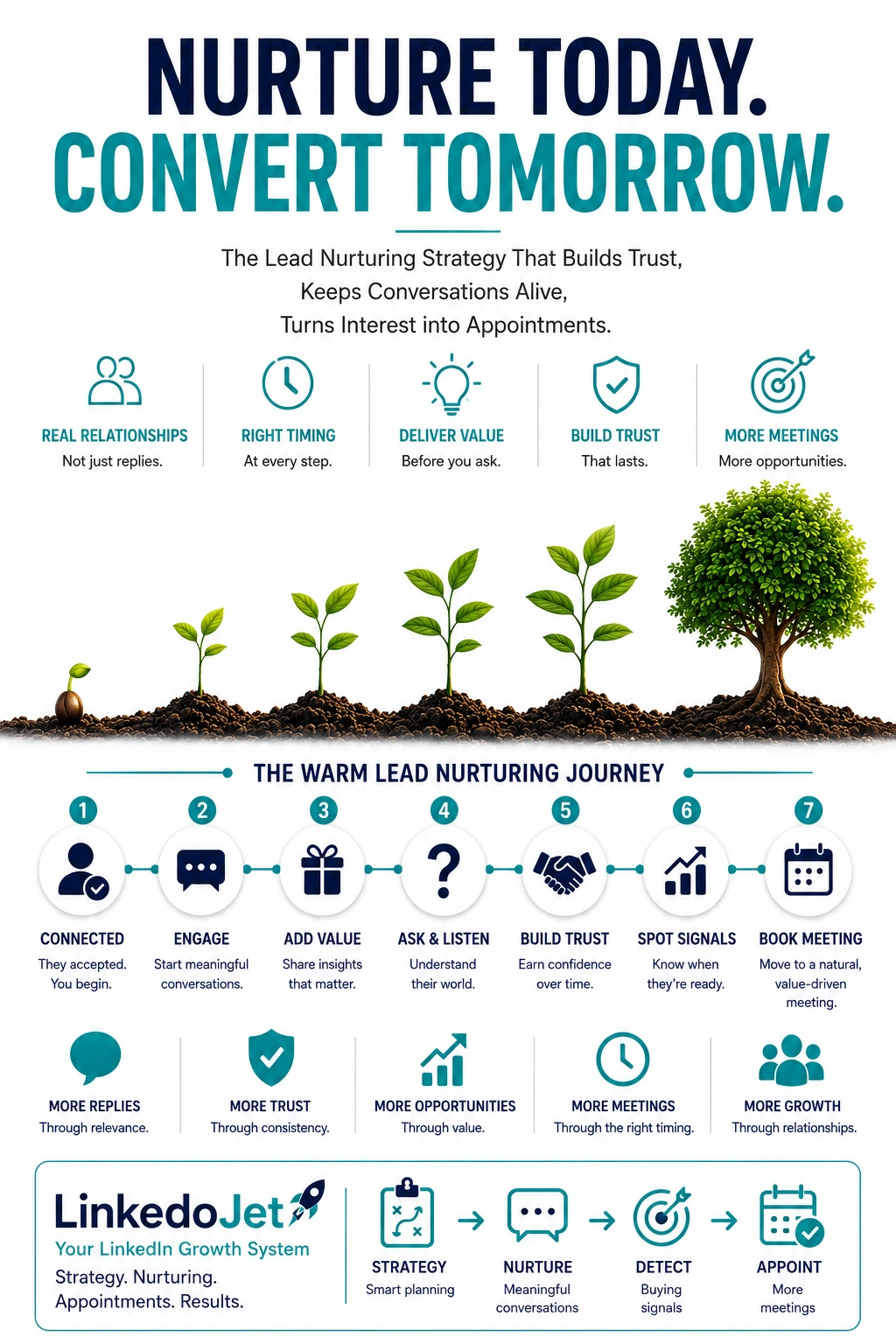
Why warm CISO threads go quiet (and the pipeline leak it creates)
Most security conversations don’t die because your message was “bad.” They die because you treated early interest like meeting intent.
You see the signals: a connection accept from a CISO, a like on your breach recap, a short “thanks,” a profile view right after you posted something about tool sprawl.
Then… nothing.
That silence is expensive in a way most revenue teams miss. Your SDRs burn cycles “following up” in threads that are already mentally filed under relevant, not today. Forecasting gets noisy because you’re counting warm signals as near-term meetings. And when the month ends, you go back to cold outbound or paid just to hit the number—while genuinely good-fit accounts sit in limbo.
In security, being deprioritized is brutal. Audit windows move. A board question turns into a fire drill. Procurement pulls forward a renewal. An architect quietly kills a tool because “integration risk.” Another vendor gets pulled into an incident because they stayed useful without demanding calendar time.
The hidden mechanic: for CISOs, early engagement usually means “I recognize the category” not “I’m starting a project.” If your next move is a demo ask or a calendar link, you’ve raised their time risk without lowering their decision risk. The safest move for them is to stop replying.
Lead temperature for security buying cycles: Engaged → Aware → Active → Urgent
The fastest way to kill a warm thread is to treat every signal like it deserves the same follow-up.
Security buyers run on triggers and constraints. Your follow-up has to match where they are in that motion.
| Temperature | What it looks like on LinkedIn | Your job | Avoid |
|---|---|---|---|
| Engaged | Likes, post comments, profile views, follows; no direct reply yet | Stay relevant with one sharp insight; ask a low-friction context question | Demo ask, “calendar link,” feature dump |
| Aware | Connection accepted; short reply (“thanks”, “makes sense”) | Earn one clarifying answer; tag likely trigger (audit vs incident vs consolidation) | Multi-question interrogations; “just checking in” loops |
| Active | They ask a question; mention a control gap, tool overlap, alert fatigue, evidence collection pain, data residency, integrations, pricing model | Move from relevance to scope; offer a short, outcome-framed scoping call | Generic “we help with X”; long PDFs; vague “let’s chat” |
| Urgent | Audit date, renewal, tool replacement, board ask, incident, insurance questionnaire, M&A / cloud migration pressure | Confirm timeline + constraints; propose a 15–20 minute working session with a tight agenda | High-pressure “book time ASAP” tone; pushing a demo before scoping |
Notice what’s missing in Engaged/Aware: a meeting request. At those stages, the best “conversion” is specificity—one sentence about timing, ownership, or pressure. That’s how you earn the right to ask for time later.
Security buyer mindset after the first touch: vendor fatigue, time-risk, and internal politics
A CISO isn’t ignoring you. They’re protecting their calendar like it’s production access.
Most security leaders are saturated. “AI-powered” claims have numbed the buyer. Everyone says they reduce risk. Everyone says they integrate. Everyone says they’re fast to deploy.
So the real objection isn’t “I don’t believe you.” It’s “Engaging with you will create work.”
And they’re not wrong. A single vendor conversation can trigger:
- architecture review and integration questions (“where does the data go?”, “what’s the agent footprint?”, “how do you handle retention?”)
- compliance involvement (SOC 2 / ISO 27001 evidence, control mapping, policy alignment)
- procurement/legal drag (MSA, DPA, security questionnaires)
- internal politics (IT ops, security engineering, and a skeptical architect who can block you quietly)
Your follow-up has to reduce perceived risk of engaging. Practically, that means you show three things early:
- You understand the trigger. Audit readiness doesn’t feel like incident response. Consolidation doesn’t feel like net-new tooling.
- You respect bandwidth. One question. One page. One small step.
- You can talk implementation reality. Not features. Friction. Ownership. Time-to-value.
If you can do that, a CISO will often give you what you actually need: a constraint (“short-staffed”), a timing marker (“after renewal”), or a pressure point (“insurance questionnaire is ugly”). That’s the doorway to a scoped call.
Conversation patterns (not scripts): 10 security-native follow-ups that keep momentum
These are short on purpose. The goal is the next small step—clarity, not a meeting by force.
1) First warm follow-up after connection acceptance (no pitch, establish relevance)
Thanks for connecting, {FirstName}. Quick context check—are you seeing more pressure right now from SOC 2/ISO 27001 evidence work, or from tool consolidation / alert volume? I’m seeing a lot of teams get stuck in the “proof” part even when the controls are mostly there.
2) Follow-up after a minimal reply (“Thanks” / “We’re busy”)
Totally get it—security calendars don’t leave much room. One quick one so I don’t make assumptions: is the pressure more audit-driven (evidence, control mapping) or incident-driven (visibility, response workload) on your side right now?
3) Educational nurturing (teach without preaching)
Something we’re seeing in audit readiness: teams don’t fail on controls—they fail on evidence collection and the “who owns this artifact?” loop. I wrote a one-page note on the common bottlenecks (no pitch). Want it?
4) Insight-based follow-up (react to an industry cue)
Saw the recent shift in {regulatory requirement / insurance questionnaire patterns} for {their industry}. The trend I’m noticing is questionnaires asking for operational proof (how fast you can detect/contain) vs policy statements. Curious—are you getting more of those evidence-heavy asks this quarter?
5) Proof-based nurturing (outcomes, not hype)
One datapoint from a recent rollout in a similar environment: we didn’t “magically reduce risk,” we reduced triage overhead—fewer noisy alerts escalated, faster time-to-clarity for analysts, and audit evidence was easier to pull without chasing screenshots. If it’s useful, I can share the before/after metrics format they used internally.
6) Soft question to reopen when it starts cooling
Quick pulse check, {FirstName}—if this category moves for you this year, is it more likely driven by tool consolidation or by audit/board proof? If neither, I’ll stop nudging and just share the occasional relevant note.
7) Buying-signal response (they reveal urgency or specifics)
That makes sense—if the {audit/renewal/tool replacement} date is {month}, the next few weeks are usually about getting clarity, not vendor tours. Two quick scoping questions: (1) what’s the current stack for {SIEM/EDR/IAM/GRC/etc.} and (2) what constraint matters most—headcount, integration risk, or procurement timeline? If you’re open to it, we can do a short call focused on your workflow and where it stalls.
8) Soft meeting request (low-pressure, scoped)
Would a 15–20 minute working session be useful? Agenda is tight: map your current {evidence collection / triage / access review} workflow, call out where time gets burned, and see if there’s a realistic path to reduce the operational load before {audit/renewal}. If it’s not a fit, you’ll still leave with a cleaner problem statement.
9) Dormant lead revival (after 30–90 days)
Circling back with a timing-based question, not a pitch. A lot of teams I speak with reset priorities around {audit season / budget planning / consolidation initiatives}. If {their company} is touching {SOC 2/ISO 27001 / tool sprawl / cloud expansion} this quarter, I can send a short checklist we use to spot where projects stall (ownerless controls, evidence gaps, integration friction). Want it, or should I leave you be?
10) Final polite close-loop (protect brand)
I’m going to stop nudging after this so I don’t add noise. If compliance pressure, renewals, or an incident suddenly makes {problem area} urgent, reply with “timing changed” and I’ll send the two questions we use to scope it quickly. Otherwise, I’ll stay out of your inbox.
When they engage with content but don’t reply
You want to use the signal without sounding like you’re watching them.
Content engagement is a weak signal, but it’s not useless. For security leaders, a like often means “I agree” or “I’ve lived this”—not “talk to me.” Your job is to turn that passive agreement into a low-friction exchange.
The mistake is calling it out too directly: “Saw you liked my post…” reads like surveillance and puts them back into time-risk mode.
Better approaches:
- Reference the topic, not the action. “On the tool consolidation point…” works. “I noticed you liked…” doesn’t.
- Add one sharper insight than the post. Give them a reason to respond beyond politeness.
- Ask a binary or minimal-effort question. Two options beats five open-ended questions.
Examples that stay human:
On the consolidation thread—one thing I keep seeing is teams underestimate the integration tax (data quality + workflow change), not the license cost. Is your pain more around tool overlap or around analyst time?
On audit evidence: the teams that move fastest usually have an “evidence owner” per control family, even if it’s informal. Do you have that ownership mapped, or does it get rediscovered every audit?
On alert fatigue: the real cost isn’t volume, it’s triage context switching. If you had to pick, is the bigger issue false positives or lack of visibility across {cloud / endpoints / identity}?
If they still don’t respond, don’t chase. Put them into a light relevance loop and wait for a real trigger.
Why security leaders go quiet
The follow-up mistakes that kill trust aren’t loud. They’re subtle—and they train buyers that replying creates work.
- Demo too early. Before you understand posture, environment, ownership, or timing, a demo is just time risk. CISOs go quiet to protect the team.
- Generic value props. “Reduce risk with AI” sounds like everyone. Security buyers respond to specifics: evidence burden, triage overhead, integration constraints, data residency, procurement friction.
- Buzzwords as a substitute for security reality. If you can’t speak plainly about control gaps, attack surface changes, or why implementations fail, you read like a vendor brochure.
- Ignoring the evaluation motion. A security architect can block you with one question you weren’t ready for. If your follow-up doesn’t anticipate integration and operational ownership, you lose credibility.
- Bad timing and over-messaging. During incident response, audit sprints, or renewal crunch, extra pings feel disrespectful. One useful note beats five nudges.
- Empty “checking in.” It signals you have nothing new to add. In security, that’s the end of the thread.
- Sending long reports with no context. CISOs don’t want homework. If you share content, tell them exactly what to look at and why it matters in their world.
The fix isn’t “more touches.” It’s a system that decides which touch, when, and for what next step—based on trigger and temperature.
FAQ
What counts as a “warm” LinkedIn signal when selling to CISOs—and what doesn’t?
Warm is anything that suggests category relevance or light recognition: connection acceptance, a short reply, repeated content engagement over time, a profile view after you publish a security-relevant take, or a comment that reflects lived experience (audit pain, consolidation fatigue, incident lessons).
Not warm (by itself): a single like from months ago, a random follow from someone outside the buying committee, or generic reactions that don’t map to security priorities. Treat these as “Engaged,” not “meeting intent.”
How long should a LinkedIn nurture sequence run for enterprise security buyers before you pause?
Longer than most SDR teams are comfortable with—because security priorities move in waves. A practical rule: run an active nurture for 2–4 weeks (light touches, each one adding value), then pause into a low-frequency relevance loop for 60–90 days.
If they signal “not this year,” stop chasing entirely and shift to occasional trigger-led notes (audit season, renewal cycles, new compliance asks). The goal is to be present when timing changes, not to win an argument in DMs.
What are the most reliable buying signals in a CISO LinkedIn conversation?
Specificity beats enthusiasm. Reliable signals include mentions of: an upcoming audit date, board-requested posture review, insurance questionnaire pressure, tool consolidation, renewal timing, a recent incident or near-miss, staffing constraints, or direct questions about deployment time, integrations, data residency, pricing model, and proof (references, measurable outcomes).
When a security leader starts describing environment details and constraints, you’re close to an “Active” or “Urgent” state—shift from insights to scoping.
How do you follow up after a CISO replies “thanks” or “we’re busy” without sounding pushy?
Acknowledge bandwidth, then ask one security-native question that helps you tag the trigger. Example: “Is the pressure more audit-driven or incident-driven right now?” or “If this moves this year, is it more likely consolidation or evidence burden?”
If they don’t answer, don’t stack follow-ups. Send a single useful note a week later, then pause.
How do you revive inactive LinkedIn conversations with CISOs after 30–90 days?
Don’t “check in.” Re-enter with timing and relevance: audit season, renewals, budget reset, consolidation initiatives, or a sector-specific breach/regulatory shift. Offer a small asset (one-page POV, checklist, benchmark) and give an easy out.
Your message should make it safe to respond in one line—without committing to a meeting.
If you already have warm signals, we’ll build the system that turns them into scoped calls
This isn’t a “strategy chat.” We’ll show you how LinkedoJet runs the nurturing engine: intent tagging, staged follow-ups, reply handling, and clean handoff rules so your team stops chasing ghosts.
LinkedoJet is run like an outbound operations function, not a message-blasting tool. We set up the targeting, build the prospect lists, run the outreach, handle replies, and keep warm threads moving until they’re meeting-ready.
On the session, we’ll pressure-test your current warm pipeline and show you what we’d implement:
- ICP + targeting setup for security buying committees (CISO/SecOps, security architecture, compliance, IT leadership) and the right account filters.
- Sales Navigator prospect list building and segmentation by trigger fit (audit readiness, incident pressure, consolidation, compliance).
- Conversation staging using a security-specific temperature model (Engaged/Aware/Active/Urgent) so your team stops asking for demos at the wrong time.
- AI-assisted personalization that stays human: security-native hooks, relevant context, and short asks—without sounding like a template vault.
- Outreach execution + reply handling so warm signals don’t die in an SDR inbox when the week gets busy.
- Lead nurturing and follow-up workflows aligned to real security calendars (audit sprints, renewal windows, incident seasons), with clear rules for when to pause.
- Warm lead tracking (intent tags like audit/incident/consolidation/compliance, temperature changes, and next-step prompts) so you can see what’s real.
- Appointment generation support with handoff rules: when a thread becomes a scoped 15–20 minute discovery call, what the agenda is, and what needs to be known before your AE joins.
- Campaign visibility through dashboards so you can see volume, response quality, warm threads, and meeting-ready accounts without guesswork.
- Ongoing refinement: we adjust targeting, messaging angles, and cadence based on replies and trigger patterns—because security markets move.
After onboarding, you receive a live outbound system: continuously refreshed prospect lists, staged LinkedIn conversations, tracked warm leads, and a repeatable path to qualified calls—without turning your SDRs into full-time DM chasers.
That’s the difference from ordinary LinkedIn automation tools. Tools send messages. LinkedoJet runs the process: targeting, personalization, execution, nurturing, tracking, and the operational follow-through that produces meetings.
Next step: stop losing warm security threads to “maybe later”
If your team is getting signals but not calls, you don’t need more outreach. You need a nurturing system that respects security reality and earns specificity before asking for time. From identifying the right decision-makers to starting meaningful conversations and turning them into qualified appointments... LinkedoJet manages the entire outbound engine for your business.