
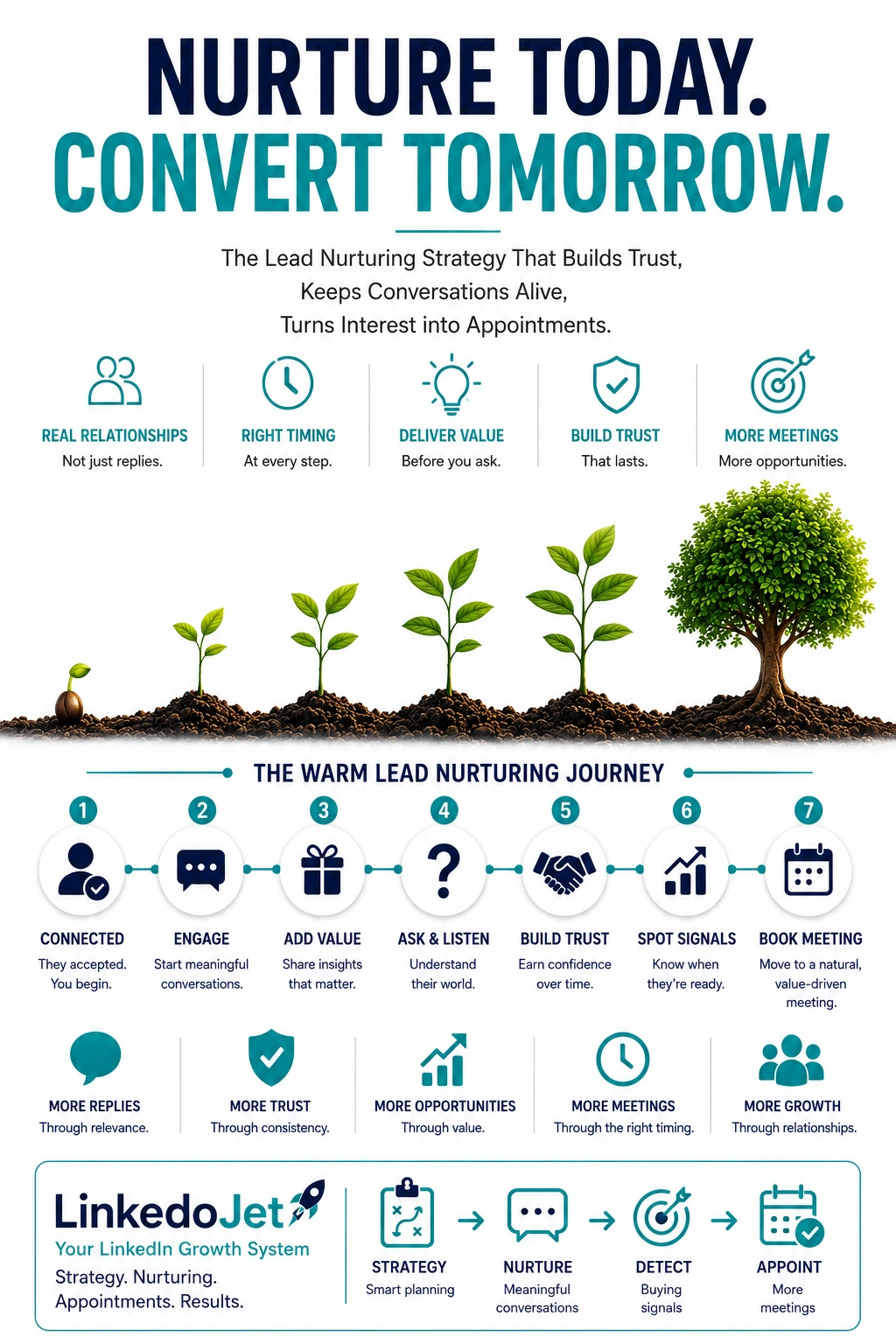
Warm signals aren’t the problem. The drop-off is.
You’re seeing the right kind of activity—profile views after a manager coaching post, an HR Director commenting on leadership development, an Enablement leader replying about adoption—then nothing turns into a scoping call.
You know the moment. A Head of L&D views your profile right after you wrote about manager reinforcement. They accept the connection. Maybe they even say, “Good point.”
And then the thread dies.
Not because they’re fake. Because training buying cycles live in the messy middle: timing shifts, stakeholders appear late, procurement changes the rules, and the buyer is trying to avoid being the person who “picked another workshop vendor” that doesn’t stick.
So your pipeline looks active—likes, comments, accepts, the occasional short reply—but meetings don’t stack up. Q3 becomes Q4. Forecasted program revenue slides. Your team keeps “following up” without changing the conversation.
The hidden trap: most corporate training sellers treat warm engagement as sales-ready intent. For L&D/HR/Enablement, it’s usually early intent. They’re collecting options, pressure-testing ideas, or quietly figuring out whether they can even mobilize internally.
If your follow-up jumps straight from “nice to connect” to “want a call?” you force them to choose before they have a story to tell their stakeholders. And silence is the easiest answer.
Stage 1–2: earn relevance, then sharpen the problem (without interrogating)
Your job early isn’t persuasion. It’s helping them name the real constraint: audience, rollout reality, adoption risk, and timing.
L&D leaders don’t want another vendor asking 12 discovery questions in DMs. They want someone who sounds like they’ve sat in the “we can’t take people off the floor” meeting and still got a program shipped.
Stage 1 is simple: show you understand their world—cohort scheduling, multi-region time zones, facilitator consistency, skeptical learners, and the fact that managers are the bottleneck for behavior change.
Stage 2 is problem sharpening: one thoughtful question at a time, phrased in their language. Not a qualification checklist.
- For Heads of L&D / Talent Development: “Is this aimed at first-time managers, or the ‘accidental manager’ layer that’s already in role?”
- For HR Directors: “Is the pressure more consistency (same standard across regions) or capability (closing gaps where performance is slipping)?”
- For Sales Enablement: “Is the real issue skill, or field adoption—managers coaching to the behaviors you want?”
Two rules that keep you from sounding pushy:
- Mirror the trigger. Reference what caused the interaction (their comment, your post, the webinar) so you’re not “randomly following up.”
- Ask a question they can answer in one line. If they have to think too hard, you just created friction.
When you do this well, you earn the right to talk about scope later. And scope is what makes a scoping call feel useful instead of salesy.
Stage 3: de-risk the program early—rollout, reinforcement, measurement, logistics
Most training vendors talk content. Buyers are worried about whether it lands.
When an L&D buyer goes quiet, it’s often because you sound interchangeable. “Custom program.” “Engaging facilitators.” “Interactive workshop.” They’ve heard it.
What they don’t hear enough is the operator side: how the program gets implemented when calendars are brutal and managers are stretched.
Stage 3 nurturing is where you become the low-risk option. You surface the derailers before they do:
- Rollout reality: cohort sizing, sequencing, virtual vs in-person mix, time zones, facilitator bench, train-the-trainer needs
- Reinforcement: manager toolkits, 1:1 prompts, observation rubrics, peer practice, nudges after the session
- Measurement that won’t backfire: behavior adoption signals, manager observation, quality checks—vs vanity metrics like attendance
- Time-away-from-work narrative: how to justify the time cost to business leaders
This is also where you gently create urgency without pushing: if they mention a compliance window, SKO, onboarding revamp, or a new manager cohort, you tie your next message to that constraint—because “when” drives these deals as much as “what.”
Stage 4–5: stakeholder mapping + the working-session pivot
The meeting isn’t the prize. Decision readiness is. Your scoping call is the tool that creates it.
Training purchases rarely move forward on one person’s enthusiasm. Even when your champion is real, they’re still negotiating:
- HRBP or regional HR wants consistency and inclusion
- Business leaders want minimal disruption and visible behavior change
- Sales leadership wants coaching and adoption, not “another training event”
- Procurement wants scope clarity and pricing logic
- Legal shows up late and slows everything down
Stakeholder mapping doesn’t have to feel like “who’s on the buying committee?” It can sound like help:
- “When this gets approved, who usually cares most about time-away-from-work?”
- “Do you normally pull in Enablement/HRBP early, or once you’ve got a strawman plan?”
- “Does procurement prefer fixed cohorts, or bands based on headcount/regions?”
Then you pivot into a call as a working session with a specific outcome. Not “30 minutes to learn about us.”
Meeting pivot that works in this niche: “If you’re aiming for a Q3 cohort and you’ve got multiple regions, it’s usually worth a short working session to pressure-test cohort design, reinforcement, and what procurement will ask for. If we’re not a fit, you’ll still have a cleaner internal plan. Want to look at 2–3 rollout options?”
That frame reduces risk. It gives them a reason to say yes even if they’re not ready to buy.
Message examples you can actually send (corporate training niche)
Short, specific, easy to answer. One idea per message. No content dumps.
First warm follow-up after connection acceptance
Example: “Thanks for connecting. I saw you lead L&D for a distributed org—curious, is your manager training more cohort-based, or embedded into a broader onboarding path?”
Follow-up after a prospect replies once
Example: “That makes sense—if adoption is the sticking point after the workshop, is it mainly manager reinforcement, or competing priorities in the first 30 days?”
Educational nurturing message (one useful idea)
Example: “One pattern that helps is a 3-week ‘apply + coach’ rhythm after the session (tiny manager prompts + a simple observation rubric). Happy to share the outline if that’s useful—would that fit your audience?”
Insight-based follow-up tied to timing
Example: “Quick timing check—lots of teams lock Q4 delivery now because Q1 calendars disappear. Are you already mapping cohorts, or still in needs analysis?”
Case-study / proof note (grounded)
Example: “We supported a 120-person frontline manager cohort across time zones; the difference-maker wasn’t the workshop, it was the manager check-ins and a simple observation rubric to keep standards consistent. If you’re dealing with consistency across regions, I can send a short summary.”
Soft question to reopen the conversation
Example: “Quick one—if training is on the roadmap, is the next trigger a budget reset, a program launch, or a compliance date?”
Buying-signal response (tighten scope and earn a meeting)
Example: “If it’s ~60 new managers in Q3 across two regions, it’s probably worth a 15-minute scoping chat to pressure-test cohort design and reinforcement. Want to look at options?”
Soft meeting request (working session, not a pitch)
Example: “Happy to run a short working session to map audience, outcomes, and rollout constraints. If it’s not a fit, you’ll still leave with a plan you can use internally.”
Dormant lead revival (no guilt)
Example: “This may have slipped with planning season—no rush. We just packaged a one-page rollout timeline for multi-cohort programs (virtual + in-person mix). Want it?”
Final polite close-loop (keep the door open)
Example: “I’ll close the loop for now. If annual planning or a new cohort comes up, feel free to nudge me—I’m happy to share what we’re seeing across other L&D teams.”
Why L&D/HR prospects disengage (and what to do instead)
Most “ghosting” is your buyer protecting themselves—from risk, from internal politics, or from wasting time.
Here’s what kills momentum in the messy middle—especially for leadership development, enablement, onboarding, and compliance programs.
- Pushing a meeting before you understand audience and constraints. Fix: ask one scope-shaping question first (audience layer, cohort size, regions, delivery mix).
- Talking “custom programs” without showing how discovery works. Fix: describe the working session outcome (a strawman rollout, reinforcement plan, measurement approach).
- Sending long PDFs too early. Fix: send a micro-asset (one-page rollout timeline, cohort sizing rule-of-thumb, stakeholder checklist) and ask a yes/no reaction.
- Over-following up during annual planning chaos. Fix: cadence that respects enterprise calendars—light touches with timing hooks, not weekly “bumping this” messages.
- Ignoring procurement and legal until late. Fix: surface scope and pricing logic early (“bands,” “cohort-based,” “region complexity”) so they can pre-wire procurement.
- Speaking only in content terms. Fix: lead with adoption and reinforcement. L&D already has content.
- Generic leadership buzzwords. Fix: talk in specifics: manager check-ins, observation rubrics, coaching prompts, field reinforcement, time-away-from-work.
- Forgetting the buyer’s internal sell. Fix: give them language they can reuse with stakeholders (“why now,” “how we’ll measure,” “how we’ll minimize disruption”).
The practical shift: treat nurturing as decision support. You’re helping them get clear enough—and safe enough—to bring you into the process.
FAQ
What counts as a “warm” LinkedIn lead for corporate training—profile view, comment, connection accept, or reply?
Warm is any signal that suggests recognition or curiosity, not just a cold connect. A profile view after an L&D-focused post, a comment with a real opinion, a connection accept paired with engagement, or a reply that mentions a constraint (audience, timing, adoption) all count. A generic “thanks” is usually lukewarm until they reference a real program situation.
What’s a sensible LinkedIn follow-up cadence when the buyer is in annual planning, reorgs, or budget resets?
Think in “enterprise-friendly touches,” not weekly chasing. Start with 2–3 messages close to the trigger (connection accept, reply, comment), then move to spaced touches tied to timing moments (planning season, cohort mapping, SKO, compliance windows). If they go quiet, pause and re-enter with a concrete micro-asset or a single diagnostic question they can answer quickly.
How do you move from “nice to connect” to a meeting without sounding pushy to L&D or HR?
Earn the meeting by narrowing scope and reducing risk. Ask one smart question first (audience layer, cohort approach, rollout constraint). Then offer a working session framed around outcomes: a strawman rollout, reinforcement loop, and stakeholder plan. L&D/HR will take calls that feel useful even if they’re not ready to buy.
What should you say when Procurement or Legal shows up late in the conversation?
Acknowledge it like it’s normal (because it is), then move the conversation to scope clarity. Offer simple pricing logic (cohort-based, bands by headcount/regions, delivery mix) and define what’s in/out. The goal is to help your champion avoid a procurement reset that kills momentum.
How do you revive a dormant LinkedIn thread with an HR Director or Head of L&D without guilt-tripping them?
Assume positive intent and give an easy re-entry. Reference the likely reason (planning season, reorg, bandwidth), share one useful artifact or observation, and ask a one-word-answer question about timing. If they still don’t engage, close the loop politely and set a re-contact trigger (budget reset, new cohort, compliance date).
If you already have warm signals, we’ll help you turn them into scoping calls—without the DM awkwardness
This isn’t a generic “strategy chat.” We’ll show you exactly how to run a temperature-based nurturing system for L&D/HR/Enablement buyers and how LinkedoJet executes it end-to-end.
On the session, we’ll review your current warm lead flow (connection accepts, content engagement, replies, profile views) and where threads stall—post-reply, post-collateral, or after a “sounds interesting” moment.
You’ll leave with a recommended nurture path by buyer persona:
- Heads of L&D / Talent Development: problem sharpening + rollout de-risking
- HR Directors: consistency, inclusion, manager capability, internal comms
- Sales Enablement: field adoption, coaching rhythms, measurement tied to behaviors
- Procurement: scope clarity, pricing logic, reliability signals
If we’re a fit, LinkedoJet doesn’t hand you a plan and disappear. We operationally provide:
- ICP and targeting setup (titles, functions, org size, regions, trigger events)
- Sales Navigator / LinkedIn prospect list building so you’re talking to real decision-makers and influencers
- AI-assisted personalization that stays human—based on role context, posts, and buyer constraints (cohorts, delivery mix, adoption)
- LinkedIn outreach execution with enterprise-friendly pacing (no spray-and-pray)
- Lead reply handling and nurturing so warm threads don’t die after the first polite response
- Warm lead tracking including timing hints, stakeholder mentions, procurement involvement, and rollout complexity
- Appointment generation support with a working-session meeting frame that fits training deals
- Campaign visibility through dashboards so you can see what’s moving, stalling, and why
- Ongoing campaign refinement based on real replies and conversion patterns—not assumptions
Ordinary LinkedIn automation tools send sequences. They don’t manage the messy middle: timing shifts, stakeholder mapping, procurement detours, and the “interested but not ready” reality of training purchases.
From identifying the right decision-makers to starting meaningful conversations and turning them into qualified appointments... LinkedoJet manages the entire outbound engine for your business.
Next step: build a nurturing motion that survives planning season
If your team is getting warm engagement but meetings aren’t landing, the fix is rarely “more follow-ups.” It’s a clearer conversation path (credibility → scope sharpening → de-risking → stakeholder mapping → working-session pivot) and a cadence that respects enterprise timing.