
The November scramble starts in September: why “sounds interesting” goes quiet (and what it costs you)
September is full of polite signals: connection accepted, a like on a “holiday kits” post, a People Ops leader viewing your profile, a DM that ends with “send info.” It feels like traction.
Then October arrives. Your follow-ups land in a swamp of internal approvals, shifting budgets, and “we’re not ready yet.” And when November hits, those same accounts resurface with a hard deadline and zero scope—no counts, no countries, no budget band, no stakeholder alignment.
That’s when gifting teams get forced into bad choices:
- Discounting to win urgency you didn’t create.
- Rushing production and hoping blanks stay available.
- Overpromising on international and praying customs behaves.
- Sending a quote that’s wrong because the buyer never clarified destinations, sizes, or timeline.
The brutal part: those warm threads didn’t die because the buyer hated you. They died because gifting interest is often real, but not urgent until a trigger lands—holiday cutoffs, an onboarding wave, SKO, a conference, a customer save moment, a surprise budget release.
If you’re not staying useful between “sounds interesting” and “we need this by the 15th,” you’re invisible when the timing finally becomes real.
Sort warm interest by buyer moment: Curious Browser vs Idea Collector vs Time‑boxed Buyer (and what to send next)
Most teams treat every warm signal the same. That’s why the nurturing feels random—and why prospects ghost after “send me info.”
You need a simple sort. Not by job title. By buyer moment.
| Buyer moment | What it sounds like on LinkedIn | What they actually need next | What you send |
|---|---|---|---|
| Curious Browser | Likes a holiday post, views your profile, accepts the connection, no clear project | A reason to remember you without committing | A seasonal reality check (timelines, cutoffs), one practical checklist, one low-pressure question |
| Idea Collector | “Send options / send a catalog / what do you have?” | Help narrowing without forcing them to do scoping work | Two friction-reducing questions (deadline + destinations), then 2–3 budget tiers or program shapes |
| Time‑boxed Buyer | “Need this by X date” / “Can you ship to Canada + UK?” / “Do you have a portal?” | Fast confidence + a clean path to scope | Direct answers + a 10–15 minute working session to confirm counts, countries, tiers, and shipping plan |
This is where LinkedoJet earns its keep: we don’t just “follow up.” We track which moment each lead is in, and we run a sequence that matches the season and the stage—so your outreach reads like an operator who’s done this before, not a rep trying to hit a task list.
Why gifting buyers go silent: the real blockers (counts, budget, lead times, brand approvals, procurement timing)
When a gifting buyer goes quiet, it’s rarely a mystery. It’s usually one of these:
- Counts are unknown. They don’t know if it’s 75 people or 750, or if contractors are included.
- Budget isn’t confirmed. They have a vibe, not a band.
- Lead times feel risky. They’ve been burned by “we can do it” turning into late deliveries.
- Brand approvals are sticky. Marketing wants control, and the buyer doesn’t want to coordinate it yet.
- Procurement is looming. They don’t want to invite a process-heavy stakeholder into an unscoped conversation.
- International adds friction. Duties, customs delays, address formats, restricted items—nobody wants surprises.
- Operational anxiety. Kitting complexity, size exchanges, returns, color drift across batches, address capture.
So what happens when you send “any thoughts?”
You force them to reply with decisions they don’t have. Silence is the easiest option.
Nurturing that works in this category does two things at once:
- Reduces uncertainty (timelines, cutoffs, international realities, what can go wrong and how you avoid it).
- Pulls scope out naturally in small bites (deadline, destinations, count range), without an interrogation.
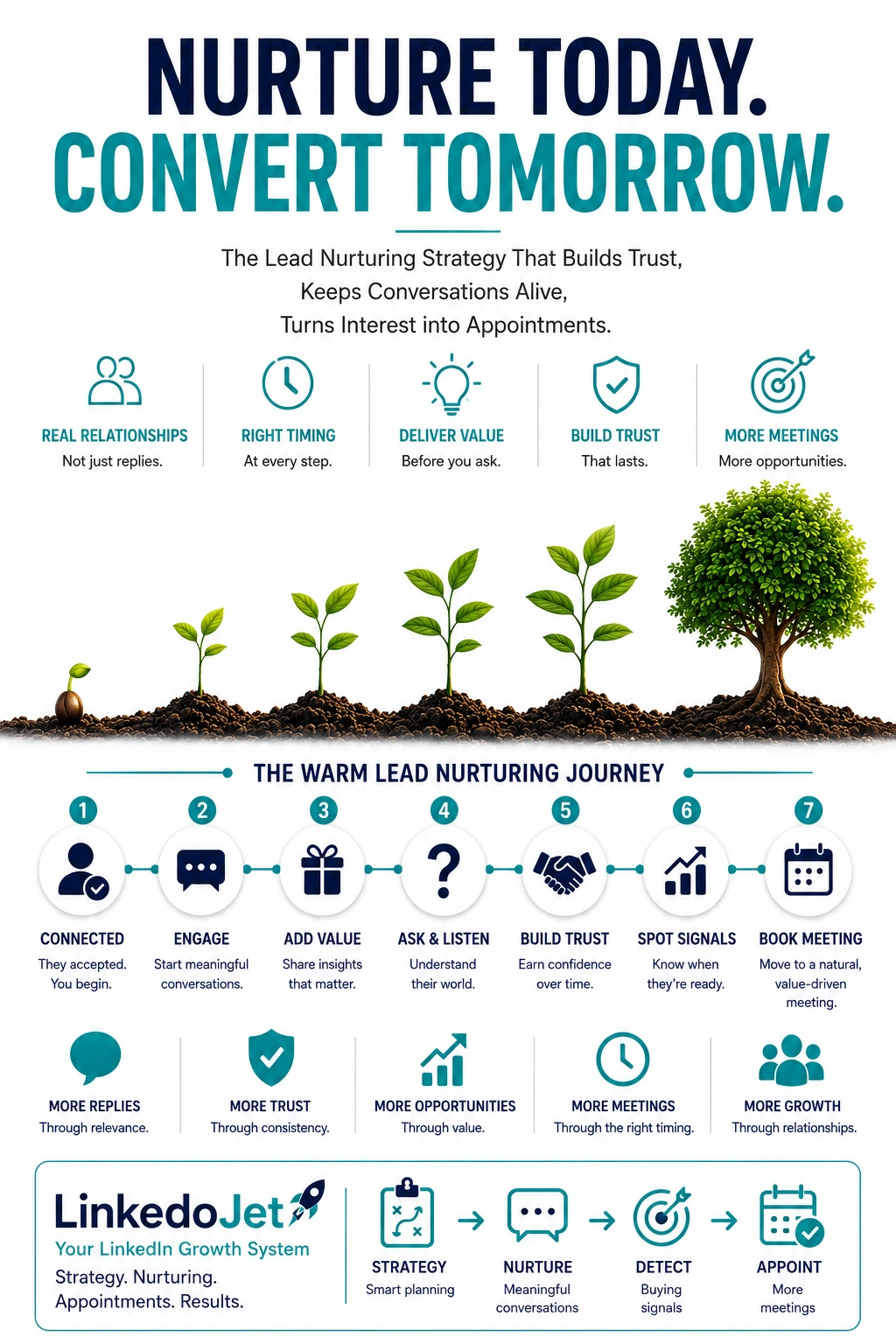
A week-by-week LinkedIn nurture progression that earns the next message (not “any thoughts?”)
Corporate gifting isn’t a three-day close. It’s a slow warm-up that suddenly turns into a sprint. Your nurture should reflect that.
Week 0 (right after the warm signal): set context without selling
- Reference their likely use case (onboarding kits, holiday gifts, event swag, customer appreciation).
- Offer a small resource: “timeline + lead-time reality check” or a one-page intake checklist.
- Ask one low-pressure question that helps you route the next message.
Week 1: reduce risk with a practical detail
- One operational insight: address collection, lead-time buffers, kitting vs single-item, size exchanges.
- Ask how they run gifting today (storefront, one-off sends, spreadsheet chaos, internal owner).
Week 2: narrow instead of expanding
- Introduce 2–3 common program shapes (e.g., “single premium item,” “bundle kit,” “storefront credit”).
- Offer budget tiers rather than a catalog dump.
- Ask for deadline + destinations (the two questions that prevent bad quotes).
Week 3: add light proof that signals competence
- Mini-story that’s about smooth execution: counts, countries, timeline, and “nothing went wrong.”
- Invite a short working session only if they’ve shown a real trigger (date, event, stakeholders, international).
Week 4+: season-aware check-ins (not guilt)
- Timing prompts: “When do you typically lock holiday gifting?” “Are you planning SKO or conference kits this quarter?”
- Close-loop when appropriate, with a clean re-entry point (late Aug / early Sept for holiday planning).
Message examples for the exact moments that stall gifting deals
These aren’t “scripts.” They’re the kinds of notes that get replies because they respect the buyer’s reality.
First warm follow-up after connection acceptance (resource, not catalog)
Message: “Thanks for connecting — quick question so I don’t send irrelevant stuff: is gifting on your side more employee (onboarding/holidays) or customer/event? If helpful, I can share a 1‑page ‘Q4 timeline + lead-time reality check’ we use so teams don’t get trapped by shipping cutoffs.”
After “sure” / “send info” (two clarifiers, then narrow)
Message: “Happy to. Two quick things so I don’t spam you with options: (1) do you have a deadline you’re working back from? (2) are these shipping to one country or multiple? If you tell me the rough band (e.g., $30–$60 vs $75–$150), I’ll send 2–3 clean directions instead of a catalog.”
Educational nurturing (prevents Q4 chaos)
Message: “One thing that saves a lot of pain in Q4: don’t wait on addresses. Even a simple ‘collect as you go’ form + cutoff date reduces 80% of the last-minute scramble. How do you collect addresses today — portal/storefront, spreadsheet, or manual?”
Insight-based follow-up (market reality that affects them)
Message: “Seeing more inventory volatility on blanks than people expect — you can approve an item in September and it’s backordered in November. The teams that stay sane have a ‘primary + backup’ per tier and lock production slots earlier than feels necessary. Do you typically lock gifting decisions by mid-Oct, or later?”
Case/proof nurturing (competence signal, not hype)
Message: “Quick snapshot from a recent program: ~420 recipients across US + Canada + UK, 3 budget tiers, one drop window, plus size exchanges. The win wasn’t ‘fancy merch’ — it was that nothing blew up: QC held, branding stayed consistent, and shipments landed inside the window. If you’re doing multi-country this season, I can share the simple intake we used.”
Soft question to reopen (timing-based, easy out)
Message: “Totally fine if this isn’t active yet. When do you normally lock holiday gifting decisions on your side — late Aug/Sept, or closer to October? If it’s later, I can circle back with a cutoff/timeline note at the right time.”
Buying-signal response (answer briefly, then suggest a short working session)
Message: “Yep — we can ship internationally. The thing that changes the plan is which countries + the delivery window (customs and carrier cutoffs matter). If you’re open, a 10–15 minute working session is enough to confirm countries, count range, and tier approach so I can give you a quote that won’t surprise you later.”
Soft meeting request (not a demo; produce something tangible)
Message: “Rather than a generic call, want to do a quick 15‑minute working session? Outcome is a 1‑page outline: count range, countries, 3 budget tiers, and a timeline/shipping plan your team can forward internally. If it doesn’t look workable, we’ll know fast.”
Dormant lead revival (seasonality + operational reality)
Message: “Heads up as we get closer to peak season: teams are starting to book production slots now, and shipping cutoffs are tighter than most calendars suggest. If you want, I can send a simple ‘holiday timeline + buffer’ checklist — useful even if you don’t run this with us.”
Final polite close-loop (opt-out + clean re-entry)
Message: “I’m going to close the loop on this thread so I don’t keep poking you. If gifting isn’t on your radar this quarter, no worries — want me to circle back in late Aug/early Sept when planning usually starts?”
Qualify without interrogating: the scoping dimensions that make approvals easier (and quotes accurate)
The fastest way to lose a warm gifting lead is to ask ten questions like a form.
The fastest way to win it is to ask the few questions that protect them from internal chaos, then earn the right to go deeper.
These are the scoping dimensions that actually matter in corporate gifting—and they map cleanly to HR/People Ops, Marketing, Sales/CS, and Procurement concerns:
- Recipient count range: “Are we closer to 50, 200, or 1,000?”
- Countries / regions: US only vs US+Canada vs EMEA/APAC.
- Deadline + drop window: “Must land by date” beats “ship by date.”
- Budget band: a range is enough to avoid irrelevant ideas.
- Item type preference: wearable vs tech vs food vs desk/home; kitted vs single-item.
- Brand constraints: logo rules, color matching sensitivity, approval path.
- Program type: one-off send vs ongoing (onboarding waves, anniversaries, spiffs).
- Portal/storefront needs: address capture, size selection, redemptions, approvals.
- Operations realities: sizing exchanges, returns, support ownership.
Notice what’s missing: “When can you meet?”
The meeting becomes the natural next step once they’ve revealed a real constraint (deadline, multiple countries, stakeholder approvals) and you can genuinely help them avoid a mess.
Keep it moving without friction: objections, buying signals, revival + close-loop, and how LinkedoJet runs the system
Warm lead nurturing breaks when your team improvises. One rep sends a catalog. Another asks for a call. Someone else disappears for two weeks, then comes back with “bumping this.” Buyers feel the wobble.
A season-aware system does three things consistently: it recognizes buying signals, answers without over-selling, and moves the conversation toward scope.
Common objections (and how to stay useful)
- “We already have a swag vendor.” “Makes sense. A lot of teams keep a vendor for basics and bring in a second option for international, kitting, or higher-stakes drops. What’s the part that gets messy for you today—lead times, brand approvals, or fulfillment?”
- “We’re not ready yet.” “Totally fair. When do you typically lock decisions—mid-Oct, or closer to November? I can send a cutoff/timeline note so you don’t get surprised.”
- “Send pricing.” “I can, but pricing swings based on count range + countries + branding method. If you give me those two, I’ll send tiers that are actually comparable.”
- “We need ideas.” “Got it. I’ll send 2–3 directions in tiers, but first—holiday vs onboarding vs event? The program shape changes everything.”
- “Procurement will get involved.” “Understood. We can keep this light until you’re ready. When procurement steps in, the questions are usually about risk, lead times, and international capability—happy to pre-empt those so it doesn’t slow you down later.”
- “We ship to multiple countries.” “We can support that. The key is mapping countries + delivery window early so customs and carrier cutoffs don’t wreck the plan.”
What LinkedoJet actually does (so your team isn’t winging it)
LinkedoJet is not a browser extension that spams your network. It’s an outbound operating system we run with you.
- ICP + targeting setup: we define the roles that actually initiate gifting (HR/People Ops, Marketing, Sales/CS, Events) and the roles that slow it down (Procurement), then build the right targeting rules.
- Sales Navigator / LinkedIn list building: we build and maintain prospect lists by segment (onboarding, holiday, events/SKO, customer programs), including geo/international filters when it matters.
- AI-assisted personalization: we personalize around the buyer’s likely “moment” and category realities (cutoffs, lead times, brand approvals), not generic compliments.
- Outreach execution: we run connection + message flows with season-aware pacing, so you stay present without sounding needy.
- Reply handling + nurturing: warm replies get triaged (Curious vs Collecting vs Time‑boxed), and the next message is designed to earn scope, not push a meeting.
- Warm lead tracking: conversation stage, last touch, buying signals, and the scoping fields you care about (count range, countries, timeline, budget band) are tracked so nothing gets “lost in DMs.”
- Appointment generation support: when the lead is ready, we help tee up a short working session framed around tangible outputs (tiers + timeline + shipping plan).
- Dashboards + refinement: you get visibility into what’s happening and we adjust messaging and segments as seasonality shifts.
The outcome isn’t “more activity.” It’s fewer dead threads, more scoped conversations, and intro calls that are already quote-ready.
Answers sales teams ask when they’re trying to keep warm gifting threads alive
What’s a realistic LinkedIn follow-up cadence for corporate gifting without sounding pushy?
Think in weeks, not days. After the first warm signal, touch in Week 0 and Week 1 with something genuinely useful (timeline, cutoffs, address collection). If there’s no response, Week 2 and Week 3 can be light proof + a narrowing question. After that, go season-aware: monthly or milestone-based (late Aug/Sept, early Oct, post-shipping cutoff reminders), not “bump” messages.
What should I send after someone says “send info” or asks for a catalog?
Don’t send a catalog first. Ask two clarifiers that prevent irrelevant info: deadline and destinations. Then send 2–3 program directions in budget tiers (with one operational note on lead times or fulfillment). The goal is to make replying easy and move them toward scope without forcing homework.
How do I nurture HR/People Ops vs Marketing vs Sales/CS vs Procurement on LinkedIn?
HR/People Ops responds to fairness, logistics, and avoiding chaos (address capture, sizing exchanges, smooth onboarding waves). Marketing cares about brand control and approval friction (consistent branding, proof you won’t cause a brand mess). Sales/CS wants speed around account moments and events. Procurement cares about risk, pricing structure, fulfillment reliability, and international predictability. Same product, different anxiety—nurture to the anxiety.
When should I ask for a call in corporate gifting—and how do I frame it without a “demo”?
Ask once they’ve shown a real constraint: deadline, multi-country shipping, a need for tiers, a portal question, or mention of procurement. Frame it as a short working session with a tangible output: a 1-page program outline, three budget tiers, and a timeline/shipping plan they can forward internally. Buyers don’t want a demo; they want fewer ways this can go wrong.
How do I handle “we already have a swag vendor” without burning the relationship?
Acknowledge it and reposition: you’re not trying to replace their basics vendor; you’re a back-pocket option for higher-stakes drops (international, kitting, time-boxed holiday sends, brand-sensitive programs). Ask what breaks today (lead times, fulfillment, brand, support). If they’re truly locked in, close-loop politely and set a seasonal re-entry point.
If you want this running without your team living in DMs, book a LinkedoJet demo session
We’ll show you how we turn warm LinkedIn interest into scoped intro calls for corporate gifting—without catalog dumps, awkward chasing, or last-minute Q4 panic.
In this session, we’ll walk through how LinkedoJet runs a season-aware nurturing system end to end: how we target the right gifting decision-makers, how we build and refresh Sales Navigator lists, and how we keep conversations warm until timing turns real.
What LinkedoJet operationally provides:
- ICP and targeting setup for HR/People Ops, Marketing, Sales/CS, Events, and Procurement influence—segmented by gifting moment (holiday, onboarding waves, SKO/conferences, customer programs).
- Prospect list building in Sales Navigator / LinkedIn, with filters that matter in gifting (geo coverage, headcount bands, growth signals, likely program triggers).
- AI-assisted personalization that reflects category realities (lead times, shipping cutoffs, brand approvals, international friction) so messages feel like a capable operator—not a template.
- Outreach execution with pacing that matches seasonality, not a daily “check-in.”
- Lead reply handling and nurturing so “send info” becomes scoping (deadline, destinations, count range, budget band) and the buyer gets fewer decisions at once.
- Warm lead tracking across conversation stage (Curious Browser vs Idea Collector vs Time‑boxed Buyer), last touch, buying signals, and key scoping fields.
- Appointment generation support that frames calls as short working sessions with tangible outputs (3 budget tiers + timeline + shipping plan), not a “demo.”
- Campaign visibility through dashboards so you can see volume, replies, warm leads, and booked conversations—without guesswork.
- Ongoing campaign refinement as the season shifts (cutoffs, inventory realities, international demand, stakeholder mix).
What happens after onboarding: we set up your targeting and lists, confirm your stage-based nurture paths, and launch campaigns that keep warm threads active for weeks—so when November urgency hits, you’re already in the conversation with scope and credibility.
Why LinkedoJet is different from ordinary LinkedIn automation tools: tools send messages. LinkedoJet runs the operating cadence—targeting, personalization, execution, reply handling, nurturing, tracking, and appointment support—so your team isn’t improvising in DMs or waking up to a thin Q4 pipeline.
Next step: turn warm LinkedIn interest into scoped gifting conversations your team can actually quote
If your calendar fills up with “send info” threads that die before scope shows up, you don’t need more follow-ups. You need a system that stays useful, season-aware, and operationally credible—until the buyer’s trigger lands.
From identifying the right decision-makers to starting meaningful conversations and turning them into qualified appointments... LinkedoJet manages the entire outbound engine for your business.