
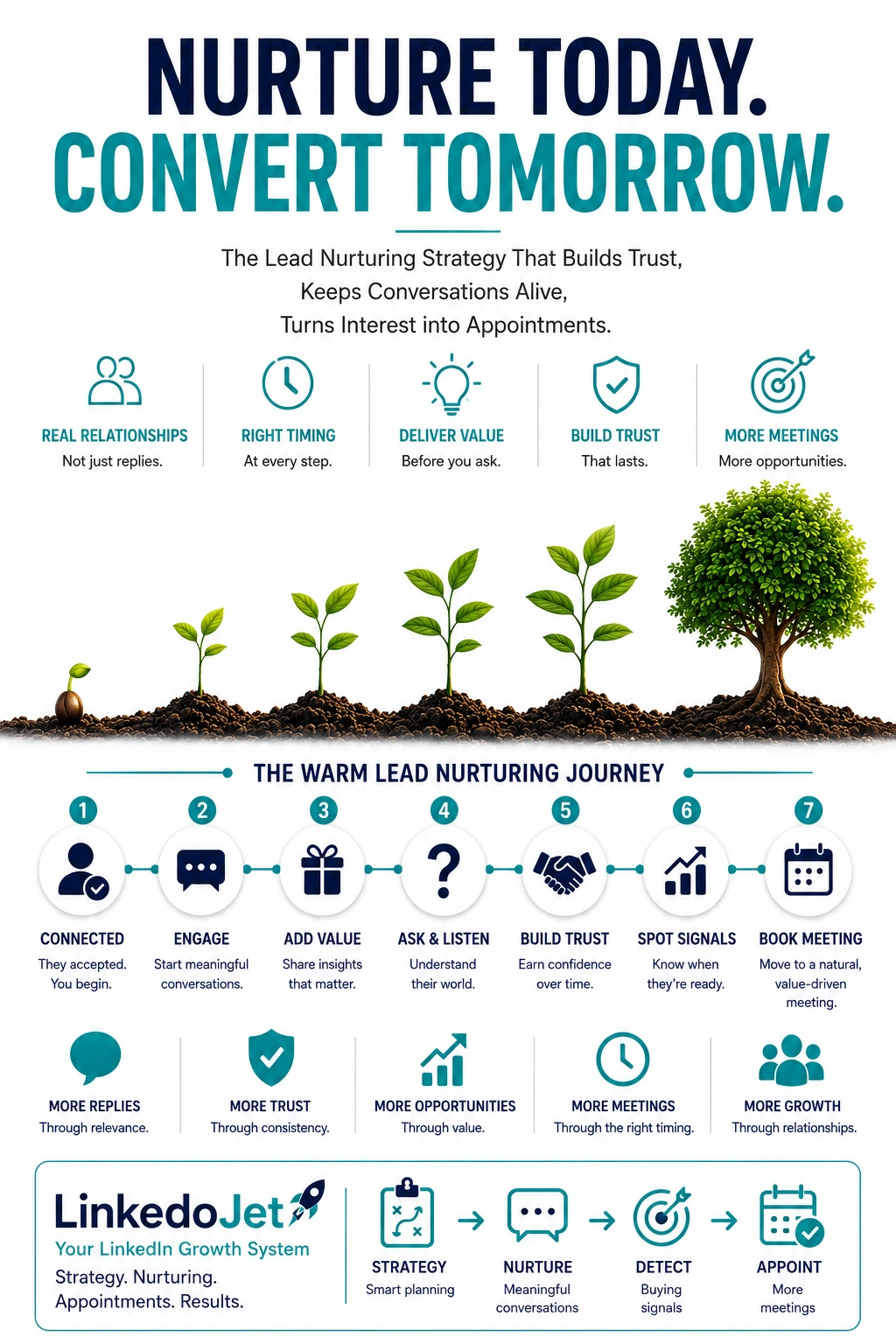
Why compliance threads stall on LinkedIn (and why forcing urgency backfires)
Most warm threads don’t die because you “followed up wrong.” They die because the buyer isn’t in a fire drill yet—and your next message makes it obvious you want them to be.
You see it all the time: connection accept, a like on a SOC 2 post, a quick “good point,” even “do you help with readiness?” Then silence.
And it’s maddening because you can tell they’re real. They’re not a random founder browsing content; they’re a compliance officer, risk manager, internal audit lead, legal ops, or a COO who’s been burned by a vendor questionnaire. They’re scanning for someone who speaks in evidence, scope, and ownership—not someone trying to manufacture urgency.
The commercial cost isn’t just the lost meeting. It’s that partners start re-sourcing leads instead of progressing the ones already showing intent. Pipeline becomes timing luck: you win when a trigger hits at the same moment your message lands. Everything else goes cold and resurfaces months later—often attached to someone else—because your follow-up didn’t stay credible during the quiet period.
Compliance buyers have vendor fatigue. They’re juggling audit calendars, security questionnaires, internal politics, and the reality that “we should do SOC 2” isn’t a single decision. It’s scope debates, control ownership fights, evidence chaos, and an uncomfortable moment when an auditor or enterprise customer pushes back.
When you push a full meeting too early, you create a risk for them: inviting a vendor into the mix before they’ve even aligned internally on driver, scope, or timing. Silence is the safest response.
Warm lead temperature in compliance terms: cool vs. warm vs. hot signals you can actually act on
If you treat every like and “thanks” as meeting intent, you’ll either chase (and lose credibility) or retreat (and lose momentum).
In compliance consulting, the right move depends on what triggered the engagement and who the stakeholder is. A COO liking a post about “audit season chaos” is not the same as a compliance lead asking about evidence workflows. Same platform. Different temperature.
| Temperature | What it looks like on LinkedIn | What it usually means in the real buying cycle | Best next step |
|---|---|---|---|
| Cool | Connection accepted; profile visit after your comment; likes on general SOC 2/ISO content | They’re sense-checking credibility. No internal urgency yet. | One short, relevant note + a narrow question tied to a trigger (customer request vs. upcoming audit). |
| Warm | Replies like “good point,” “we’re thinking about SOC 2,” “we’ve got questionnaires piling up,” asks “do you do readiness?” | They have pain, but scope/timing aren’t aligned. They’re testing whether you can speak their language. | Mirror their wording, clarify driver + timing, offer a small artifact or quick alignment (not a full pitch). |
| Hot | Mentions a deadline, customer pressure, auditor friction, “we need to get this done,” questions about scope, evidence, remediation sequencing | A trigger is active. They need help deciding what to do next and how to structure it. | Two concrete options: 15-min scope alignment or a short readiness snapshot with a clear output. |
The nuance: “SOC 2” can be a brand-new idea, a board request, a blocked deal, or an auditor already scheduled. Same words, different reality. Your follow-up has to earn the right to ask for time by showing you understand that difference.
A weeks-not-days nurture cadence that matches audit calendars and vendor fatigue
The goal isn’t to be “persistent.” It’s to stay relevant until timing becomes real—without sounding like you’re running a sequence.
Most compliance timelines don’t move smoothly. They spike. A customer sends a questionnaire. An internal audit report lands. Procurement blocks a renewal. Someone asks “are we actually doing what our policy says?”
So your follow-up cadence has to assume quiet periods and still feel professional.
- Day 0–2 (after the signal): Acknowledge context, add one concrete observation, ask one narrow question.
- Day 7–10: Send a practical mini-artifact in plain text (something they can forward internally). No meeting ask.
- Day 18–24: Insight + small proof (anonymized) + a low-effort “worth comparing notes?” question.
- Day 35–45: Timing-based re-open tied to audit season, quarter-end, renewal cycles, or a change event (new product, new enterprise customers, tool change, acquisition).
- Quarterly light-touch: Only for cool leads: one relevant note tied to common pre-audit failure points. Give an easy out.
What you’re really doing is building a memory: “this person talks in scope, evidence, and sequencing.” When the trigger hits, you’re the obvious thread to reply to.
Also: stop treating “no reply” as rejection. In regulated environments, non-response often means “not safe to engage right now.” Keep it respectful, keep it useful, and keep your messages skimmable.
Conversation moves that build trust: validation → specific insight → small proof → narrow consultative question
Your job is to reduce their uncertainty without increasing their workload.
Compliance stakeholders disengage when they feel they’re being pulled into a sales process before they’ve even framed the problem. So the conversation needs a shape.
- Validation: show you heard the context and you’re not forcing a meeting.
- Specific insight: a real failure mode (scope creep, control ownership gaps, evidence back-and-forth) stated plainly.
- Small proof: a grounded example or artifact, not a loud case study.
- Narrow consultative question: one question that reveals driver/timing without turning into an intake form.
Examples of narrow questions that don’t feel like interrogation:
- “Is this coming from a customer request / procurement review, or are you planning an audit window already?”
- “Are you thinking readiness work first, or do you already have an auditor picked?”
- “Where does it usually slow down for you: scope clarity, control ownership, or evidence collection?”
- “Is the pain mostly questionnaires blocking deals, or internal governance catching up with growth?”
Stakeholder angle matters:
- Compliance / GRC: maturity, defensibility, audit readiness, avoiding last-minute churn.
- Security: risk decisions, control design vs. operational reality, what’s defensible under scrutiny.
- Internal audit: evidence quality, repeatability, testing approach, ownership and exceptions.
- Legal ops: commitments, representations, vendor terms, how to avoid over-promising.
- COO/CFO: distraction cost, timeline risk, what gets done in the first 2–4 weeks.
Same offer, different entry point. If you don’t adapt, you’ll sound generic even when your work isn’t.
Example follow-ups you can send (without sounding like another vendor)
These are written the way a partner who’s actually been inside readiness work would message: calm, specific, and respectful of bandwidth.
First warm follow-up after connection acceptance
Message:
Thanks for connecting, [Name]. Noticed you sit close to GRC/internal audit—usually means you’re juggling both “program on paper” and “evidence in reality.”
One thing I keep seeing with SOC 2/ISO readiness is scoping decisions getting made too late, which turns evidence collection into a scramble.
Quick question: is compliance on your side being driven by a customer/procurement request, or do you have an audit window in mind already?
Follow-up after a prospect replies “we’re thinking about SOC 2”
Message:
That makes sense. When someone says “thinking about SOC 2,” it’s usually either (a) a customer ask that’s starting to block deals, or (b) an internal push to formalize the program before the next audit cycle.
Two quick clarifiers so I don’t assume wrong: are you aiming for readiness work first, or already leaning toward a formal audit this year? And is scope the part you feel good about, or still fuzzy?
Educational nurturing message (plain-text artifact)
Message:
Sharing a small thing we use internally—no pitch.
3 places SOC 2 timelines usually slip:
1) Scope gets widened via vendor questionnaires (“just add this system”)
2) Control owners aren’t named early, so evidence requests float
3) Remediation gets prioritized by noise, not audit impact
If any of those sound familiar, which one is the biggest drag where you are?
Insight-based follow-up
Message:
One pattern I’ve noticed: vendor security questionnaires often reveal hidden scope creep before the audit does. A single “where is data processed/stored?” question can pull in systems nobody planned to include.
When you look at your current requests, is the friction mostly scope (what’s in/out), or evidence (getting consistent artifacts out of the org)?
Case-study / proof-based nurturing message (anonymized, grounded)
Message:
Quick mini-story from a recent engagement (kept vague on purpose): a regulated SaaS team prepping for SOC 2 Type I had policies in place, but evidence was scattered and control ownership was unclear across Security + IT + Ops.
We spent the first two weeks tightening scope, naming owners, and setting a simple evidence workflow (what “good” looks like, where it lives, and who signs off). The audit stopped being a daily interruption and became a weekly cadence. Less back-and-forth, fewer surprises.
If you’re heading toward SOC 2, do you already have control owners named, or is that still informal?
Soft question to reopen the conversation (timing-based)
Message:
Checking in with context, not to “bump” this. We’re coming up on the stretch where a lot of teams realize their Q3/Q4 audit windows are tighter than expected.
If SOC 2/ISO is still on your radar, is it more of a “later this year” item, or tied to a specific customer/procurement deadline?
Buying-signal response (deadline / pressure / auditor friction)
Message:
Got it—that’s a real trigger. If there’s a deadline/customer asking, the fastest path is usually to confirm scope and evidence expectations before you commit to a big plan.
Two options that keep it lightweight:
1) 15-min scope alignment to confirm what’s in/out and the realistic timeline
2) A readiness snapshot where we review your current controls/evidence approach and you walk away with a short list of what to fix first (and what can wait)
Which one fits your bandwidth this week?
Soft meeting request (no pressure)
Message:
Based on what you said (customer pressure + timelines), I don’t think a generic “intro call” helps.
If you’re open to it, we can do a tight 20 minutes focused only on: scope boundaries, readiness vs. audit timing, and where evidence will bottleneck. You’ll leave with a clear next-step path either way.
Want me to send a couple times?
Dormant lead revival message
Message:
We spoke a while back about SOC 2 readiness. The thing I’m seeing right now is teams getting tripped up by control ownership during growth—controls exist, but nobody feels accountable for producing evidence consistently.
If it’s useful, I can share a short “owner + evidence” checklist we use to prevent last-minute churn. Worth a quick compare?
Final polite close-loop message
Message:
I’m going to pause my follow-ups so I’m not adding noise. If SOC 2/ISO or vendor questionnaires flare up again—customer request, audit window, internal audit findings—reply here and I’ll jump back in with something specific.
Either way, appreciate the connection.
What makes compliance buyers disengage (and how to avoid burning credibility with one message)
In this niche, the wrong follow-up doesn’t just lose a meeting. It lowers your perceived professionalism.
The quickest ways to get silently filtered:
- Asking for 30 minutes before confirming the driver. If they’re not sure whether it’s customer-driven or audit-driven, a meeting feels premature.
- Generic capability blurbs. “We help with compliance” reads like you don’t know whether they mean readiness, certification, or program clean-up.
- Ignoring audit calendars. “Any updates?” during quarter-close or pre-audit weeks is a good way to get muted.
- Talking in vague outcomes instead of evidence and scope. They want to hear how you prevent evidence ping-pong, scope creep, and owner confusion.
- Over-teaching with no qualification path. Thought leadership that never asks a narrow question keeps you in “nice content” land.
- Forgetting stakeholders. Compliance may agree in principle while Security worries about defensibility, Legal worries about commitments, and the COO worries about distraction.
If you get a negative signal, don’t “overcome objections.” Adjust the path.
- If they say “we picked a firm,” respond with a short, classy note and go quarterly at most.
- If they say “audit is cancelled / not this year,” tie your next touch to a realistic trigger (renewals, customer questionnaires, internal audit cycle).
- If they say “not my area,” ask who owns it and then stop; don’t keep them on a drip.
Restraint is not passivity. It’s respect for how regulated buyers protect their time and manage vendor exposure.
How LinkedoJet runs warm-lead nurturing as a system (segmentation, cadence, reply handling, meeting conversion)
This is where most firms fall down: they have warm signals, but no operational way to classify them, follow up cleanly, and turn them into scoped discovery calls.
LinkedoJet isn’t “LinkedIn automation.” It’s an outbound and appointment generation system built to keep professional conversations moving—especially in trust-heavy categories like compliance.
What we set up and manage:
- ICP and targeting setup: we define your ideal accounts and stakeholders (compliance, risk, internal audit, legal ops, security leadership, COO/CFO) and the triggers that matter (audit windows, customer pressure, questionnaires, board asks, internal audit findings).
- Sales Navigator / LinkedIn prospect list building: we build and maintain lists that match your real buying committee, not a single title.
- AI-assisted personalization: we generate first-touch and follow-up language that references the right context (stakeholder angle + trigger) while staying calm and credible—no template energy.
- LinkedIn outreach execution: we run connection + follow-up flows with timing that respects vendor fatigue.
- Lead reply handling and nurturing: when replies come in, we help classify intent (cool/warm/hot) and draft consultative responses that move toward scope clarity rather than a hard pitch.
- Warm lead tracking: every lead gets a temperature, trigger notes, and next action so threads don’t die in someone’s inbox.
- Appointment generation support: we turn buying signals into small-next-step asks (scope alignment, readiness snapshot) and track booked calls.
- Campaign visibility through dashboards: you can see what’s happening—what’s getting engagement, which stakeholders respond, where conversations stall.
- Ongoing campaign refinement: we adjust targeting, messaging, and cadence based on replies and real-world outcomes, not vanity metrics.
The point is repeatability. Partners shouldn’t have to “feel it out” every time. With the right segmentation and nurture motions, the quiet period stops being dead time and becomes a controlled holding pattern until timing is real.
FAQ
What’s a realistic LinkedIn follow-up cadence for compliance consulting without annoying compliance officers or internal audit leaders?
Think weeks, not days. A clean pattern is: a contextual follow-up within 48 hours of the signal, a useful artifact 7–10 days later, an insight/proof touch around week 3, then a timing-based re-open around week 6. After that, quarterly is plenty for cool leads.
If you’re following up more often than you have something new to say in audit-and-evidence terms, you’re creating noise.
How do you tell the difference between SOC 2/ISO 27001 curiosity and a meeting-ready buying signal on LinkedIn?
Curiosity sounds like: “we’re thinking about it,” “good point,” or general engagement with readiness content.
Meeting-ready signals usually include constraints: deadlines, customer/procurement pressure, auditor pushback, scope uncertainty, or evidence pain (“we’re drowning in requests,” “not sure what’s in scope,” “need timelines”). When you see constraints, offer a small scoping step with a clear output.
What consultative questions qualify readiness vs. certification work without sounding like an interrogation?
Ask one narrow question at a time, tied to how compliance work actually starts:
- “Is this driven by a specific customer/procurement request, or an audit window you’re planning?”
- “Are you aiming for readiness first, or do you already have an auditor selected?”
- “What’s the current bottleneck: scope, control ownership, or evidence collection?”
It’s the tone that matters: you’re trying not to assume, not trying to run an intake form in chat.
What should you send when a prospect goes quiet after saying “we’re thinking about SOC 2”?
Send something that reduces work for them: a small plain-text checklist or a short insight about common timeline slip points, then a low-effort question that invites a simple reply.
Example angle: “When teams go quiet here, it’s often because scope isn’t settled yet. Is scope still fuzzy, or is the blocker evidence/owner bandwidth?”
How do you tailor nurture messages for compliance vs. security vs. legal ops vs. COO/CFO stakeholders?
Keep the same structure (validation → insight → proof → narrow question) but change the lens:
- Compliance/GRC: maturity, audit readiness cadence, evidence workflow.
- Security: defensibility, control design vs. operational reality, risk decisions.
- Legal ops: commitments, representations, keeping questionnaires from turning into over-promising.
- COO/CFO: timeline risk, distraction cost, what happens in the first 2–4 weeks.
When the stakeholder feels “this was written for my world,” response rates change.
Book a working session: turn your warm LinkedIn interest into scoped discovery calls
If you already have early signals (accepts, likes, profile visits, polite replies), we’ll show you how to keep threads alive in compliance language—and convert real triggers into meetings without chasing.
This isn’t a generic “discovery chat.” It’s a working session focused on the warm pipeline you already have—and the exact points where conversations stall.
On the session, we’ll cover:
- Your ICP and stakeholder map (compliance, risk, internal audit, legal ops, security, COO/CFO) and which roles are actually responding on LinkedIn.
- The trigger model that matters in compliance consulting (customer due diligence, audit windows, questionnaires, board asks, internal audit findings) and how to tag leads by temperature.
- A weeks-not-days cadence that matches audit calendars and reduces vendor-fatigue risk.
- How to move from “interesting” to “meeting-ready” using scope/evidence language: readiness vs. certification, scope boundaries, evidence workflow, control ownership, remediation sequencing.
What you’ll receive if we’re a fit and you onboard:
- ICP and targeting setup tailored to regulated buyers and buying committees.
- Sales Navigator + LinkedIn prospect list building so you’re not hunting titles one-by-one.
- AI-assisted personalization that stays grounded in audit-and-evidence language (and adapts to stakeholder angle), rather than blasting templates.
- Outreach execution across connection + follow-up flows, with cadence aligned to how compliance urgency shows up.
- Reply handling + lead nurturing so warm replies don’t die in a partner inbox; we help draft consultative responses and guide next steps.
- Warm lead tracking with temperature, trigger notes, and next actions—so the quiet period stays controlled.
- Appointment generation support to convert buying signals into small scoped calls (15-minute alignment, readiness snapshot) and track booked meetings.
- Campaign visibility through dashboards so you can see what’s working and where threads stall.
- Ongoing campaign refinement based on real replies and outcomes, not vanity engagement.
Why this is different from ordinary LinkedIn automation tools: tools send messages. They don’t tell you which stakeholder is showing intent, what trigger is likely behind it, how to speak in scope/evidence terms, or how to progress a warm thread into a scoped call without burning credibility. We run the system—targeting, messaging, execution, nurturing, tracking, and iteration—so your team spends time on real conversations, not chasing ghosts.
Next step: make warm interest predictable
If you’re tired of watching good-fit compliance buyers go quiet, the fix isn’t more follow-ups. It’s a warmer, more precise system that respects timing and builds credibility in every message.
From identifying the right decision-makers to starting meaningful conversations and turning them into qualified appointments... LinkedoJet manages the entire outbound engine for your business.