
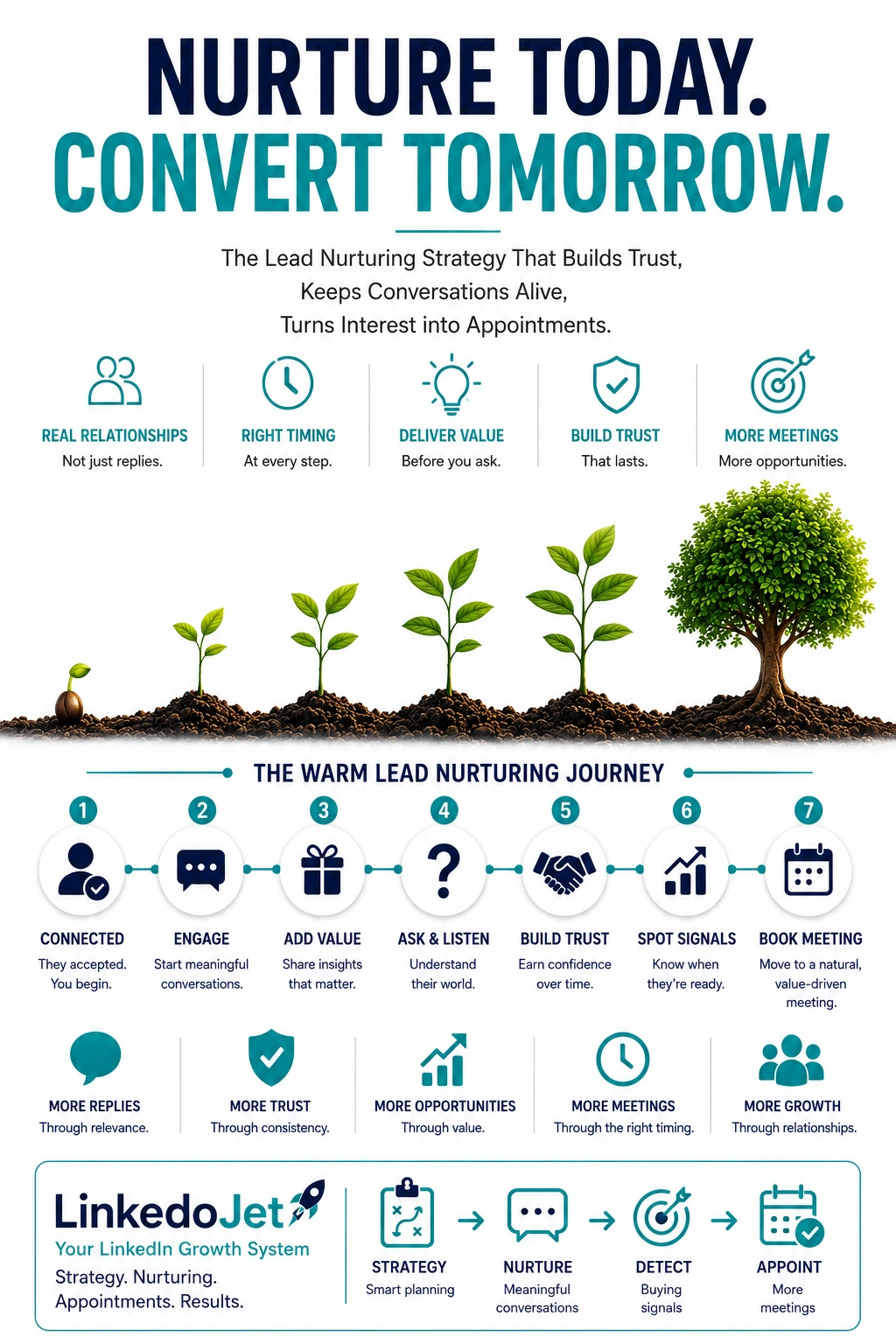
Warm CRE leads don’t go quiet. They go back to their day.
In commercial real estate, most people don’t wake up wanting a broker meeting. They wake up to a lease rollover they haven’t staffed, a lender email they don’t want to forward, an occupancy issue that’s spreading, a partner pushing for liquidity, or a tenant asking for something that changes the whole story.
So when someone accepts your connection request, likes a post, replies once, then disappears, it’s rarely a rejection. It’s timing. It’s workload. It’s the fact that their “interest” is usually latent intent—they’re collecting context until a trigger forces action.
The painful part isn’t the silence. It’s the not knowing.
Was that owner just being polite? Did we push too hard? Are they covered by another team? Or are they quietly moving toward a decision and we’re drifting out of relevance?
And CRE has a long memory. If your follow-up feels like a mass broker blast, you don’t just lose this thread—you teach the market to filter you out.
What the silence is actually telling you (and how teams misread it)
Most CRE teams treat a warm LinkedIn response like an inbound lead that should convert quickly. That mindset creates two bad outcomes:
- Too aggressive: “Want to hop on a quick call?” arrives before you’ve earned it. The prospect feels worked. Thread dies.
- Too passive: You send a generic “market update” and disappear for 60 days. The moment arrives, someone else is already in the room.
Decision cycles aren’t linear right now. Lease events collide with headcount uncertainty and longer build-out lead times. Refinancing and debt terms dictate sale timing. Investors underwrite harder and move only when pricing and capital markets line up.
Your follow-up has to match that reality. Not more messages. Better pacing, tied to plausible triggers.
Here’s the cost when you don’t: you end up doing reactive business development. Chasing. Cold calling. Scrambling when a real trigger finally hits—only to learn the prospect already has a shortlist.
Lead temperature in CRE terms: Light Warm → Warm → Hot
Temperature isn’t a vibe. It’s a decision-readiness proxy. You’re watching for signals that the person is moving from “tracking the market” to “I have a problem with a clock attached.”
| Temperature | What it looks like in LinkedIn | CRE meaning | What you do next |
|---|---|---|---|
| Light Warm | Accepted connection, liked/commented, profile view, short “thanks” | They’re open to awareness, not a process | One local, specific touch + one low-friction question. Then pause. |
| Warm | Real reply, asks a question, mentions submarket/property type, reacts to a post about a nearby deal | They’re forming an opinion or updating assumptions | Clarify one detail that matters (timing, asset, thesis) and give a useful micro-insight. |
| Hot | Shares an address, mentions lease dates/option window, debt maturity, “we’re evaluating options,” comp request | A trigger is active or imminent | Move to a tight next step: comp set, concession read, scenario compare, or 15-minute sanity check. |
When you’re wrong on temperature, you pay for it. Ask for a meeting at Light Warm and you feel pushy. Stay “educational” at Hot and you look asleep.
Simple rule: speed up when the clock shows up (lease, debt, partner pressure, pricing clarity). Slow down when it’s just curiosity.
Three relationship tracks you run in parallel (owner / occupier / investor)
The same message doesn’t work across roles because the pressure points are different. A principal owner cares about timing, NOI story, lender pressure, and optionality. A corporate real estate manager cares about deadlines, approvals, and risk. An acquisitions lead cares about assumptions, debt, and pipeline quality.
- Owner / listing track: disposition planning, refinance vs sell, lease rollover exposure, NOI narrative, buyer pool reality.
- Occupier / tenant track: lease event timing, option/ROFR language, space planning, headcount uncertainty, build-out lead times, sublease risk.
- Investor / acquisitions track: return hurdles, debt constraints, basis expectations vs cleared trades, sourcing, hold vs sell debate.
Even within a track, the tone changes by persona:
- Owner/principal: concise, judgment-heavy, respects privacy.
- Asset manager: numbers and operational constraints; less “relationship,” more “decision support.”
- CFO/finance: debt terms, covenants, timing, downside cases.
- Property manager: tenant issues, retention risk, concessions reality.
When your team runs one blended nurture sequence, it feels generic. When you run tracks, it feels like you actually understand why they’d ever respond.
A follow-up cadence that matches CRE timing (first 7 days, weeks 2–4, days 30–90)
Your goal isn’t constant contact. It’s staying credible until a trigger turns “interesting” into “we need to decide.”
First 7 days: earn permission without pitching
- Day 0–1: quick thanks + one sentence that proves you’re local (submarket, asset type, a real observation) + one question that invites context.
- Day 3–5: one useful touch tied to a plausible trigger (lease rollover pressure, concessions shift, debt sentiment). No attachments.
- Day 7: a clean check-in that narrows scope: “Worth tracking X, or is your focus elsewhere this quarter?”
Weeks 2–4: trade small insights for better information
- Send 1 message per week only if you have a reason: a nearby tenant move, a pocket of availability, a notable cleared trade, a lender stance shift.
- Ask one clarifying question each time (timing window, decision owner, submarket, asset constraints). That’s how temperature rises.
- For tenant-side: acknowledge build-out lead times. If they have 12–18 months left, they still feel “early” even when the calendar says otherwise.
30–90 days: stay present without becoming “that broker”
- Touch every 3–6 weeks with a market-timed reason that relates to their world, not yours.
- Offer a micro-deliverable: a quick comp set, a concession read, a one-page snapshot, a tour strategy, a scenario compare.
- If there’s no engagement after 2–3 relevant touches, close-loop politely and park them. Reputation beats persistence.
10 message drafts CRE teams can send today (local, specific, low-friction)
Use these as patterns. Keep them short. Swap in your submarket, asset type, and the real signal you saw (post they engaged with, deal they commented on, profile view after a thread).
1) First warm follow-up after connection acceptance (owner-focused)
Draft: “Appreciate the connect, [Name]. I’ve been watching how [submarket] is trading—especially around [asset type] where concessions have quietly shifted the last few months. Are you mostly focused this quarter on lease rollover exposure, refinance timing, or just keeping optionality?”
2) Follow-up after a prospect replies (tenant/occupier-focused)
Draft: “That’s helpful. When you say ‘later this year,’ are we talking a real move window or more of a ‘keep an eye on it’ situation? In [submarket] I’m seeing build-out lead times become the hidden constraint—especially for teams trying to avoid a rushed decision. Want me to share the two pockets where availability is actually workable right now?”
3) Educational nurturing (investor/acquisitions-focused)
Draft: “Quick observation from what we’re seeing: a lot of deals are being priced off last year’s narratives, but the ones clearing have tighter debt assumptions and more conservative exit cap thinking. Are you leaning toward waiting for more clarity, or actively building a pipeline for when basis gets realistic?”
4) Insight-based follow-up (landlord/listing-focused)
Draft: “Saw a nearby [tenant move / renewal] in [submarket] that’s changing tour behavior for [asset type]. It’s small, but it’s showing up in where tenants are actually willing to look. If it’s useful, I can send a one-page snapshot of what that’s doing to rent vs concessions.”
5) Proof-based nurturing (without bragging)
Draft: “One situation we ran into recently (similar property type, different asset): tour volume was fine but conversions weren’t. Two small shifts—positioning and how we handled the ‘renew vs relocate’ narrative—changed the outcome fast. Want the 2–3 things that made the difference? No deck, just the bullets.”
6) Soft question to reopen when they’ve gone quiet
Draft: “Quick check—are you closer to a decision on the renewal vs relocation question, or is it still ‘watching the market’ for now?”
Alt (owner/debt): “Did the debt conversation get pushed, or is it still on the table for this year?”
7) Buying-signal response (address / timing / comp request)
Draft: “Got it. If you’re looking at [address/submarket] and timing is within [window], the fastest way to de-risk this is a tight comp/concession read (not a long report). I can send a short set today. What matters more for you: pricing reality, velocity, or who the most likely buyers/tenants actually are?”
8) Soft meeting request (owner appointment framing)
Draft: “Rather than a generic call, would it be useful to do a quick scenario compare: hold vs sell given where debt and buyer pools are, or renew vs re-tenant given current concessions? If yes, I can do 15 minutes and come in with a point of view.”
9) Dormant lead revival (30–90 days later)
Draft: “Circling back because a trade in [submarket] just cleared at a number that’s shifting expectations for [asset type]. It changes the ‘wait vs act’ math for a few owners/investors. Are you thinking about a move in the next 2 quarters, or still keeping it on the shelf?”
10) Final polite close-loop (preserve reputation)
Draft: “I’ll stop tapping you on the shoulder for now. If it becomes helpful to sanity-check rents/concessions or talk through timing around your lease/debt calendar, I’m happy to be a resource. Want me to check back later in the year, or just leave it open-ended?”
FAQs
What’s a good LinkedIn follow-up cadence for CRE brokers after someone accepts a connection?
Start with one thoughtful follow-up within 24 hours, then one more useful touch in days 3–5. After that, weekly is fine only if you have a real reason tied to their submarket or a plausible trigger. For most warm CRE relationships, a 3–6 week rhythm (with market-timed reasons) keeps you present without feeling like a sequence.
How do I follow up with a property owner on LinkedIn without sounding like I’m fishing for a listing?
Don’t ask “are you selling?” and don’t lead with a meeting. Lead with a grounded observation (a nearby tenant move, concessions shift, buyer pool change) and ask a question about what they’re watching this quarter: lease rollover exposure, refinance timing, or optionality. The owner should feel you understand the pressure points, not that you’re trying to trigger a pitch.
What should I send instead of a generic “market update” when I’m nurturing warm CRE leads?
Send one micro-insight that helps them make a better decision: a short comp read, a concession trend in their pocket, a single cleared trade that resets expectations, or a note on lender posture affecting your asset class. Keep it to a few sentences and offer an optional one-page snapshot—only if they want it.
How do I revive a dead LinkedIn conversation with a landlord or investor after 30–90 days?
Come back with a specific, time-linked reason: a notable trade, a rent/concession shift, a new pocket of availability, or a change in debt terms affecting buyers. Then ask one question that maps to likely triggers (“timing this year or next?” “still tracking refinance vs disposition?”). Avoid “just checking in.”
What are the strongest buying signals in LinkedIn DMs for tenant rep, listing, or investment sales conversations?
Watch for clocks and specifics: lease expiry/option windows, debt maturity, an address, a comp request, “we’re evaluating options,” “who else should be involved,” or a shift from general talk to constraints (timing, geography, cap stack, approval process). Those are moments to narrow scope and offer a tight next step (comp set, concession read, scenario compare) rather than more nurturing.
If your team has conversations but not appointments, we’ll build the follow-up engine and run it with you.
This isn’t a “send more DMs” tool. LinkedoJet is the operating system for targeting, outreach, warm-lead nurturing, and appointment generation support—built to match CRE timing.
On a demo, we’ll show you exactly how LinkedoJet keeps CRE relationships warm without torching trust—by temperature and by role (owner, occupier, investor).
What LinkedoJet operationally provides:
- ICP + targeting setup: you get a clear decision-maker map by asset type, submarket, and role (principal/owner, asset manager, CFO, acquisitions, corporate real estate).
- Sales Navigator + LinkedIn list building: we build and maintain prospect lists that reflect how CRE buying actually happens (entities, titles, local operators, and the people behind the decision).
- AI-assisted personalization: messages are personalized around real signals—submarket notes, plausible triggers, and role-specific pressure points—so it reads like a broker, not a template.
- Outreach execution: connection + initial messaging is run consistently, with pacing that avoids broker-blast patterns.
- Reply handling + lead nurturing: warm replies don’t sit in an inbox. We help route, tag, and respond with the right next touch, keeping threads alive until timing turns.
- Warm lead tracking: Light Warm / Warm / Hot status is tracked so your team knows when to slow down, when to press for clarity, and when to move to a working session.
- Appointment generation support: when a prospect shows a real trigger (lease, debt, address, comps), we guide the next step into a qualified meeting—positioned as decision support, not a pitch.
- Dashboards + visibility: you can see outreach volume, replies, warm lead counts, and which tracks are producing real conversations.
- Ongoing refinement: we adjust targeting, messaging, and follow-up cadence based on what the market is responding to.
What happens after onboarding: we stand up your targeting, build lists, ship message drafts in your voice, launch outreach, and run the nurture workflows daily. Your team isn’t guessing who to follow up with or what to say—they’re working a system.
Why this is different from ordinary LinkedIn automation tools: automation sends. LinkedoJet manages the full outbound motion—targeting, personalization, execution, reply handling, nurturing, tracking, and appointment support—so the outcome is calendar time, not “activity.”
From identifying the right decision-makers to starting meaningful conversations and turning them into qualified appointments... LinkedoJet manages the entire outbound engine for your business.
Next step: put warm follow-up on rails (without sounding scripted)
If you want your brokers spending time on real conversations—not chasing silence—this is the move. We’ll install the targeting and nurturing system, run the outreach, handle replies with discipline, and track warm leads until triggers turn into qualified appointments.