
Why warm cloud migration threads die (and it’s not your message volume)
When a CIO or Head of Infrastructure goes quiet after a decent first exchange, most teams assume they “lost interest.” That story is comforting. It also keeps you stuck.
Cloud migration buyers don’t disappear because your follow-up was one message too few. They disappear because the risk is personal: downtime attached to their name, a cutover window that slips into a black-out period, a security exception that becomes an audit finding, cloud spend that gets escalated above their pay grade.
So when your follow-up feels even slightly templated—“happy to jump on a quick call,” “we do migrations end-to-end,” or a deck link with no context—you don’t get categorized as “helpful.” You get categorized as “vendor pressure.” And once that happens, silence becomes the safest move for them.
Meanwhile your pipeline looks active: connections accepted, a couple replies, profile views after your VMware exit post. But the warm threads leak. Your team compensates by hunting for new leads instead of progressing the ones already leaning in.
The real dynamic is slower and messier: quarter budgeting, procurement gates, security reviews, app owner politics, and “we can’t touch identity/networking right now.” Your follow-up has to match that reality—calm, specific, and staged—so you stay in the deal while they navigate internal constraints.
Warm signals in cloud migration aren’t one state. They’re different buying jobs.
Most teams treat warm engagement as a single bucket: “interested.” Then they run one follow-up sequence. In cloud work, that’s how you get mis-timed fast.
A like from a cloud platform engineer is not the same as a reply from a CIO. A profile visit after a cloud cost post isn’t the same as a comment on landing zone standards. Each signal points to a different job the buyer is trying to do—and a different fear they’re trying to avoid.
| Warm signal you see | What it often means | Best next move |
|---|---|---|
| Connection accepted after your VMware exit / data center exit post | They’re tracking options; timing may be unclear; they’re avoiding early commitments | Ask one context question: planning vs execution, and what’s driving it (EoL, lease, audit, cost) |
| Short reply: “We’re early” / “Maybe next quarter” | They don’t want vendor pressure; they do want a safe path to clarity | Offer a small artifact (1-page readiness checklist) + one constraint question (security/procurement/app complexity) |
| Profile visit after cloud spend / FinOps post | Cost scrutiny is rising; they’re collecting narratives for internal conversations | Send a practical observation about where spend surprises happen (egress, idle, licensing) and ask if it’s board-level yet |
| Like/comment from platform engineer / architect | Influencer is validating approaches; may be wary of “slideware” | Share a technical, plain-language nugget (identity/networking early) and invite a quick “does this match your setup?” |
| Question like “AWS vs Azure?” or “How long does an assessment take?” | They’re translating curiosity into planning; early buying intent | Answer directly, then ask what’s fixed vs flexible (timeline driver, app count, compliance gates) |
The point: you don’t “follow up.” You pick the next move based on what the signal says about their stage and risk posture.
How trust is built in migration conversations: reduce uncertainty, don’t raise pressure
Migration buyers are professional risk managers pretending to be “just busy.”
They’re scanning for whether you understand sequencing and blast radius—without you making them teach you their environment in a 45-minute sales call.
What actually reduces uncertainty tends to map to a few recurring decision lanes:
- Scope reality: what’s in/out, what counts as “done,” what stays on-prem, what’s truly legacy.
- Sequencing: landing zone and governance before app waves, not as an afterthought. Dependency mapping before dates get promised.
- Foundations: identity, networking, DNS, logging, key management. These are where “simple” projects get expensive.
- Security/compliance gates: who signs off, what evidence they need, what exceptions are politically impossible.
- Cutover risk: black-out windows, DR posture, rollback plans, and the difference between “we migrated” and “we can operate it.”
Your follow-up should keep threading back to these lanes in small, low-friction ways: one question, one useful artifact, one short proof point.
A daily follow-up system that works in long IT buying cycles
You’re not trying to “win the week.” You’re trying to stay the most credible option in their inbox until internal timing opens up.
Here’s a simple stage-based cadence that doesn’t rely on chasing.
| Stage | What you send | What you’re looking for | Decision checkpoint |
|---|---|---|---|
| Day 0–2: post-connection | One-line context + one small question | Planning vs execution, and what’s driving it | If they answer with a driver, you can start narrowing |
| Week 1: early nurture | Short artifact + one constraint question | Security/procurement gates, app complexity, timeline pressure | If they mention gates/stakeholders, shift toward scoping |
| Week 2–3: credibility drip | Practical observation + tiny proof (no deck) | Do they react to sequencing/governance/cutover topics? | If they ask “how would you approach…”, they’re warming |
| Week 4+: re-engage loops | Two-option prompt + timing check | Parked vs active; who owns the next step internally | If timing is “next quarter,” set a reasoned follow-up date |
| Buying signals | Structured call ask framed as risk reduction | They share specifics: app list, timelines, tooling, target state | Book a 20–30 min scoping call with tangible outputs |
The rotation matters. If every touch is “any updates?” you train them to avoid you. If each touch adds clarity—without demanding a meeting—you become the safe pair of hands.
Message examples: consultative micro-conversations that feel native to cloud work
1) After connection acceptance (light, specific, non-salesy)
“Thanks for connecting, <
2) After they reply “we’re early / next quarter” (build on their words + small artifact)
“That makes sense. Early is usually where the most expensive mistakes get baked in—especially around identity/networking and the first landing zone decisions. If it’s useful, I can send a 1-page readiness checklist we use to surface the usual risk flags. One question so I don’t guess: what tends to be the hard gate for you—security sign-off, app owner alignment, or procurement timing?”
3) Educational nurture (teach without lecturing)
“Small pattern we keep seeing: timelines slip when landing zone governance gets decided after the first app wave starts. Then teams redo networking, logging, policies, and exception handling under pressure. Are you already aligned internally on landing zone standards, or is that still an open debate?”
4) Insight-based follow-up (timely, relevant)
“Quick one—cloud spend scrutiny seems to be moving from ‘engineering problem’ to ‘finance conversation’ at a lot of mid-market shops. Is cost becoming a board-level topic for you, or still mostly within the infra team?”
5) Proof without a deck dump (short story, specific risk)
“We worked with a team that looked ‘ready’ on paper, but identity sprawl and mixed network patterns were the real constraint. We paused app waves, set a minimal landing zone baseline (IAM patterns, network segmentation, logging/alerting), then ran phased waves with a cutover checklist and rollback assumptions written down. The big change wasn’t speed—it was fewer security exceptions and fewer surprises during cutovers. Want the outline of that baseline checklist?”
6) Re-open after silence (assume good intent, easy answer)
“Quick check, <
7) Buying-signal response (they ask about assessment/timeline/cost/stakeholders)
“Yes—we typically start with a short scoping pass so you’re not committing blind. If you’re open to it, we can do a 25-minute scoping call focused on: scope boundaries, top 5 risks (identity/networking/cutover/security), a draft wave approach, and the governance gates you’ll need to clear. Afterward you’ll have a written summary with risk flags and recommended next steps you can share internally. Who else needs to be in the room—security, platform owner, or someone from procurement?”
8) Soft meeting request (sanity-check / options review)
“If it helps, we can do a 20–30 minute sanity-check on your current plan—no deck. We’ll pressure-test sequencing (landing zone vs waves), call out the likely rework points (identity/networking/logging), and you’ll get a short follow-up note with risk flags + a recommended next step. Want to do that this week or next?”
9) Dormant lead revival (weeks/months later, tied to real triggers)
“Circling back because VMware licensing/EoL conversations are heating up again. If that’s touching your roadmap, I can share a cutover planning checklist plus the questions security usually asks before they’ll sign off. Is any of that relevant right now, or is the timing still later in the year?”
10) Final close-loop (protect reputation)
“I’m going to stop popping up in your inbox after this. Last we touched on assessment timing + landing zone readiness. If you reply with ‘not this year’ or ‘circle back in Q4,’ I’ll follow your timing. If it becomes urgent sooner, just message me ‘restart’ and I’ll pick it up.”
The mistakes that make warm migration leads go silent (and the safer alternatives)
- Asking for a meeting before you’ve named the gates. Safer: ask one question that surfaces the real blocker (security sign-off, procurement, app owners, CCoE).
- Generic “we do cloud migrations end-to-end.” Safer: pick one lane that shows competence (cutover planning, landing zone baseline, identity/networking constraints) and speak plainly.
- Acronym soup that doesn’t map to their environment. Safer: mirror their language first (“hybrid sprawl,” “shared services,” “black-out windows”), then introduce specifics only where it matters.
- Deck dumping as proof. Safer: one short story with the risk, the sequence, and the outcome—and offer the outline/checklist instead of a slide stack.
- Ignoring quarter reality. Safer: treat “not this quarter” as a timing statement, not a rejection. Set a follow-up date with a reason (“after budget unlock,” “post security review”).
- Never acknowledging delivery risk. Safer: name the fear directly—downtime, audit findings, cost overruns, missed cutover windows—then show how you reduce it with sequencing and guardrails.
- Following up with “any updates?” Safer: follow up with a decision-useful prompt—one question, one artifact, one proof point.
When you switch from “persistence” to “relevance over time,” the dynamic changes. You’re no longer chasing. You’re staying useful until the moment they’re ready to move.
FAQ
What counts as a “warm” LinkedIn lead for cloud migration—and how should the follow-up differ by signal?
Warm is any signal that indicates attention plus some degree of intent: connection acceptance after a relevant post (VMware exit, landing zone), a reply (even short), a profile visit after a cost/governance post, a like/comment from a platform engineer, or a direct question about assessments/timelines. The follow-up should match the signal: light context questions for early signals, artifacts + constraint questions for “early/next quarter,” and structured scoping when they share specifics (apps, stakeholders, gates, timelines).
How do you follow up after a CIO/Head of Infrastructure says “not this quarter” without sounding needy?
Accept the timing, then make the next touch about reducing future risk. Offer one small asset they can use internally (readiness checklist, gate map, cutover questions) and ask one clarifying question about what actually blocks movement (security review, procurement window, app owner alignment). Then set a specific re-contact point tied to their calendar reality: “I’ll check in first week of Q4 after budgets reset—fair?”
What should a cloud migration scoping call agenda include to feel like risk reduction (not a sales meeting)?
Keep it tight and output-driven: confirm scope boundaries, identify the top risks (identity/networking, security gates, cutover constraints, data transfer), outline a draft wave approach, and map the stakeholders and approvals needed. The call should end with a short written summary: risk flags, sequencing recommendation, and a suggested next step (assessment, landing zone baseline, or deeper workshop).
How often should you message warm LinkedIn leads in long IT buying cycles without getting muted?
Early: one follow-up within a couple days if they accept/connect. Then 1 touch per week for 2–3 weeks, rotating between a question, a small artifact, and a proof nugget. If they go quiet, slow down—every 3–4 weeks—with a re-engagement prompt tied to real triggers (budget windows, EoL dates, audits). Consistency beats intensity; relevance beats frequency.
What lightweight artifacts actually help move a migration conversation forward (readiness checklist, landing zone scorecard, risk flags)?
Artifacts that help them think and align internally: a 1-page migration readiness checklist, landing zone readiness scorecard (identity/networking/logging/policy/guardrails), a “top 10 risk flags” sheet for cutovers, and a simple gate map (security/procurement/app owners) that shows what tends to delay timelines. Avoid long decks early; send something they can forward without embarrassment.
If you want warm threads to turn into scoping calls, we can run the nurturing engine with you
LinkedoJet isn’t a “send more LinkedIn messages” tool. It’s an outbound operating system that builds targeted lists, runs stage-based follow-up, handles replies, and tracks warm intent until the right moment to book a scoping call.
Onboarding is practical: we set your ICP and targeting rules (titles, functions, cloud platform owners, infra leadership, company size, triggers like data center exit or VMware pressure). Then we build Sales Navigator prospect lists you can actually sell to—no bloated scraping, no random “IT” titles.
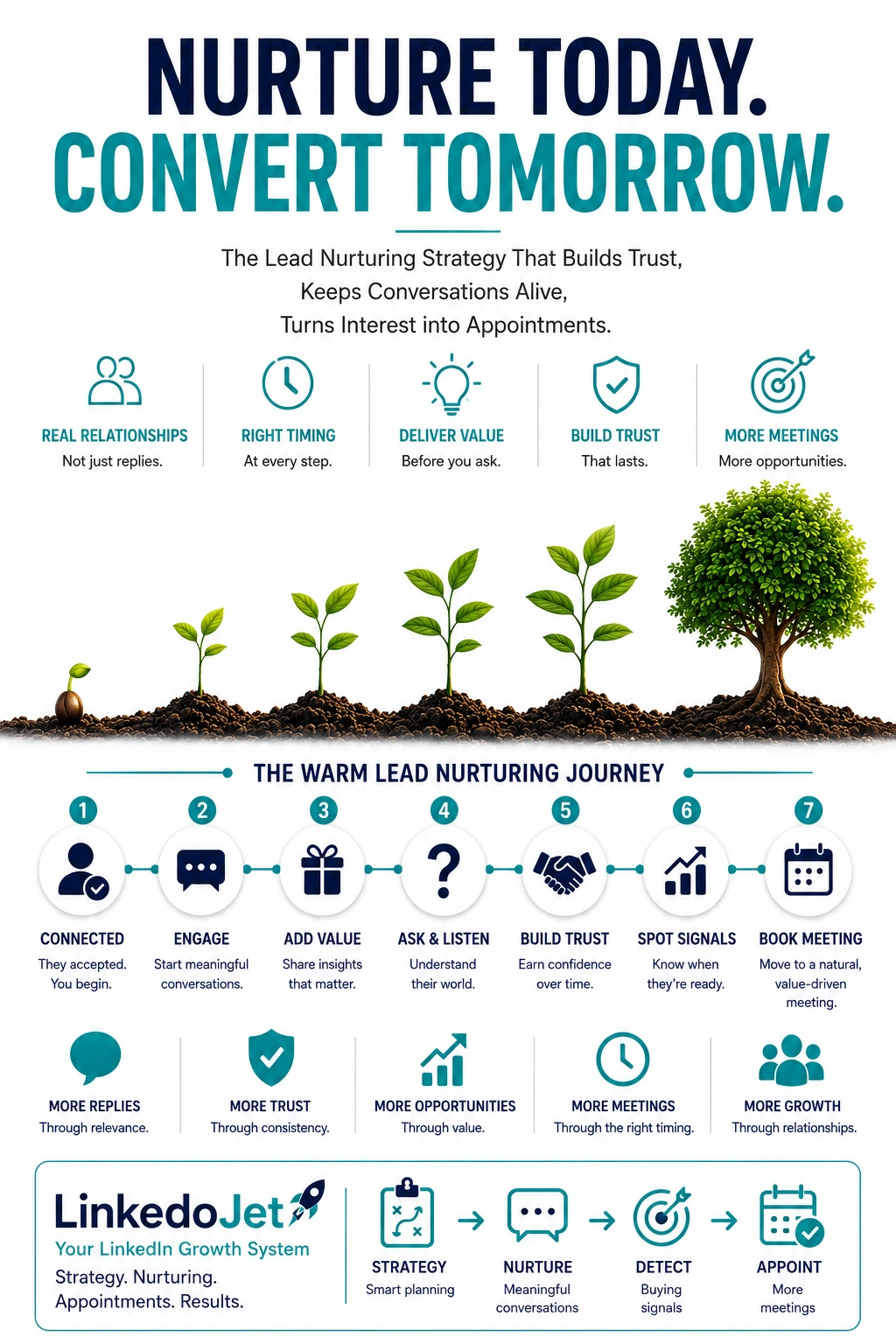
From there, LinkedoJet runs outreach and warm nurturing with a stage-based system: connection → context question → constraint check → artifact/proof drip → re-engage → buying-signal response. Messages are AI-assisted for personalization, but constrained by operator rules so they still read like a real cloud practitioner: plain language, relevant to their environment, and grounded in sequencing, governance, and cutover risk.
Replies don’t sit in a founder inbox. We handle reply routing and lead nurturing workflows so warm conversations keep moving without you living in DMs. Every lead is tracked by temperature and topics (landing zone, identity/networking, app waves, security gates, procurement timing), and you get campaign visibility through dashboards—what’s active, what’s stalled, and what’s showing real intent.
When a lead shows readiness signals (stakeholders, timelines, app scope, “how would you approach…”), we support appointment generation: a scoping call ask that’s framed as risk reduction, with a clear agenda and tangible outputs. You show up to calls with context, not guesswork.
This is why it’s different from ordinary LinkedIn automation tools. Automation sends volume. LinkedoJet manages the full system: targeting, personalization, execution, nurturing, tracking, and appointment support—so you can focus on delivery and closing the right work.
From identifying the right decision-makers to starting meaningful conversations and turning them into qualified appointments... LinkedoJet manages the entire outbound engine for your business.
Next step: build a follow-up system that earns the meeting
If your warm LinkedIn conversations keep dying, the fix isn’t more chasing. It’s a staged nurturing motion that mirrors how migration decisions actually get made—gates, sequencing, stakeholders, and timing.
When we work together, you get targeting + list building, AI-assisted personalization with operator guardrails, outreach execution, reply handling, warm lead tracking, and appointment generation support—plus the dashboards and ongoing refinement so the system improves month after month.