
The moment it goes quiet: why silence is normal in confidential M&A
That one polite reply (or “Appreciate it”) isn’t a dead end. It’s usually a safety check.
You’ve seen it: an owner accepts your connection, replies once, then the thread goes cold for weeks. Or a buyer says “send me what you have,” and vanishes the second you ask anything that would make the deal real.
In business brokerage, silence often means “not safe yet” or “not timed yet”, not “no.” Owners are protecting employees, customers, family dynamics, and their own pride. Buyers are protecting time and attention after looking at too many vague teasers.
The pipeline leak happens when your follow-up strategy treats quiet like a persistence problem. One slightly-off message—“Are you thinking of selling?” “What’s your EBITDA?” “Happy to value the business”—and you’ve triggered the confidentiality alarm. Now you’re remembered as the broker who was fishing.
And the painful part: you can be doing “the right work” (starting relationships) while your team has no shared way to label intent, keep the conversation discreet, and re-enter with a legitimate reason. Timing flips happen—burnout, partner changes, year-end numbers, lending shifts—and you’re not the first call because you disappeared or you pushed too hard.
Warm intent signals to watch: seller-side vs buyer-side (and what they really mean)
Your follow-up should change based on what they’re signaling, not on your quota calendar.
Most brokerage teams lump “warm lead” into one bucket. That’s how you end up talking to an owner like they’re a buyer, or sending a buyer language that sounds like you’re pitching a listing service.
Separate the tracks early. Sellers are screening for discretion and dignity. Buyers are screening for relevance and process discipline.
| Signal | What it usually means | Best next move |
|---|---|---|
| Seller: profile visit after you post about succession, exit timing, or burnout | They’re curious but not ready to be “seen” engaging | Low-pressure note that names confidentiality and asks a timing window question |
| Seller: “Not right now” / “Maybe later” | They’re protecting optionality; they don’t want to admit intent | Offer a small, private asset (readiness checklist) and a single “what would change timing?” question |
| Seller: asks about confidentiality, NDAs, “who would see this?” | They’re closer than they’re willing to say | Propose a short fit-check call with guardrails (what you will/won’t ask in LinkedIn) |
| Seller: mentions partner changes, health, key manager leaving, lease renewal | Trigger event; timing may compress fast | Ask permission for a brief private call focused on options and timing, not “selling” |
| Buyer: “Send me what you have” but no criteria | They want deal flow, but they’re filtering you | Two-question fit screen (size band + industry) before sharing anything |
| Buyer: references capital ready, add-on strategy, geographic flexibility | Active buyer; speed matters if fit is tight | Offer a 12–15 minute fit-check to confirm criteria and process before any teaser |
| Buyer: asks for off-market / “pre-LOI looks” | They’ve been burned by fluff and want signal | Clarify your process and ask for criteria in ranges; keep it crisp |
The mistake is treating every reply as permission to accelerate. In confidential deals, a reply is often just permission to keep things calm.
A temperature model brokers actually stick to
Four states. Clear language. No “lead score theater.”
When your team doesn’t share a temperature model, follow-up becomes improvisation. One rep sends a long paragraph about services. Another asks for financials. A third disappears for a month. The lead doesn’t ghost because they’re bad—your handling feels risky.
| Temperature | What it sounds like | What you’re allowed to ask (LinkedIn-safe) | What you should avoid |
|---|---|---|---|
| Polite | “Thanks.” “Appreciate it.” | Timing window (6–24 months), sector/geo fit, “is it worth staying in touch?” | Any implication they’re selling; valuation talk; long explanations |
| Curious | “How does confidentiality work?” “What do buyers pay for?” | Process questions, size band in ranges, what a fit-check call covers | Asking for EBITDA/SDE, customer concentration, or names in DMs |
| Quietly considering | Mentions timing triggers; asks about NDA; asks “what would you need?” | Offer a private 12–15 minute fit-check; outline guardrails; confirm next step after mutual fit | Pressuring for a “listing meeting”; sending documents in LinkedIn |
| Ready for a private call | “Can we talk?” “What’s the process?” “Who would see this?” | Schedule. Confirm two context points (industry + rough size band) and discretion preferences | Over-qualifying in chat; asking for financial statements before the call |
Cadence that doesn’t feel like chasing
Short touches, spaced out, always with a reason to reappear.
Brokers lose warm conversations by “checking in.” Not because it’s frequent—because it’s empty. A good nurture touch earns attention with a small, relevant reason and stays at the context-and-fit level.
A realistic cadence (seller or buyer) looks like this:
- Day 2–4: first warm follow-up after acceptance (discreet, one question)
- Day 10–14: one educational note (no valuation, no ask for financials)
- Day 21–30: a market observation tied to their niche (one prompt)
- Day 45–60: a proof vignette (process step that reduced risk)
- Quarterly: timing check anchored to a real trigger (year-end numbers, lending appetite, competitor sale)
For sellers, you’re building a private “permission ladder.” For buyers, you’re proving you won’t waste their time.
Also: you don’t need more messages. You need fewer messages that are more defensible. If your thread got forwarded to a partner or attorney, would it read like an advisor—or like a salesperson trying to pry?
Message examples you can send as-is (seller + buyer)
Measured tone. No fishing. Built around confidentiality and fit.
1) First warm follow-up after connection acceptance (seller-focused)
Message: “Thanks for connecting. I work with owners in [industry] businesses roughly [size band] where confidentiality is non-negotiable. Quick question—when you think about the next 12–24 months, is ‘succession / exit planning’ a now topic, a later topic, or simply something you keep an eye on?”
2) Follow-up after a vague reply (seller-focused)
Message: “Completely fair. Most owners I speak with are in ‘not right now’ for a long time. If it helps, I can send a one-page readiness checklist (private—no numbers needed). Also curious: what tends to move this from ‘later’ to ‘sooner’ in your world—partner changes, fatigue, a growth plateau, something else?”
3) Educational nurturing message (seller-focused)
Message: “One thing that catches owners off guard: buyers don’t pay for ‘revenue,’ they pay for repeatable earnings. A clean story around normalized earnings (and clean add-backs) often matters more than a heroic top-line year. If you ever want it, I can share a simple checklist of the add-backs buyers tend to accept vs. push back on—no valuation conversation needed.”
4) Insight-based follow-up (market observation)
Message: “Quick observation from the last few months: we’re seeing more buyers pay up for businesses with recurring / contracted revenue and get noticeably stricter on customer concentration. Does that match what you’re seeing in your space, or is your niche behaving differently?”
5) Case-study / proof-based nurturing message (discreet)
Message: “A recent situation (keeping it high-level): owner-run service business, strong cashflow, but they were anxious about employees finding out. The turning point wasn’t ‘pitching a sale’—it was a 15-minute teaser call to map discretion rules, then an NDA step before anything detailed moved. Once the owner felt control over who would see what (and when), the process stopped feeling scary.”
6) Soft question to reopen a quiet thread (seller or buyer)
Message: “Quick one—should I think of your timing as this year, next year, or no active window right now?”
7) Buying-signal response (seller-ready): NDA / process / confidentiality
Message: “Happy to outline the process. To keep it discreet, I don’t ask for sensitive details in LinkedIn. The next step is a private 12–15 minute fit-check where we cover: (1) confidentiality guardrails (who sees what, when), (2) typical timeline options (fast vs. staged), and (3) what info is only needed later after there’s mutual fit. If it makes sense, we can then move to NDA before anything detailed.”
8) Soft meeting request (seller or buyer): 12–15 minute fit-check
Message: “If you’re open to it, we can do a quick 12–15 minute fit-check. Goal is simple: (1) confirm whether there’s any reason to keep a conversation going, (2) align on size band / criteria in ranges, and (3) agree on confidentiality rules. If it’s not a fit, we’ll close the loop and I won’t keep pinging you.”
9) Dormant lead revival message (seller-focused)
Message: “Circling back for a practical reason—this is usually the season when year-end numbers and tax planning make timing feel more real for owners. No assumption you’re selling. Has anything changed on your side that would make a private ‘options + timing’ chat useful, even if it’s 6–18 months out?”
10) Final polite close-loop message
Message: “I’m going to close the loop on my side so this doesn’t turn into noise. If timing isn’t on the table, no worries—I won’t keep following up. If it changes later, reply with a simple ‘Q4’ or ‘2026’ and I’ll circle back around then.”
These work because they don’t force disclosure. They create a safe path from “polite” to “private conversation” without tripping the wires that make owners and buyers disappear.
What triggers confidentiality alarms and buyer deal-fatigue (and how to avoid it)
Most warm leads don’t die. They get mishandled.
The fastest way to poison a sell-side relationship is to make an owner feel exposed. The fastest way to lose a buyer is to make them feel like you’re going to send junk.
- Asking “What’s your EBITDA/SDE?” in chat. Save it. Early stage is ranges and fit, not financial extraction.
- Implying they’re selling when they haven’t said it. “When are you selling?” reads like you’re fishing for a listing.
- Writing long paragraphs about your services. Owners hear “sales pitch,” not “discreet advisor.”
- Offering a valuation in DMs. Without normalized earnings context, it feels unserious—and risky.
- Mixing seller and buyer language. A buyer doesn’t want “succession planning.” A seller doesn’t want “deal flow.”
- Sending teasers that don’t match criteria. One mismatch and you’re filed under “spam broker.”
- Over-following up during early thinking. If they’re “polite,” your job is spacing and relevance, not pressure.
- No continuity across the team. The owner gets a different tone from different people and assumes you’re disorganized.
Fixing this isn’t about being “nicer.” It’s about treating follow-up like risk management: reduce perceived risk, increase clarity, and only escalate when signals justify it.
How LinkedoJet operationalizes warm nurturing (without looking automated)
Separate seller/buyer tracks, temperature-based next steps, and booked fit-check calls—handled end to end.
Most “LinkedIn tools” stop at sending connection requests. That’s the easy part. In brokerage, the value is what happens after the first reply—when you have to be consistent, discreet, and patient without going quiet.
LinkedoJet is built to run that middle: warm lead handling that protects your reputation and keeps threads moving until timing flips.
- ICP and targeting setup: we define seller and buyer targeting separately (industry, geography, role/title, owner-operator indicators, buyer types) so your messaging doesn’t cross-contaminate.
- Sales Navigator / LinkedIn list building: we build and maintain prospect lists that match your size bands and deal thesis, not random “business owners.”
- AI-assisted personalization: short, broker-sounding personalization that references what actually matters (sector, footprint, timing cues) without making claims or creeping people out.
- Outreach execution: connection + first touches delivered on a cadence that fits confidential conversations (calm, spaced, defensible).
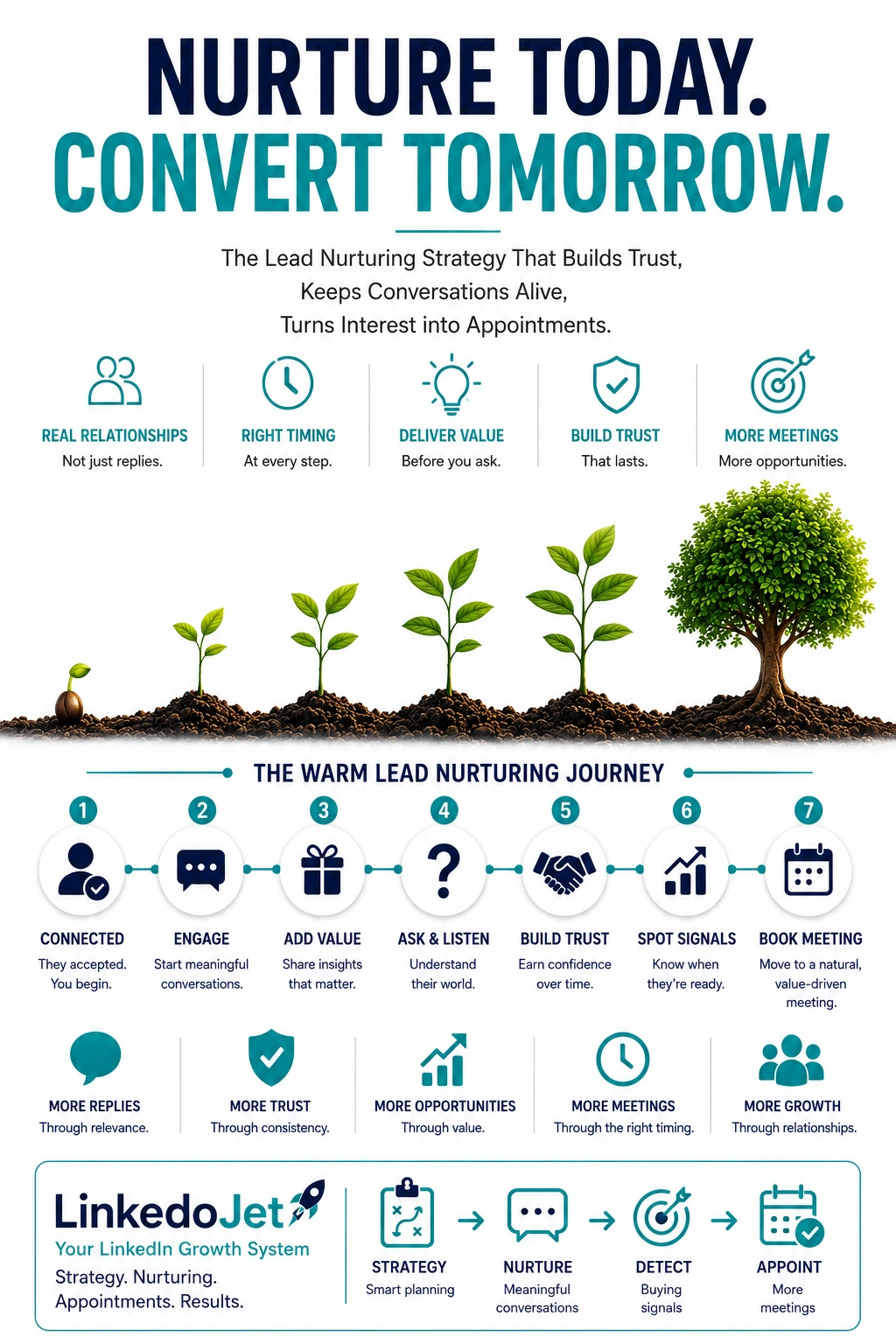
- Reply handling and nurturing: we categorize replies (polite/curious/quietly considering/ready), queue the next-best touch, and keep threads alive with legitimate reasons to reappear.
- Warm lead tracking: we track signals like reply type, follow-up status, and engagement patterns so “quiet” doesn’t disappear into a spreadsheet.
- Appointment generation support: we help move the right leads into 12–15 minute fit-check calls with clear guardrails (especially NDA/confidentiality conversations).
- Campaign visibility: dashboards show what’s happening—who’s warm, who’s stalled, where conversions are breaking, and which messages create replies.
- Ongoing refinement: we adjust targeting, sequencing, and language as you see which triggers and segments respond (seller vs buyer behavior is rarely symmetrical).
The outcome isn’t “more activity.” It’s fewer awkward follow-ups, cleaner qualification, and more private fit-check calls that actually lead to mandates and qualified buyer relationships.
Answers brokers usually want before they change how they follow up
What’s a realistic LinkedIn follow-up cadence for confidential seller conversations?
Think in weeks, not days. One discreet follow-up a few days after acceptance, then spaced touches every 10–20 days with a real reason (readiness concept, market observation, timing trigger). If the owner is “polite,” pushing weekly usually creates risk. If they’re asking about process or confidentiality, you can tighten the spacing and move to a private 12–15 minute fit-check.
How do I follow up with a business owner who replied “not right now” without sounding pushy?
Acknowledge it and give them a dignified next step that doesn’t require disclosure: a readiness checklist, a “what changes the timeline?” question, or a note that you’ll only circle back when they tell you to. The key is to avoid implying they’re selling; you’re offering a safe planning conversation, not chasing a listing.
What should (and shouldn’t) be discussed in LinkedIn messages before an NDA?
Keep it at context and fit: industry, geography, timing window, and process guardrails. You can talk in ranges and concepts (normalized earnings, what buyers focus on) but avoid sensitive business details, customer names, exact earnings, or anything that would make them feel exposed if a partner or employee saw the thread.
How do I keep buyer conversations going without sending mismatched teasers?
Don’t “feed” until you’ve confirmed two criteria points (industry + size band) and one constraint (geo flexibility or operator/investor preference). Buyers stay engaged when they feel you’re filtering. A short fit-check call often saves weeks of back-and-forth and prevents you from being labeled as a spammy broker.
How can I tell if silence means “not interested” vs “not safe yet” in sell-side outreach?
Look for indirect signals: profile revisits after succession content, questions about confidentiality, process curiosity, or timing-adjacent comments (“busy right now,” “maybe next year”). “Not interested” tends to be explicit or consistently cold. “Not safe yet” looks like polite engagement plus avoidance of commitment. Your job is to keep it discreet and give them a low-friction way to tell you timing without admitting intent.
See what warm nurturing looks like when it’s actually run like an operation
If you want fewer stalled threads and more qualified 12–15 minute fit-check calls, we’ll show you the exact seller/buyer tracks and how they’re managed week to week.
LinkedoJet isn’t “send more LinkedIn messages.” It’s a managed outbound and nurturing system built for sensitive, slow-maturing conversations—exactly like confidential sell-side and selective buy-side.
On this session, we’ll walk through how we would run your warm follow-up engine with two separate tracks (seller and buyer), including the temperature model, the cadence, and the exact language that keeps discretion intact.
After onboarding, LinkedoJet operationally provides:
- ICP and targeting setup for sell-side and buy-side (separate segments, separate messaging rules)
- Sales Navigator prospect list building that stays inside your size bands, geographies, and deal thesis
- AI-assisted personalization that sounds like a broker: calm, specific, and defensible (no creepy over-personalization)
- Outreach execution across connection + first touches with a cadence designed for confidentiality
- Lead reply handling + nurturing workflows that label intent (polite/curious/quietly considering/ready) and queue the next-best touch
- Warm lead tracking so quiet conversations don’t get lost (and you know which silence is “not safe yet”)
- Appointment generation support to move the right leads into protected 12–15 minute fit-check calls
- Campaign visibility through dashboards so you can see what’s working and where deals stall
- Ongoing refinement as your market responds (lending changes, buyer appetite shifts, seasonal timing)
What you receive is not a PDF strategy. You get working seller and buyer sequences, message examples aligned to your process (NDA/teaser/fit-check), and an operating rhythm your team can trust.
How targeting and list building works: we build segmented Sales Navigator lists (owners by sector/geo/keywords; buyers by role/strategy/criteria proxies) and keep them clean so your nurture stays relevant. Buyers don’t get seller language. Owners don’t get “deal flow” talk.
How personalization is used: AI helps draft short, context-aware openers and follow-ups based on the segment and the last signal (reply type, engagement, timing cues). Everything is reviewed against confidentiality-safe rules.
How follow-up workflows operate: touches are spaced and reason-based (market observation, readiness concept, process guardrails, timing triggers). The system prompts the right next message without turning you into a “just checking in” machine.
How warm leads and appointments are tracked: warm signals, reply categories, next steps, and booked calls are visible in one place so you can forecast reality—not hope.
Why this is different from ordinary LinkedIn automation tools: automation sends. LinkedoJet manages the full conversation arc—targeting, sequencing, reply handling, nurturing, and appointment movement—while protecting confidentiality and your reputation.
Get a seller + buyer nurture map you can run immediately
We’ll set up the two-track system (seller vs buyer), install the temperature model, and put discreet follow-ups on rails so quiet threads turn into qualified fit-check calls.
From identifying the right decision-makers to starting meaningful conversations and turning them into qualified appointments... LinkedoJet manages the entire outbound engine for your business.