
SaaS pipeline rarely fails from product— it fails from missing the right decision-makers
If your outbound feels “busy” but demos are inconsistent, the issue is usually prospect intelligence: who to target, why now, and how to reach them with relevance.
B2B SaaS buying is a committee decision. When targeting is shallow, you get replies from the wrong people, long sales cycles with no internal champion, or polite “not a priority” responses.
LinkedoJet is built as a LinkedIn prospect intelligence system: it turns your ICP into a repeatable process for identifying accounts, mapping stakeholders, prioritizing intent signals, and running structured outreach that produces qualified conversations.
The real SaaS lead generation problem: shallow targeting, wrong titles, weak qualification, and no follow-up structure
Generic LinkedIn outreach fails because it optimizes for volume, not decision access.
Most SaaS teams struggle with the same failure modes:
- Shallow targeting: broad industries, broad keywords, and “anyone in sales/IT/HR.”
- Wrong titles: messaging people who look relevant but don’t own budget or evaluation.
- Weak qualification: no check on company stage, existing stack, or timing triggers.
- Irrelevant messaging: no tie to operational pressure (hiring, compliance, productivity, security, revenue efficiency).
- No follow-up system: one touch, then the lead disappears—even though SaaS buyers need multiple exposures.
In SaaS, a “no” is often “not this quarter.” Without a follow-up cadence and role-aware messaging, your pipeline gets invisible gaps that only show up weeks later.
Book a Strategy Call to map your buyer committee, targeting filters, and a follow-up sequence that fits your sales cycle.
Map the buyer committee by SaaS category (and avoid title traps)
The right title depends on what your product changes operationally: workflow, risk, revenue, compliance, or headcount efficiency.
| SaaS category | Primary decision-makers | Key influencers | Titles to avoid (unless influencer targeting) |
|---|---|---|---|
| HRTech / People Ops | CHRO, VP People, HR Director, Head of Talent | People Ops Manager, HRIS Manager, Talent Ops | Recruiter (IC), Coordinator, Assistant |
| SalesTech / CRM / RevOps | CRO, VP Sales, Head of Sales, Head of RevOps | RevOps Manager, Sales Ops, Enablement, Sales Systems | SDR (IC), Account Executive (IC) unless power user |
| Cybersecurity | CISO, CIO, CTO (varies by org), IT Director | Security Manager, SecOps Lead, IT Manager, GRC | Software Engineer (no ownership), Analyst (IC) |
| Finance SaaS | CFO, Finance Director, Controller, Head of FP&A | Finance Ops, RevRec, Procurement, Ops Director | Bookkeeper, Junior Accountant |
| AI / workflow automation | COO, CTO, Head of Ops, Digital Transformation | Business Systems, Product Ops, Data/Automation Lead | General “Consultant” with no internal remit |
Title intelligence is not just a list. Two “VP Sales” profiles can be completely different: one owns tooling and pipeline process; another focuses on coaching and leaves systems to RevOps.
In practice, you want a mix: a likely budget owner plus 1–2 operational influencers who will validate the problem and push the evaluation forward.
Sales Navigator targeting architecture for SaaS: filter with intent, then prioritize by signals
Sales Navigator works when filters are tied to buying logic: stage, ownership, and a reason to change.
Use filters to narrow to “possible buyers,” then use signals to decide “who gets outreach this week.”
| Filter | What to set | Why it matters for SaaS |
|---|---|---|
| Geography | US, UK, Canada, UAE, Singapore, Australia, Europe (as applicable) | Aligns to pricing, legal/compliance, time zones, and referenceability. |
| Industry | Software Development; IT Services & Consulting; Financial Services; Marketing Services; Human Resources Services; Cybersecurity; Healthcare; Manufacturing | Prevents “everyone” targeting. Also impacts compliance, security review, and buying committees. |
| Company headcount | 11–50 (startup buyers), 51–200 (scaling), 201–500 (mid-market), 501–1000+ (enterprise) | Proxy for process maturity, deal size, and the number of stakeholders you must map. |
| Seniority level | CXO, VP, Director, Owner/Partner, Manager (role dependent) | Controls for decision access. Use Manager when the manager owns systems (RevOps/HRIS/SecOps). |
| Function | Sales, Operations, IT, Engineering, Marketing, HR, Finance, Product, Business Development | Matches your category’s buyer committee and avoids adjacent-but-irrelevant roles. |
| Years in current position | < 1 year; 1–2 years | New leaders are more likely to review tools, change process, and sponsor vendors. |
| Posted on LinkedIn | Past 30 days | Active prospects are materially more reachable and easier to personalize to. |
| Keywords | automation, digital transformation, AI, revenue operations, compliance, productivity, scaling, workflow, cloud, cybersecurity | Signals internal initiatives and language you can mirror in outreach. |
Prioritization rule: if you can’t explain why this company should care this quarter, it is not an A-lead. It is a nurture lead.
Get the Free Report for a SaaS-specific Sales Navigator setup and signal checklist you can copy.
Account + company intelligence: build high-fit lists with growth signals and negative-fit exclusions
You do not need more leads. You need better account selection so your messaging lands with operational urgency.
High-fit account lists are built from company-level signals, not just industry tags.
| Company signal | What it suggests | How to use it in targeting |
|---|---|---|
| Recent funding / capital event | Growth mandate, new targets, budget flexibility | Prioritize for scaling workflows, hiring, and tooling consolidation. |
| Hiring velocity (sales, RevOps, IT, security, HR ops) | Operational load is increasing | Build lists by function hiring aligned to your product category. |
| Leadership changes (new CRO/CFO/CISO/COO) | New operating system, vendor evaluation cycles | Target new leaders + their direct operational owners. |
| Product launch / expansion to new region | Process strain, new compliance or reporting needs | Target operations + finance + security stakeholders together. |
| High LinkedIn company activity | Modern GTM motion, higher responsiveness | Prioritize for faster connect rates and easier personalization. |
| Negative-fit: layoffs, no hiring, inactive page, very small team for your ACV | Budget or focus constraints | Exclude to reduce wasted touches and protect sender reputation. |
Account-list strategy is often sharper than broad searches: recently funded companies, companies hiring for relevant functions, companies in partner ecosystems, or companies likely using competitor tools (where you can validate via profile and content clues).
Buying signals + profile reading: qualify beyond title and seniority
Filters find “possible.” Profile reading finds “probable.” Signals decide “now.”
Intent on LinkedIn is usually indirect. You’re looking for operational pressure and change events:
- Hiring signals: SDR/AE hiring (growth), RevOps hiring (process), IT/security hiring (risk), HR ops hiring (scale), finance ops hiring (controls).
- Initiative language: posts about automation, AI adoption, digital transformation, compliance, productivity, security posture, revenue efficiency.
- Role transitions: “just joined,” “excited to start,” new leadership announcements.
Then qualify the person, not just the title:
- Do they own systems (HRIS/RevOps/SecOps/Finance Ops) or just execution?
- Have they scaled before (e.g., moved from a 50-person org to 300+), indicating tool evaluation experience?
- Do they reference metrics, process, stack, or cross-functional alignment in their content?
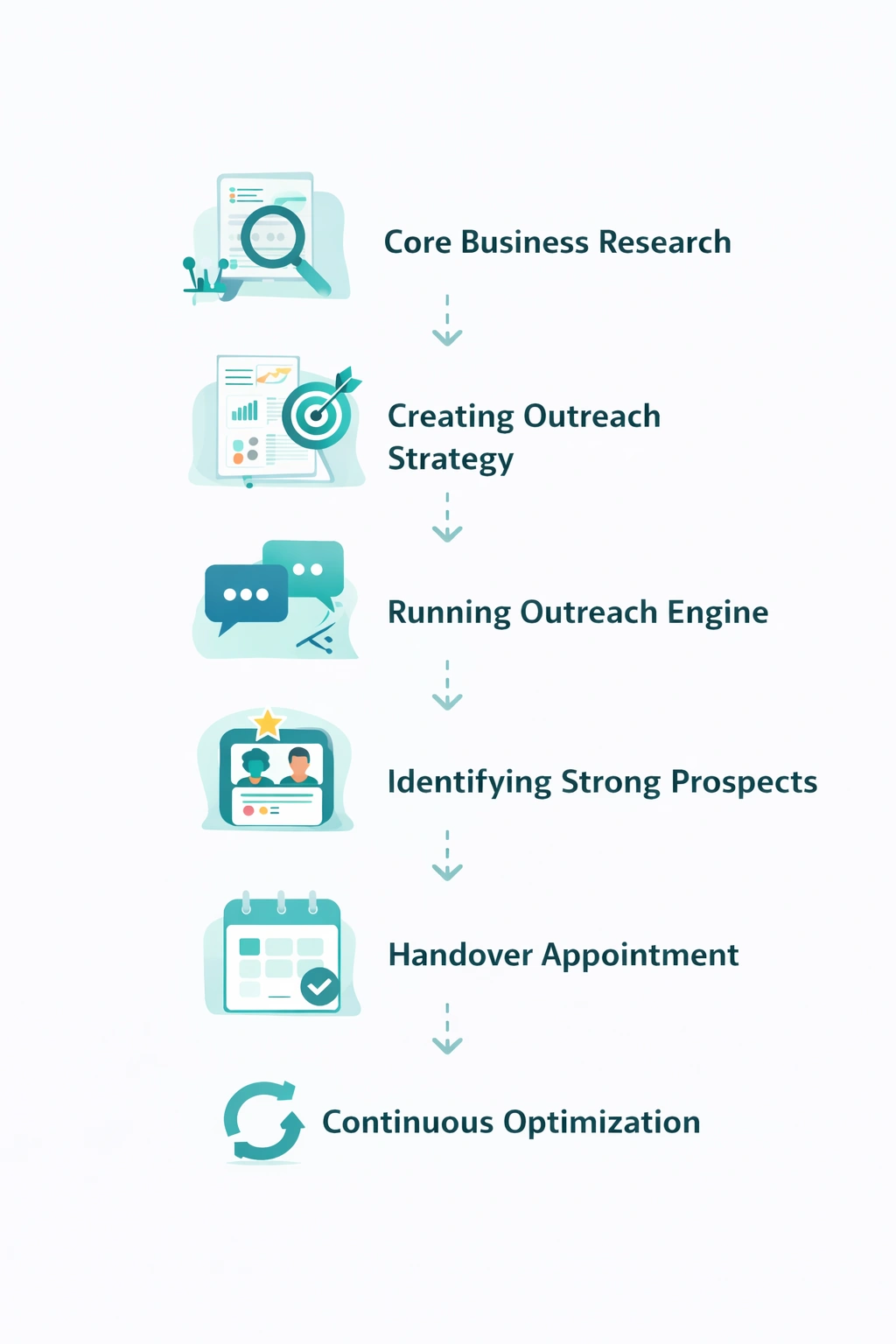
How LinkedoJet operationalizes the system: targeting → qualification → AI-assisted personalization → outreach → reply management → nurture
Execution matters because SaaS cycles are multi-threaded: you need consistent coverage across stakeholders without turning into spam.
LinkedoJet is designed to run the full workflow with control:
- Targeting architecture: Sales Navigator filters built around your ICP, regions, and category-specific committees.
- Qualification layer: account signals, negative-fit exclusions, and profile-based role validation.
- AI-assisted personalization: grounded in company signals and LinkedIn activity (not generic compliment lines).
- Outreach sequencing: connection + value-first follow-ups tied to role and trigger.
- Reply management: categorize responses, route to the right owner, and keep follow-up disciplined.
- Nurture: keep warm accounts moving until timing flips.
If your team is already doing outbound, this system reduces waste: fewer low-fit conversations, better stakeholder coverage, and a cleaner handoff into a demo process.
Book a Strategy Call to pressure-test your targeting, stakeholder map, and signal prioritization before you scale outreach volume.
Frequently asked questions
How can B2B SaaS companies find qualified leads on LinkedIn (without spraying messages)?
Start with a defined ICP and buyer committee, then use Sales Navigator to narrow to high-fit accounts and roles. Prioritize prospects with change signals (new role, hiring, expansion, active posting). Only then personalize outreach to the role’s responsibility and the company’s likely trigger.
What are the best Sales Navigator filters for SaaS lead generation—and why do they matter?
Core filters are geography, industry, company headcount, function, seniority, and years in role. Add “Posted on LinkedIn (past 30 days)” to increase reachability and keyword filters to align with initiatives (automation, RevOps, compliance, security). Filters reduce noise; signals decide who is worth contacting now.
Which job titles should SaaS companies target for HRTech, SalesTech/CRM, Cybersecurity, Finance SaaS, and AI/workflow tools?
HRTech: CHRO/VP People/HR Director + HRIS/People Ops. SalesTech/CRM: CRO/VP Sales/Head of RevOps + Sales Ops/Enablement. Cybersecurity: CISO/CIO/CTO/IT Director + SecOps/Security Manager/GRC. Finance SaaS: CFO/Controller/Head of FP&A + Finance Ops/Procurement. AI/workflow: COO/CTO/Head of Ops/Digital Transformation + Business Systems/Automation leads.
How does LinkedoJet identify qualified SaaS prospects beyond title and seniority?
LinkedoJet adds company intelligence (funding, hiring, growth, leadership changes) and profile reading (ownership signals, scope, prior scaling experience, activity patterns). The goal is to contact people who can evaluate and mobilize a purchase, not just people with senior-sounding titles.
Can LinkedIn automation work for complex SaaS sales cycles with multiple stakeholders?
It can if “automation” means workflow control, not message blasting. Complex SaaS requires stakeholder sequencing, role-aware value angles, and disciplined follow-up. The system should support human judgment: exclusions, prioritization, and reply handling that respects buying committees.
Build your SaaS LinkedIn targeting and outreach system
Use this session to map your buyer committee, Sales Navigator architecture, and signal-based prioritization—so outreach produces qualified demo conversations, not noisy lead lists.
Ideal for founders, GTM leaders, sales directors, and RevOps teams running a sales-led or hybrid motion.
- Clarify category-specific decision-makers and influencers
- Set targeting filters and exclusions that match your ACV and sales cycle
- Define the signals that should trigger outreach vs. nurture
Choose your path
If you want predictable demos, start with targeting precision and a follow-up system you can run every week.