
Find Fractional CMO leads without begging for attention
LinkedoJet turns Sales Navigator + real buying signals (hiring, funding, GTM changes, leadership gaps) into a prioritized target account map and decision-maker list.
You already know you can drive outcomes. The part that wears you down is the randomness: one month you’re booked, the next you’re staring at calendar gaps and wondering how you’ll replace a retainer that ends early.
Most fractional CMO “lead gen” is just cold outreach roulette. It creates activity, not control.
- Identify need-now companies (signals that they’re about to invest in marketing leadership)
- Map the real stakeholders (CEO/CRO/marketing owner/finance—so deals don’t die in the manager layer)
- Lead with situational angles tied to their current moment, not generic “I help with marketing” positioning
Why most fractional CMO prospecting fails (and burns your best hours)
The painful part isn’t rejection. It’s spending a Tuesday doing “smart outreach,” only to realize the companies were never in a need-now window. No budget. No urgency. Or the wrong buyer entirely.
Fractional CMO deals don’t close because your message is clever. They close because the timing is obvious and the buyer can act. Without that, you end up donating strategy in DMs and on intro calls just to manufacture interest.
Three failure modes show up over and over:
- No trigger: targeting “B2B SMBs” and hoping pain exists instead of proving a change event (hiring, funding, leadership gap, GTM shift).
- Wrong buyer: starting at the marketing manager layer, then wondering why approvals drag or retainers get negotiated down.
- Generic context: “I help with pipeline / demand gen / positioning” with nothing in their world to anchor to.
The hidden cost is compounding: longer sales cycles, smaller retainers, and that gnawing feeling that your pipeline is an accident. The requirement is simple but non-negotiable: prove timing + authority + pain before you ask for a meeting.
Who to target: a qualification checklist that actually predicts a retainer
If your list isn’t built around readiness, outreach turns into persuasion. That’s backwards. You want companies where “fractional” is the rational choice: speed-to-impact and reduced hiring risk.
Core company fit (use this to build your starting universe)
- Headcount: 10–500 (core). Prioritize 25–250 for fastest deal velocity. Add 500–2000 for PE-backed divisions/carve-outs.
- Revenue proxy: Seed–Series C SaaS, or $2M–$100M revenue services/ecom/manufacturing with clear growth ambition.
- Industries that tend to pay for leadership: B2B SaaS, cybersecurity, fintech, martech, vertical SaaS, IT services/MSPs, tech-enabled professional services, healthcare SaaS, logistics/industry SaaS. (Optional: DTC/ecom when paid efficiency + retention are under pressure.)
- Business model: high LTV products/services; sales-led or hybrid GTM. Avoid ultra-low ACV where “strategy + oversight” gets treated like overhead.
- Readiness markers: a sales team/SDR motion, active paid spend, consistent content cadence, product releases, or a customer success function.
| Good-fit signals (move up your list) | Bad-fit signals (deprioritize) |
|---|---|
| Hiring VP/Head of Marketing, Demand Gen, Product Marketing, Marketing Ops, RevOps | Headcount <5 with no funding; “idea-stage” founders shopping for free advice |
| Recently funded or PE-backed; new product/vertical; pricing/packaging changes | Repeated layoffs + “cost cutting” narrative; hiring freeze with runway concerns |
| Highest marketing title is manager/director at 50–300 employees | Tenured CMO + deep marketing bench and no hiring/growth triggers |
| Sales hiring (SDRs/BDRs) but weak marketing leadership (gap between sales push and demand engine) | Purely local low-ticket businesses where fractional ROI is hard to justify |
Micro-CTA: If you want, we’ll turn your fit criteria into three tiered account lists (need-now → likely-soon → nurture) and the stakeholder map for each. Speak to our Experts.
Who can buy: map the committee before you send a single message
Fractional CMO retainers die when you’re “owned” by someone who can’t approve urgency. You can have the cleanest diagnosis in the world; if the CEO/CRO never feels it, you’ll get slow-walked into “maybe next quarter.”
Stakeholder map (and how to aim your first touch)
- Economic buyer: CEO, Founder, Co-Founder, President, Managing Director, Owner
- Likely champion: VP Marketing, Head of Marketing, Marketing Director, Director of Growth, VP Growth, Head of Growth, Demand Gen Director/Manager, Performance Marketing Lead, Lifecycle/Retention Lead
- Revenue co-buyer: CRO, VP Sales, Head of Sales, RevOps leader, COO (often delegated)
- Approver (when needed): CFO, VP Finance
- PE-backed layer: Operating Partner, Portfolio Operations, Venture Partner (growth), Principal (platform)
Simple routing rules (based on the signal you found)
- Hiring VP/Head of Marketing → lead with CEO: “You’re about to invest in leadership—fractional de-risks the next 90 days while you hire.”
- Pipeline complaints / SDR ramp / conversion issues → lead with CRO/VP Sales: “Sales is scaling; marketing leadership is the bottleneck. Here’s the first 30-day demand-gen stabilization plan.”
- Attribution/ops mess + manager-level marketing lead → start with marketing owner as champion, but still map CEO early: deals close faster when CEO understands the transition risk.
- PE integration / acquisition → include portfolio ops: they often sponsor interim leadership to hit integration milestones.
Three Sales Navigator saved searches built for fractional CMO deals
You’re not looking for “companies that might want marketing.” You’re looking for accounts advertising intent through hiring patterns, org gaps, and GTM shifts.
A) Accounts hiring senior marketing leadership
- Account filters: Industry (B2B SaaS/cyber/fintech/martech/IT services/pro services), Geography (your delivery), Headcount (11–50, 51–200, 201–500 as separate saved searches), Company type (Privately Held).
- Spotlights: Job openings (on).
- Interpretation: if they’re hiring VP Marketing/Head of Marketing/Demand Gen, they’ve already admitted the gap. Your “fractional” angle is speed + de-risking the full-time hire.
B) Funded but no CMO (the leadership gap list)
- Accounts: SaaS/vertical SaaS, 11–200 headcount, “Mentioned in the news” where available.
- People verification step: run a people search at that company for marketing leadership. If the highest title is Marketing Manager/Director and there’s no CMO/VP Marketing, tag as “gap.”
- Angle: “You’re past the stage where tactics win. Fractional gives you senior leadership now, while you decide whether a full-time exec is the right risk.”
C) Sales-led pipeline push + marketing leadership mismatch
- Accounts: 25–250 headcount, sales-led/hybrid industries above.
- Signal check: hiring SDRs/BDRs + RevOps + maybe demand gen, but no senior marketing leader.
- Lead search: target CRO/VP Sales/RevOps plus CEO. This is a revenue conversation, not a “marketing support” conversation.
Lead filter strings (copy/paste conceptually)
- Function: Marketing, Sales, Operations
- Seniority: Owner/Partner, CXO, VP, Director, Head
- Title keywords: (CEO OR Founder OR CRO OR "VP Marketing" OR "Head of Marketing" OR "Marketing Director" OR "Head of Growth" OR "VP Growth" OR "Demand Generation" OR RevOps OR COO)
- Relationship: 2nd-degree (to increase reply rate), “Posted on LinkedIn in past 30 days” (to increase contextual hooks)
Exclusions that save you weeks
- Exclude industries you won’t win (non-profit/government unless it’s your niche).
- Exclude <5 headcount unless funded.
- Exclude companies where a tenured CMO + full bench exists and there’s no hiring/growth trigger—curiosity doesn’t pay retainers.
- Exclude internal “Fractional CMO” titles at target accounts (you’re walking into an embedded competitor).
Buying signals → priority: build a signal stack, then earn the meeting
One signal is interesting. Two is credible. Three is a buying window.
The mistake is treating each trigger as a one-off. The better approach is a stack: when signals cluster, your outreach stops sounding like a pitch and starts sounding like pattern recognition.
The signal stack (examples that map cleanly to fractional CMO retainers)
- Hiring intent: VP/Head of Marketing, Demand Gen, Product Marketing, Marketing Ops, RevOps; SDR/BDR expansion
- Org signals: marketing leader left; “acting/interim” leadership; new CEO/CRO; new VP Marketing tenure <90 days
- Market events: funding, PE acquisition, merger/carve-out, international expansion
- GTM change: new product/vertical, pricing/packaging shift, moving from PLG to sales-led, partner channel build
- Activity signals: CEO/CRO posts about growth targets, pipeline coverage, CAC pressure; company running webinars/events/ads
- Tech shifts: HubSpot/Salesforce implementation, new MAP, intent tooling—signals operational readiness
Simple scoring (so your week isn’t a guess)
| Tier | Signal combination | Recommended first angle |
|---|---|---|
| Tier 1 | Hiring senior marketing leadership or funded/PE event + leadership gap | “Speed-to-impact + de-risk the hire” (90-day leadership sprint) |
| Tier 2 | Headcount growth + demand gen/RevOps hiring + active marketing motion | “Demand gen rebuild + attribution baseline in 30 days” |
| Tier 3 | Steady companies with content/ads but no obvious change event | Nurture: share one sharp observation, wait for a trigger |
What to say when multiple signals hit
- Funding + VP Marketing hiring: “You’re investing into growth and leadership at the same time. Fractional can set direction and stabilise execution while the hire lands.”
- SDR hiring + CRO posting about pipeline coverage: “Sales is being asked to do more; marketing leadership is the fastest way to improve coverage and conversion without burning the SDR team.”
- Marketing leader left + product launch cycle: “Launches without senior oversight get noisy fast. A 60–90 day interim CMO layer keeps positioning, funnel, and reporting tight.”
When you can point to what changed, what it breaks, and why fractional is safer/faster than a full-time search, CEOs reply. Not because you wrote a perfect opener—because you’re describing their week.
FAQ
What’s the best headcount range for fractional CMO clients?
Core range is 10–500 employees, but the best strike zone for consistent retainers is usually 25–250: enough budget and complexity to value leadership, not so much bureaucracy that it turns into a six-month buying cycle. Go bigger (500–2000) when there’s a PE-backed division, carve-out, or integration event where speed matters more than org charts.
Should I target CEOs or VPs of Marketing first?
Target based on the trigger. If the signal is leadership investment (hiring VP Marketing/CMO, funding, PE activity), start with the CEO—they own the risk and the decision. If the signal is execution pain (attribution chaos, paid inefficiency, team stuck at manager-level), a VP/Head of Marketing can be the fastest champion—just don’t let the deal stay trapped there. Always map the CEO/CRO path early.
How do I find companies that need marketing leadership but aren’t hiring a CMO yet?
Look for the mismatch: 50–300 employees where the highest marketing title is Marketing Manager/Director, paired with growth pressure (SDR hiring, new vertical, new product) or operational readiness (HubSpot/Salesforce rollout). These teams often know they need leadership but don’t want the cost/risk of a full-time exec until they’ve stabilised the plan.
Which hiring and GTM signals are strongest for fractional CMO outreach?
Best signals are the ones that imply senior decisions are being made: hiring VP/Head of Marketing, Demand Gen, RevOps, Product Marketing, plus SDR/BDR expansion. GTM signals that convert well: pricing/packaging changes, moving from PLG to sales-led, partner channel build, acquisitions/integration, and any public push for predictable pipeline.
How do I avoid companies that already have strong marketing leadership?
Disqualify fast when you see a tenured CMO and a full bench (VP Growth, Demand Gen, Product Marketing) and no hiring/growth trigger. Also deprioritise teams posting “cost cutting” updates or running layoffs without a counter-signal like fresh funding. Curiosity calls are fine; they just shouldn’t be your pipeline plan.
Get a Fractional CMO Lead Map: accounts, stakeholders, and angles tied to real signals
This isn’t a generic “strategy call.” We’ll show you what LinkedoJet would run for your fractional CMO offer: signal-based targeting, stakeholder mapping, and outreach execution that turns evidence into booked conversations.
What LinkedoJet operationally provides: we build and manage a prospect intelligence + outbound system designed for fractional CMO retainers—where timing and authority matter more than volume.
On the session, we’ll pressure-test your best-fit company profile (headcount, industries, GTM motion, readiness markers), then walk through the exact signal stack we’d use to prioritise accounts (hiring, funding/PE, leadership churn, GTM changes, pipeline pain).
After onboarding, you receive:
- ICP + targeting setup translated into Sales Navigator searches (with exclusions that prevent wasted cycles).
- Prospect list building: tiered account lists (Tier 1/2/3) built around buying signals, not just firmographics.
- Stakeholder mapping per account: CEO/founder, CRO/VP Sales, marketing owner, and finance/PE ops when relevant—plus the recommended first contact based on the trigger.
- AI-assisted personalization that pulls proof points from profiles, posts, job openings, and recent news to create credible angles (without sounding templated).
- LinkedIn outreach execution: connection + message flows run consistently, with human-grade context and guardrails (not spammy blasts).
- Lead reply handling and nurturing: we manage follow-ups, route replies, and keep warm leads moving with the right asset (CMO diagnostic, funnel teardown, 90-day plan).
- Warm lead tracking + appointment support: you see what’s happening, which accounts are heating up, and what’s booked—so your calendar isn’t a surprise.
- Campaign visibility through dashboards, plus ongoing refinement as we learn what signals and angles convert in your market.
How targeting and list building works: we start with your constraints (region, minimum retainer, vertical focus) and build separate searches for 11–50, 51–200, and 201–500 employee bands. Then we overlay signals (job openings, news, job changes, posting activity) to create a prioritized lead map you can actually act on each week.
Why LinkedoJet is different from ordinary LinkedIn automation tools: tools send messages. LinkedoJet runs the system—who to target, why now, who can buy, what to say, how to follow up, and how to measure whether it’s working.
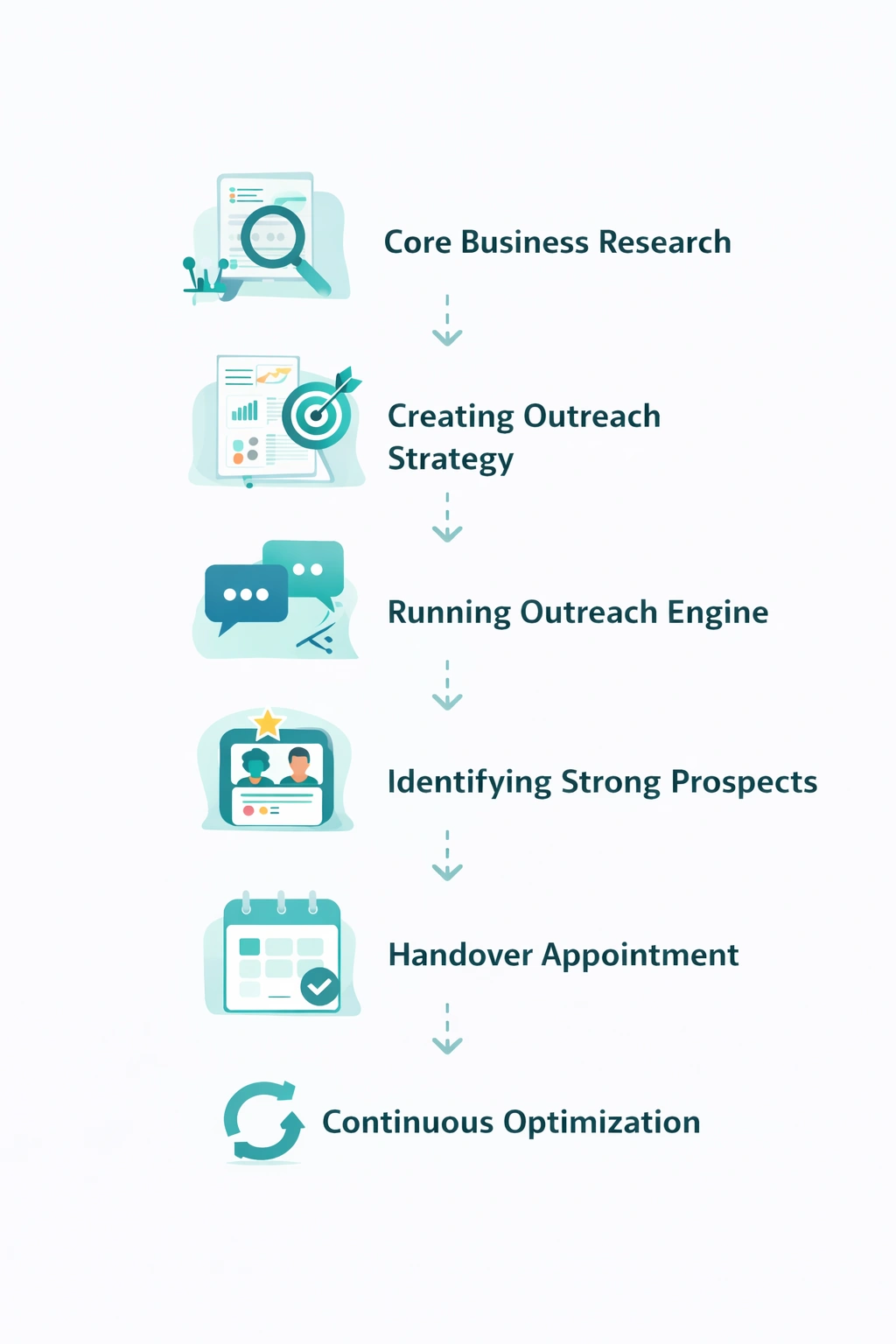
From identifying the right decision-makers to starting meaningful conversations and turning them into qualified appointments... LinkedoJet manages the entire outbound engine for your business.
Next step: replace outreach roulette with a signal-driven retainer pipeline
If you’re serious about consistent fractional CMO deal flow, the win isn’t “more messages.” It’s a repeatable engine: the right accounts, the right buyer, and the right moment—supported by real follow-up and clear tracking.
Outcome you should expect: a tiered target list built on buying signals, mapped stakeholders (CEO/CRO/marketing/finance/PE ops), and context-driven angles you can stand behind—then outreach execution and nurturing that keeps warm opportunities moving until they book.