
How to find leads for Translation & Localization Services on LinkedIn (without drowning in freelancers)
A repeatable system for LSPs: build tight Sales Navigator searches, watch for l10n/i18n triggers, qualify accounts like an operator, then reach out with context tied to what they’re already shipping.
Most LSPs aren’t short on capability. They’re short on timing.
You see it happening in public: a SaaS posts release notes every week, an app pushes into LATAM, an eCommerce team adds EU currencies, a company announces a new documentation hub, and suddenly there’s a Localization Manager job. By the time the vendor portal listing appears, the shortlist already exists.
LinkedIn can be an intent surface for those moments—if you stop treating it like a contact database.
- Sales Navigator targeting that finds actual decision-makers across Localization, Content/Marketing, Product, Support, and (when appropriate) Procurement.
- Trigger-signal monitoring for expansion, launches, multilingual hiring, and tooling work (TMS/i18n refactors) that signals budget and urgency.
- Qualification scoring so you avoid low-budget “maybe someday” conversations and focus on accounts with international footprint + content volume + workflow complexity.
Why most LSP LinkedIn outreach fails (even when the work is excellent)
When pipeline is referral-driven, you can go from “too busy” to “too quiet” in a month. Vendor portals and RFP boards don’t fix it—they’re crowded, late-stage, and designed to push price down.
So teams default to LinkedIn search. They type translation or localization, connect with whoever appears, and send a capability blurb.
And then the predictable things happen:
- You pull in freelancers, other agencies, students, recruiters, and tooling vendors—anyone who talks about language.
- You target only “Localization Manager” and miss the people who control budget in Content, Product, Support, or Ops.
- You start conversations before the pain is felt (no urgency), or after procurement has already standardized vendors (no access).
The cost of guessing is real. Hours disappear into outreach that can’t convert, reply rates fall, cycles drag, and when a real buyer finally bites you feel forced into discounting because you showed up as “one more translation vendor” instead of a credible partner tied to their current initiative.
Who to target (and what each role actually cares about)
Localization buying is fragmented. A “localization team” might be one person. Or it might be a program under Product. Or it might live inside Content Ops. If you only message one title, you’re betting your pipeline on your prospect’s org chart.
| Buyer group | Titles to include (examples) | What they actually care about |
|---|---|---|
| Localization owners | Head of Localization, Localization Manager, Localization Program Manager, Localization Lead, Globalization Manager, Internationalization (i18n) Manager, Localization Operations Manager, Localization Vendor Manager |
|
| Multilingual content owners | VP Marketing, Director of Content, Head of Content, Content Operations Manager, Global Content Manager, Director of Brand, Demand Gen Director |
|
| Product & Support owners | VP Product, Product Director, Product Manager (International/Global), Program Manager, Engineering Manager (i18n), Head of Platform, Release Manager, VP Customer Support, Director of Support, CX Operations Manager |
|
Procurement usually isn’t the starting point—but in mature companies it becomes the gate. Add it when headcount and industry suggest formal vendor management (or when you see “strategic sourcing” / “category manager” roles tied to marketing services or professional services spend).
Account qualification that predicts budget and urgency (and what to exclude)
Good outreach copy can’t rescue a bad list. For LSPs, the list is the strategy.
LinkedoJet qualifies accounts the way a strong BD lead would—using signals that correlate with recurring localization spend, not one-time “translate our brochure” requests.
Qualification checklist (what we score)
- International exposure: operates in 2+ regions, multilingual site indicators, country subfolders (e.g.,
/de/,/fr/), multi-currency checkout, global user base. - Content volume: active help center, documentation hub, frequent release notes, large product catalog, academy/training program, regular investor/policy updates.
- Complexity: regulated or technical content, multiple product lines, omnichannel support, high change frequency (apps/SaaS/gaming updates).
- Budget/procurement maturity: vendor management roles, category managers, “preferred suppliers,” signs of consolidation.
- Localization readiness: mentions of l10n/i18n workflows, TMS, translation management, localization pipelines, or known tooling ecosystems (Smartling, Lokalise, Phrase, Transifex, Crowdin, memoQ, Trados, XTM, GlobalLink).
Exclude / avoid (list hygiene)
- Companies that are themselves LSPs/translation agencies (competitors) and interpretation firms.
- Recruiting/staffing firms (easy to accidentally pull into “vendor manager” and “localization” searches).
- Single-market local businesses, English-only positioning, hobby apps, and micro teams with no distribution.
- Profiles clearly selling “machine translation only” with no services spend (unless you sell MTPE with QA and can position it credibly).
Sales Navigator filter recipes (copy/paste) for real localization buyers
Build your base lists by segment, then layer triggers on top. The mistake is starting with triggers first—you end up chasing noise. Start with high-fit accounts, then let signals tell you who to contact this week.
Recipe 1: Localization owners at scaling SaaS
- Industry: Computer Software; Information Technology & Services; Internet
- Company headcount: 51–200, 201–500, 501–1,000 (add 1,001–5,000 if you sell enterprise)
- Seniority level: Manager, Senior, Director, VP
- Title contains: Localization, Globalization, Internationalization, i18n, l10n, Program Manager, Operations, Vendor Manager
- Geography: set both company HQ region + lead geography (start where your LSP sells well)
Recipe 2: Content/Marketing leaders driving multilingual growth
- Function: Marketing
- Seniority level: Director, VP, CXO
- Titles to include: VP Marketing, Director of Content, Head of Content, Content Operations Manager, Global Content Manager, Director of Brand, Demand Gen Director
- Company headcount: 201–5,000
- Keywords (lead or company): multilingual, international, global, localization, translated, “available in”
Recipe 3: Procurement/vendor gatekeepers for services spend
- Function: Purchasing
- Titles to include: Procurement Manager, Strategic Sourcing Manager, Vendor Manager, Category Manager (Marketing Services / Professional Services), Purchasing Manager
- Industry focus: Medical Devices, Pharmaceuticals, Financial Services, Insurance, Legal Services (or any sector where vendor controls are strict)
- Seniority: Manager–Director
Operationally: save each search, build an account list per vertical (SaaS, mobile apps, eCommerce/marketplaces, regulated), and keep a clean title map so you’re not stuck talking only to “localization” titles.
Buying signals you can see on LinkedIn (and how we prioritize them)
Intent doesn’t show up as “We need translation.” It shows up as work that creates localization pressure.
Triggers that usually precede vendor spend
- Expansion: “launching in EMEA/APAC,” “now available in [language],” opening new offices, hiring a regional GM, new distributors/resellers.
- Product velocity: major app release, platform rebrand, new product line, public roadmap posts, release manager updates.
- Hiring (high-priority): Localization Manager/Program Manager, Localization Engineer, International SEO Manager, Content Operations, Technical Writer (multilingual), Vendor Manager.
- Tooling/workflow: TMS mentions, translation management posts, i18n refactor threads, CMS migrations, support stack changes (e.g., help center rebuilds).
- Compliance pressure: entering regulated markets, policy updates across regions, labeling/IFU conversations, SOC2/ISO comms that must be consistent in multiple languages.
LinkedoJet priority-scores accounts by stacking signals: one trigger can be curiosity; two or three plus strong international footprint is usually a buying moment. A new Localization Manager hire at a company with weekly releases and a multilingual help center goes to the top of the queue. A “global” tagline with no footprint and no content volume gets deprioritized.
We also watch activity signals: posts and comments about multilingual UX, i18n, global launches; new role changes (first 30–90 days is gold); and company page updates announcing new languages or markets.
How LinkedoJet runs this daily for LSPs (so your pipeline isn’t luck)
You don’t need another “send more connection requests” motion. You need an outbound engine that stays relevant as your market shifts.
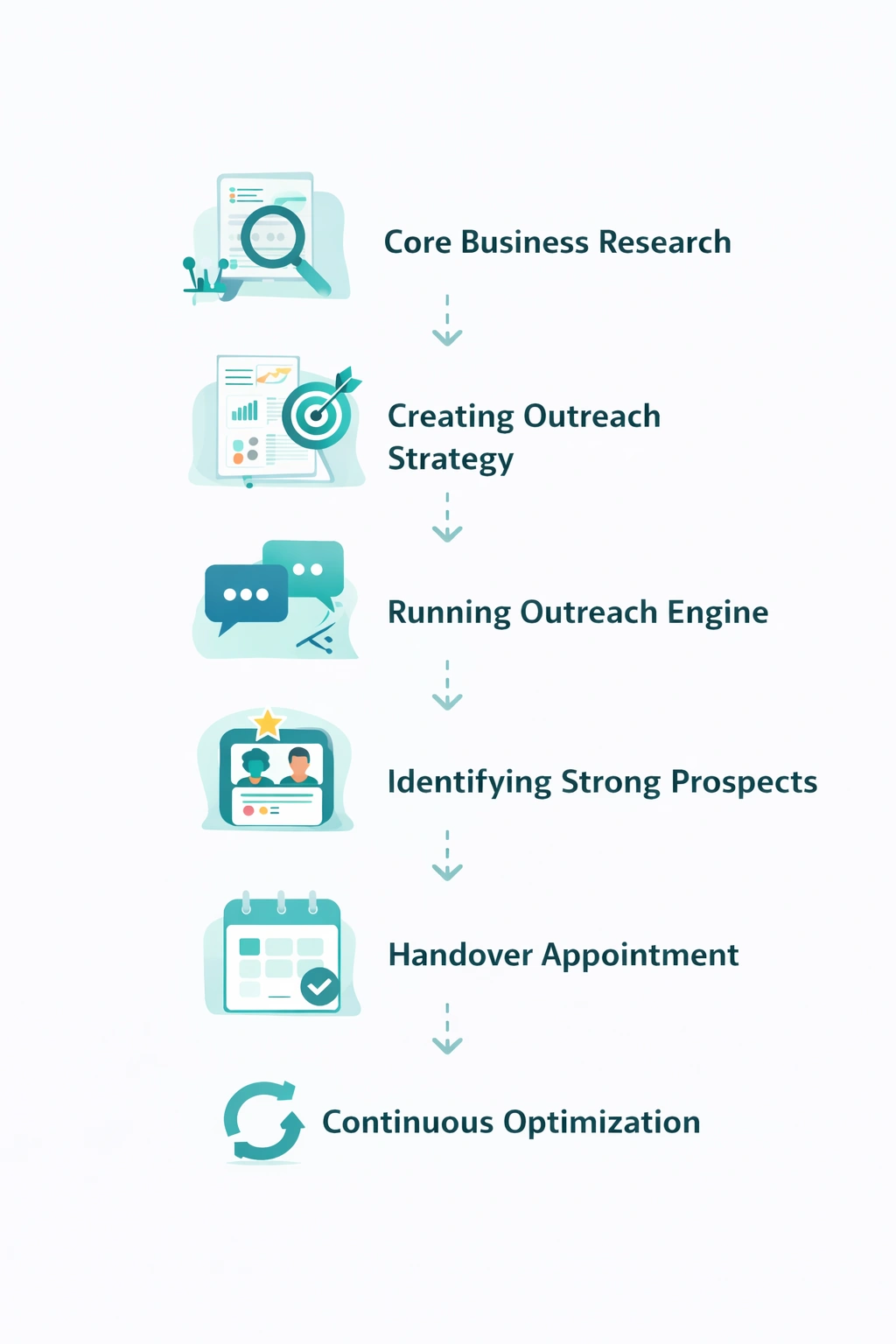
The operating loop we implement
- Segment picks: choose 1–2 verticals (common wins: SaaS/B2B software, mobile apps/consumer tech, eCommerce/marketplaces, regulated sectors) and 2–3 buyer personas to cover real ownership.
- Sales Nav buildout: we set up saved searches, account lists, and a buyer-title map so you hit Localization + Marketing/Content + Product/Support (and Procurement when it’s a gate).
- Signal capture: we monitor hiring, launches, expansion posts, tooling mentions (TMS/i18n), and profile/company changes; each gets tagged to a trigger category.
- Qualification scoring: international footprint, content volume, complexity, urgency, and budget maturity determine who is contacted first and who is held back.
- Context-first outreach execution: AI-assisted personalization pulls the right context (role scope, tech stack hints, recent posts, region/language focus) so your opener makes sense. No generic “we do translation” pitch.
- Trigger-based opener: acknowledge the initiative (new language launch, new l10n hire, TMS work, expansion).
- One-sentence value hypothesis: tied to their role (release velocity, brand voice consistency, QA/rework reduction, support deflection).
- Soft CTA: “Worth sharing how other teams handle [workflow/quality/velocity] when [trigger] hits?”
- Reply handling + nurturing: we manage follow-ups based on what they said (timing, current vendor setup, tooling, languages), not a fixed sequence that ignores reality.
- Warm lead tracking + appointment support: warm replies are tracked, surfaced, and driven toward booked meetings with visibility via dashboards. Weekly refinement keeps list quality high.
Done right, this creates a steady queue of conversations with teams that are already feeling localization pressure—so you’re early, specific, and priced like a partner, not a commodity.
Speak to our Experts | Create my Roadmap to Success
Built around signal-based prospect intelligence and qualification—not volume blasting.
FAQ
Who is the real buyer of localization—Localization Manager or Marketing?
It depends on where localization sits. In product-led orgs, a Localization Program Manager or Globalization Manager often owns workflow and vendors. In content-heavy orgs, Marketing/Content Ops can hold budget and timelines. We don’t guess—we target a mapped set across Localization + Content/Marketing + Product/Support, then prioritize based on triggers and who is posting, hiring, or building tooling.
How do you avoid targeting other translation agencies, freelancers, or recruiters on LinkedIn?
Two layers: (1) account-level exclusions (industries and company keywords that indicate LSPs, interpretation, staffing/recruiting), and (2) lead-level hygiene (exclude profiles heavy on “freelance translator,” “linguist,” “recruiter,” and agency positioning). We also bias searches toward buyer functions (Marketing, Product, Support, Purchasing) instead of language keywords alone.
If a company is hiring a Localization Manager, doesn’t that mean they won’t outsource?
Usually the opposite. A first l10n hire is a signal of budget and urgency. They still need vendor capacity, language coverage, QA support, overflow handling, and specialization (regulated content, multimedia, ASO, community). The outreach angle shifts: you’re not replacing them—you’re helping them hit velocity and quality targets while they build the program.
Can this work for specialized translation (medical/legal/technical) and regulated localization?
Yes. The core system stays the same, but the qualification model tightens: industry filters (medical devices, pharma, fintech/insurance, legal), compliance triggers (policy updates, regulated market entry), and title sets (quality/regulatory, procurement/category managers). Messaging emphasizes risk reduction, controlled workflows, and auditability—alongside speed.
Do you require Sales Navigator to run this?
Sales Navigator is strongly recommended because it makes the targeting and saved-search monitoring precise. We can start without it for a proof-of-concept, but your ability to segment, exclude noise, and track triggers at scale is limited. Most teams move to Sales Navigator quickly once they see the difference in list quality.
See what your next 30 days of high-intent localization outreach could look like
This is not a generic “strategy call.” We’ll show you the exact targeting + trigger + qualification setup we’d run for your LSP, and what you receive once we onboard and execute.
What LinkedoJet operationally provides: we build your ICP and targeting system, create Sales Navigator prospect lists, run AI-assisted personalization for relevance, execute LinkedIn outreach, handle replies and follow-ups, track warm leads, and support appointment generation—while you get visibility through dashboards and ongoing refinement.
What we review on this session:
- Your best-fit segments (e.g., SaaS with multilingual help centers, app-first teams shipping globally, eCommerce with multi-currency + support load).
- Your buyer-title map across Localization, Content/Marketing, Product/Support, and when to bring Procurement into the sequence.
- Your trigger stack: expansion, launches, multilingual hiring, and TMS/i18n work—and which combinations signal a real buying moment.
- Your disqualifiers (competitor LSPs, recruiters, low-fit local businesses) so your list stays clean.
What happens after onboarding: LinkedoJet sets up saved searches and account lists, captures signals daily, priority-scores prospects, and runs context-first outreach that references the initiative they’re already driving (new market entry, release velocity, hiring, tooling). Replies are triaged and nurtured with role-aware follow-ups, and warm leads are tracked through to booked meetings.
What you receive: a buyer-title map + saved searches by segment, a signal-based priority queue, qualification scoring rules tailored to your motion, tested message angles by trigger, and ongoing campaign visibility (who was contacted, who replied, who is warm, who booked).
Why this is different from ordinary LinkedIn automation tools: we’re not selling “send volume.” We run the intelligence, targeting, personalization, follow-up, and tracking as a managed outbound engine—so your team stops burning BD hours on low-intent conversations.
From identifying the right decision-makers to starting meaningful conversations and turning them into qualified appointments... LinkedoJet manages the entire outbound engine for your business.
Next step: turn LinkedIn into a predictable source of localization buyers
If you’re an LSP selling B2B services and you have capacity to deliver, the win isn’t “more activity.” It’s a daily queue of qualified accounts, contacted at the moment they’re feeling l10n/i18n pressure—with replies handled and warm leads pushed to meetings.