
How to Find Leads for Podcast Agencies on LinkedIn—Using Prospect Intelligence, Not Spray-and-Pray
Most “podcast agency leads” lists are just companies with marketing teams. A repeatable system finds the ones already gearing up for a show (or a relaunch), identifies the real buyer, and reaches out when timing is obvious—so you book qualified calls instead of polite dead-ends.
- Sales Navigator targeting + intent signals
- Company qualification rules (budget + content maturity)
- Prioritized outreach by LinkedIn activity
If your outreach feels smart but your pipeline still feels fragile, it’s usually not your offer. It’s that you’re talking to companies that were never podcast-ready—and you only find out after the call.
Speak to our Experts Create my Roadmap to Success
What you get: a prioritized list of podcast-ready accounts, the exact titles to message, and the signal to reference (launch, refresh, booking, or repurposing) so the first message lands like it belongs.
Why your pipeline feels busy but stays weak
The time bleed isn’t the “no.” It’s the string of maybe’s that were never real opportunities.
You send thoughtful outreach. You get a few replies. You run discovery. Then the truth shows up—wrong buyer, no budget, “we’re doing it in-house,” or “we like the idea, not this quarter.”
That’s not rejection. That’s wasted operator time.
Podcast agencies get trapped here because “podcast” sounds like a single purchase. In B2B it’s rarely that. A real engagement is a content engine: episodes, clips, newsletter, YouTube, distribution, guest pipeline, internal alignment, and reporting. The buyer has to be ready for that level of commitment.
- Wrong account: you pitch production to a company that doesn’t consistently fund content.
- Wrong person: you message a social manager who can’t buy a season, never mind a program.
- Wrong timing: you miss the window right after funding, a new Head of Content, or a rebrand.
- Hidden in-house signal: they just hired an audio editor and are quietly building a studio.
The output looks like activity—calls, proposals, “circle back.” The business output is worse: lower reply rates, longer sales cycles, and deals that cap out at small transactional retainers instead of launch + distribution + repurposing + guest pipeline.
Define “podcast-ready” accounts (and exclude the time-wasters)
Podcast-ready is not “has a marketing team.” It’s budget + content maturity + internal urgency.
Start with qualification rules you can apply fast, before you ever write a message.
Best-fit account profile
- Type: B2B SaaS, fintech, cybersecurity, DevTools, HR tech, martech, agencies, consultancies, professional services, VC/PE portfolio companies.
- Size: 11–5000 employees (11–200 moves fast; 201–1000 has budget and content teams; 1001–5000 has programs and approvals).
- Budget/fit proxies: headcount growth, recent funding, active marketing hires, multiple GTM roles.
- Business model: considered-purchase categories (thought leadership and trust actually change outcomes).
- Content maturity: already investing in content (webinars, newsletter, blog cadence, YouTube, events) or actively building it.
Best-fit scenarios (why they buy)
- Founder-led thought leadership: CEO wants an owned platform, not just guest appearances.
- Content engine: marketing wants podcast → clips → newsletter → blog and a predictable workflow.
- Demand gen alignment: they want executive credibility, partner co-marketing, and category authority.
- PR/comms pressure: they need a booking machine and cleaner narratives for executives.
Hard exclusions (or deprioritize)
- Pre-seed teams with no marketing headcount or no content cadence.
- Local SMBs with no content team and no clear distribution plan.
- Companies openly “no agencies” / “no vendors.”
- Companies already running a full in-house podcast studio (Head of Podcast + Producer + Editor) unless you’re selling overflow, distribution, booking, or a relaunch.
- Dormant show with last episode > 12 months ago and no other current content activity (unless there’s a fresh trigger like funding or new leadership).
Target the real buyers (and stop getting stuck with “nice-to-have” conversations)
Podcast decisions live with brand/content leadership, not whoever posts on social.
On LinkedIn, title targeting is half the qualification. The other half is knowing who to message first by company size so you don’t get trapped in internal handoffs.
Primary decision-makers (own content/brand budget)
- VP Marketing, Head of Marketing, Director of Marketing
- Head of Content, Director of Content Marketing, Content Marketing Manager (often buyer at smaller firms)
- VP Brand, Head of Brand, Director of Brand Marketing
- VP Communications, Head of Communications, Director of Corporate Comms
- VP Demand Generation, Head of Demand Gen, Director of Demand Gen (when podcast is tied to pipeline programs)
- VP Growth, Head of Growth (secondary; depends on org design)
Founder/executive buyers (especially 11–200 employees)
- CEO, Founder, Co-Founder, President
- Managing Partner, Principal (professional services)
Podcast-specific titles (strong urgency signals)
- Podcast Producer, Executive Producer, Head of Podcast, Podcast Manager
- Audio Producer, Multimedia Producer, Content Producer
- Head of Media
Who to message first (simple rule)
- 11–50: Founder/CEO first, with a content-engine angle and a clear “done-for-you” operating model.
- 51–500: Head/VP Marketing or Head of Content first; they can sponsor the program and make it real.
- 500+: Brand/Comms/Content leadership first; loop in podcast lead or producer second if they exist.
One niche-specific tell: if a company’s “Content Marketing Manager” is running webinars, newsletters, and event recaps, they can often sponsor a pilot season—even when the Head of Marketing is busy. But don’t confuse influence with authority. Your sequencing should reflect that.
Sales Navigator setup for podcast agency leads (copy-this searches + a qualification checklist)
You’re not building a big list. You’re building three small lists you can work hard: launching, hiring, and exec-led thought leadership.
Set your defaults once:
- Geography: North America, UK/Ireland, ANZ, Western Europe (adjust to your delivery capacity).
- Account headcount: 11–5000.
- Lead spotlights: posted on LinkedIn in past 30 days; changed jobs in last 90 days (optional but powerful).
- Relationship: 2nd-degree where possible; add shared groups when relevant (B2B marketing, demand gen, podcasting).
| Qualification check | What you’re looking for | De-prioritize when… |
|---|---|---|
| Budget proxy | Headcount growth, funding, multiple GTM hires, marketing stack signals (e.g., HubSpot/Marketo/Salesforce) | No marketing hires, flat headcount, no GTM roles |
| Content maturity | Webinars, newsletter, YouTube, events, consistent exec posting | Company page dormant; leadership never posts; no content footprint |
| Urgency trigger | Podcast launch/relaunch hints, hiring, new marketing leadership, rebrand, category push | “Nice idea” energy; no trigger and no content engine |
| In-house capability | Light in-house team or gaps you can fill (distribution, booking, editing throughput) | Fully staffed in-house studio + recent hires (unless overflow) |
Recipe A: “Podcast launch intent” list
Accounts: headcount 11–1000. Account keywords on company page: podcast OR studio OR episodes OR newsroom OR media. Leads: Head of Content OR VP Marketing OR Director of Content Marketing. Spotlights: posted in last 30 days.
Recipe B: “Hiring intent” list
Accounts with job postings containing: podcast producer, audio editor, content producer, video editor, content marketing manager, head of content, head of brand. Leads: Director/VP Marketing, Head of Brand/Comms, Head of Content.
Recipe C: “Thought leadership engine” list
Leads: CEO/Founder/VP Marketing. Industries: SaaS, fintech, management consulting, information security, HR/staffing. Spotlights: posted in last 30 days. Add: years in current position 0–24 months to catch new leaders building their first “flagship” program.
What you get: we turn these searches into clean prospect queues, with qualification rules and prioritization so your team spends time on accounts that can actually buy.
Intent + activity signals: what to watch, what to ignore, and how to personalize without sounding like everyone else
The signal isn’t “they’re in SaaS.” The signal is momentum: hiring, launches, leadership change, and visible content push.
Prioritize signals by tier
- Tier 1 (act now): podcast announced, launch trailer, “new show” page; hiring for podcast/audio roles; exec posting about recent podcast appearances or asking for guest/show recommendations.
- Tier 2 (strong timing): new CMO/VP Marketing; funding/M&A; rebrand or new category narrative; explicit posts about awareness/category education.
- Tier 3 (warming up): increased webinar/event cadence; newsletter launch or refresh; YouTube expansion; community program build.
Negative signals (save your operators)
- They just staffed a full in-house podcast team and are proud of it.
- Careers page language: “no agencies,” “no vendors,” or procurement-heavy vendor gates for small projects.
- Content is dormant across the board (company page + exec posts) and there’s no trigger event.
What to read before you message (5 minutes, no excuses)
- Buyer’s last 5 posts (look for content priorities and how they talk about growth).
- Featured section (podcast appearances, webinars, keynotes, newsletter).
- About section (role scope: brand vs demand gen vs comms).
- Company page recent posts (event cadence, launches, hiring).
- Hiring tab (what they’re building internally).
Five personalization angles that actually fit podcast agencies
- Webinar-to-episodes: “You’re already investing in webinars—podcast can turn those themes into an evergreen content engine with clips and distribution baked in.”
- Hiring-to-launch: “Noticed you’re hiring a content producer—often that’s the moment to anchor the new workflow around a season format.”
- Guesting-to-owned show: “Saw the founder promoting guest appearances—let’s build a guesting pipeline and an owned show so you’re not renting attention.”
- Repositioning-to-season narrative: “Your narrative is evolving—season arcs are a clean way to tell the new story without a full rebrand campaign.”
- Community-to-programming: “Your audience is already active—podcast programming can anchor community content and partner episodes.”
The goal is simple: reference the trigger they already care about, then map it to the right offer angle (launch vs refresh vs booking vs distribution/repurposing). That’s prospect intelligence in practice.
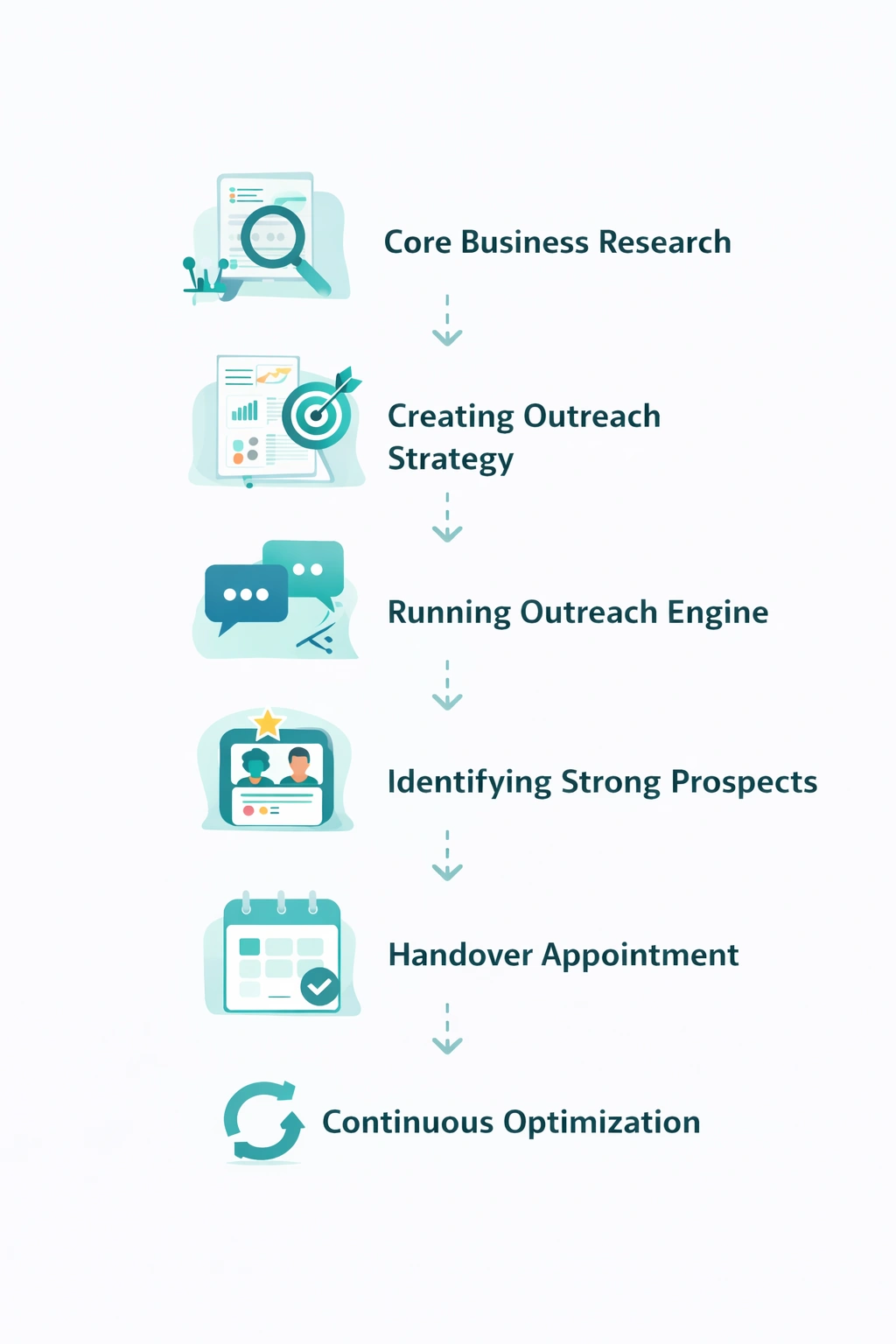
How LinkedoJet runs prospect intelligence for podcast agencies (4 steps)
LinkedoJet is not “automation.” It’s the operating system that keeps your outbound focused on podcast-ready accounts—and keeps follow-up consistent once replies start coming in.
Step 1: Define ICP + exclusions (so your list stops lying)
We set your account rules (size, industry, geo) plus hard exclusions (pre-seed with no marketing, anti-agency, fully in-house studios unless overflow). We also lock the title map so you’re not selling a season to someone who can’t approve it.
Step 2: Build Sales Navigator lists that match real buying moments
We build and maintain the three working lists—Launching/Announced, Hiring for Podcast/Content, and Exec Thought Leadership—plus vertical slices (SaaS founders, fintech CMOs, consulting partners, VC platform teams) so your outreach stays coherent.
Step 3: Layer intent + activity scoring (timing beats volume)
We score accounts by signals: hiring, funding, leadership changes, posting frequency, company page activity, and specific podcast indicators. The output is a prioritized queue, not a spreadsheet you’ll ignore.
Step 4: Execute outreach + handle replies + nurture until booked
LinkedoJet runs the outreach workflow with AI-assisted personalization prompts based on the profile and company context (launch, relaunch, booking machine, distribution/repurposing). We manage follow-up and lead nurturing, track warm leads, and support appointment generation so momentum doesn’t die after the first reply.
What you get: fewer, better prospects; higher-quality replies; faster qualification calls; and more deals that look like strategic programs—not one-off editing retainers.
FAQs
Which industries buy podcast agency services fastest for B2B (production, launch, booking, marketing)?
Fastest cycles usually show up where thought leadership shortens sales friction: B2B SaaS (especially cybersecurity/DevTools/HR tech/martech), fintech, management consulting/professional services, and VC/PE portfolio companies with a platform/content mandate. They already live in webinars, events, and category education—podcasts fit their motion.
How do I find companies launching a podcast right now on LinkedIn?
Look for direct launch signals on the company page and leadership posts: “new show,” “trailer,” “first episode,” “now streaming,” new artwork, or a new show page link in Featured. Then cross-check hiring for podcast/audio/content roles. In Sales Navigator, pair account keyword filters (podcast/episodes/studio/media) with leads who posted in the last 30 days so you’re not messaging ghosts.
Should I pitch founders or marketing leaders first for done-for-you podcast services?
By default: 11–50 employees, go founder/CEO first (they’re the brand and can greenlight quickly). 51–500, go Head/VP Marketing or Head of Content (they own the budget and workflow). 500+, start with brand/comms/content leadership and then loop in any podcast-specific operator. If the founder is visibly pushing thought leadership on LinkedIn, that can override the rule—timing beats org charts.
What if a company already has a podcast—how do I position a refresh, growth, or repurposing offer?
Don’t sell “we produce podcasts.” Diagnose the gap: inconsistent cadence, weak distribution, no guest pipeline, no clips workflow, no narrative arc, or no connection to campaign themes. Then pitch one clear outcome: relaunch with a season format, build a booking machine, add distribution + repurposing, or increase throughput without hiring. A stalled show with a new CMO or a rebrand is often a perfect relaunch moment.
How do I avoid low-budget prospects when I’m looking for podcast agency leads?
Use budget proxies before outreach: 11–5000 employees, headcount growth, funding/M&A, active marketing hiring, and clear content maturity (webinars/newsletter/YouTube/events). Then exclude early teams with no marketing headcount, local SMBs without a content function, and companies openly anti-agency. If they can’t run a content calendar, they won’t fund a season.
See what your podcast-agency pipeline looks like with real prospect intelligence
This isn’t a vague “strategy chat.” We’ll show you how we build and run a LinkedIn client acquisition system that finds podcast-ready accounts, prioritizes them by intent, and turns conversations into booked appointments.
What LinkedoJet operationally provides: ICP and targeting setup, Sales Navigator prospect list building, AI-assisted personalization, LinkedIn outreach execution, reply handling and lead nurturing, warm lead tracking, appointment generation support, and campaign visibility through dashboards—with ongoing refinement as we learn what converts in your niche.
What happens after onboarding: we translate your best-fit accounts (and exclusions) into repeatable Sales Navigator searches, build three working lists (Launching/Announced, Hiring, Exec Thought Leadership), and then turn them into a prioritized prospect queue based on intent and activity signals.
What you receive:
- A clean, qualified account universe (not a bloated list) with the right buyer titles mapped by company size.
- Signal-based prioritization so your team works the accounts most likely to buy this month.
- Personalization prompts grounded in real context (launch vs relaunch vs booking machine vs distribution/repurposing), so your first message reads specific—not templated.
- Outreach sequences executed end-to-end, with follow-up and lead nurturing handled so warm threads don’t go cold.
- Warm lead and appointment tracking, plus visibility into what’s working via dashboards.
How targeting and prospect list building work: we use Sales Navigator filters (geo, headcount, industry, seniority, title, spotlights like “posted in last 30 days” and “changed jobs in last 90 days”) plus account keywords (podcast, episodes, media, newsroom) and hiring cues (podcast producer, audio editor, content producer) to build lists aligned to buying moments.
How AI-assisted personalization is used: not to spam. We use it to summarize the trigger and suggest a clean angle—“noticed the new Head of Content + webinar push” or “founder is actively guesting”—then your message speaks to the moment.
How lead nurturing and follow-up workflows operate: when someone replies with “later” or “send details,” we keep the thread alive with relevant follow-ups tied to their trigger (e.g., relaunch plan, guest pipeline, distribution workflow) instead of resetting the conversation every two weeks.
How warm leads and appointments are tracked: every active conversation is tracked as it moves from first reply → qualified interest → scheduled meeting, so you’re not guessing what’s stuck.
Why LinkedoJet is different from ordinary LinkedIn automation tools: automation sends messages. LinkedoJet runs the whole outbound operating system—qualification rules, intent scoring, personalization, execution, nurturing, and appointment support—so you spend your time on delivery and high-quality sales calls.
From identifying the right decision-makers to starting meaningful conversations and turning them into qualified appointments... LinkedoJet manages the entire outbound engine for your business.
Next step: build a prospect queue that only includes podcast-ready accounts
If you’re tired of discovery calls that collapse into “no budget” or “we’re doing it in-house,” the fix isn’t more volume. It’s a tighter client acquisition system: qualification rules, real buyer targeting, intent timing, and consistent follow-up—run end-to-end.
Operational outcome: a prioritized list of podcast-ready accounts, the titles to message first, the trigger to reference, and an outbound workflow that keeps warm leads moving until meetings are booked.