
How to find leads for pharma recruitment firms—using Sales Navigator + real buying signals
Most pharma recruiters aren’t short on names—they’re short on truth. Truth about who’s actually hiring, who can add a supplier, and whether the account is winnable right now. This approach builds a qualified target list of pharma/biotech/CRO/CDMO decision-makers and ties outreach to the signals that show demand weeks before the “recruiter-friendly” job ad appears.
- Target TA and procurement/MSP and functional hiring leaders (not just job posters)
- Prioritize accounts with real catalysts: funding, approvals/PDUFA milestones, trial ramp, tech transfers, plant expansions
- Segment properly: big pharma/biotech vs CRO vs CDMO vs VC-backed biotech (different buying paths)
- Bias toward reachable buyers: active LinkedIn users, new leaders (0–180 days), people posting/sharing hiring content
- Avoid “no-agency” dead ends and MSP-only traps before you burn a week
If you’re serious about predictable BD, the goal isn’t “more outreach.” The goal is a weekly, signal-led list that tells you: who to contact, why now, and what vendor path you’re actually trying to get onto.
Why your pipeline feels busy but revenue stays lumpy (and what it’s really costing you)
You can feel the month slipping.
Recruiters are waiting on reqs, delivery capacity is underused, and your BD activity looks “healthy” on paper—yet you’re still the backup agency that gets called when the hiring spike is already messy and urgent. That’s not a lead volume issue. That’s a targeting and timing issue.
Life sciences hiring is gated now. Post-2023, procurement tightened, vendor rationalization became normal, and MSP/VMS control expanded. Plenty of companies post roles while freezing spend, forcing referral-first policies, or pushing everything through a preferred supplier list you aren’t on.
So the classic failure modes compound:
- Chasing TA contacts who can’t add vendors (or can only route you to an inbox)
- Pitching hiring managers with no budget authority—they’re “hiring,” but not “buying”
- Working pharma logos with an MSP wall without a realistic path to vendor approval
- Hitting accounts during freezes/layoffs and wondering why conversations stall
- One generic list + one generic message across pharma, CRO, and CDMO—three different worlds
The hidden cost isn’t just wasted messages. It’s the slow erosion of confidence inside your firm: recruiters stop trusting BD, BD starts optimizing for activity, and leadership gets addicted to “big logo” fantasies while cash flow stays unpredictable.
Who actually controls vendor access: TA vs procurement/MSP vs functional leadership
In life sciences staffing, “the buyer” changes by segment, size, and whether the company is set up for contingent labor through an MSP/VMS. Your job isn’t to find a contact. It’s to map the decision path.
| Control point | What they do | When they’re the bottleneck | Titles to target |
|---|---|---|---|
| TA / HR | Runs req intake, recruiter capacity, sometimes supplier management | Mid-market biotech/medtech; growing teams; vendor reset with new TA leader | Head of Talent Acquisition, Director of Talent Acquisition, Talent Acquisition Manager, Senior Talent Acquisition Partner, TA Lead, Global Talent Acquisition, TA BP, Recruitment Lead; CHRO, VP Human Resources, HR Director, Head of People, People Director, People Operations |
| Procurement / MSP | Controls MSA/PSL/VMS access, rate cards, compliance docs, supplier onboarding | Large pharma; global CROs; enterprises with contingent labor programs | Procurement Manager, Head of Procurement, Strategic Sourcing Manager, Category Manager (Professional Services/HR/Contingent Labor), Vendor Manager, Supplier Relationship Manager, MSP Program Manager |
| Functional leadership | Creates urgency, defines role profile, can sponsor introductions and exceptions | Specialist hiring (clinical, regulatory, quality, manufacturing); site-based ramp; trial acceleration | VP Clinical Operations, Head of Clinical Operations, Director Clinical Operations; VP Regulatory Affairs, Head of Regulatory Affairs; VP Quality, Head of Quality, QA Director; VP Manufacturing, Head of Manufacturing, Plant Manager, Site Head/General Manager; Head of R&D, VP R&D; Head of Bioanalytical; Head of Pharmacovigilance/Safety |
Org map rule: build at least two contacts per account before you send a single message—one TA/HR and one functional leader. Add procurement/MSP when the company is enterprise-sized, mentions MSP/VMS, or you see contingent labor category roles.
And read profiles like a compliance document, not like a social feed. Look for phrases such as “preferred supplier,” “contingent workforce,” “vendor management,” “MSP,” “built TA function,” or “workforce planning.” That language is a tell.
Qualification rules that prevent dead ends: Signal + Capacity + Authority
You don’t need a prettier list. You need fewer lies in your list.
Use a micro-framework that forces honesty before outreach:
- Signal: a real hiring catalyst exists (not just evergreen postings)
- Capacity: they can spend and staff (not under a freeze, not a “nice-to-have”)
- Authority: there’s a path to vendor onboarding (or a sponsor who can create one)
Practical fit rules for life sciences staffing:
- Segments to run separately: pharma/biotech/medtech employers; CROs; CDMOs/CMOs; VC-backed biotech (51–200 headcount often moves fastest)
- Headcount bands: prioritize 200–10,000 for consistent demand; include 51–200 for funded biotech; avoid <10 unless you know it’s genuinely scaling
- Geography hubs: US (MA/Cambridge, NJ, PA, NC/RTP, Bay Area, San Diego), UK (London, Cambridge, Oxford, Stevenage), EU (Basel, Dublin, Amsterdam, Munich, Copenhagen)
- Hiring intensity markers: recurring LinkedIn postings; multiple roles in Clinical Ops, Data Management, Biostats, Regulatory, QA/QC, Validation, MSAT, CSV/Automation; contractor language (“6–12 months,” “on-site shift,” “validation shutdown,” “batch release surge”)
- Vendor openness markers: language about “agency partners,” “preferred suppliers,” “staff augmentation,” “contingent workforce,” or visible procurement/category hiring
Explicit exclusions (save your team’s morale):
- Job ads that clearly state “no agencies” / “no recruiters” as policy
- Accounts with hiring freezes, layoffs, rescinded offers, or repeated downsizing news
- Stealth or pre-funding biotech with no real hiring footprint
- MSP-only programs where the stated process is “submit details” and nothing else
This is how you stop “busy pipeline” from becoming a quarterly surprise.
Sales Navigator recipes: saved searches by segment (pharma/biotech, CRO, CDMO, VC-backed biotech)
Build saved searches like you build a delivery team: by specialty, not by wishful thinking. One giant “Talent Acquisition” list across life sciences will always underperform because the buying committee and urgency triggers are different.
Saved search A: “Pharma/Big Biotech TA Leaders (US Northeast)”
- Account filters: Industry = Pharmaceuticals, Biotechnology, Medical Devices; Geography = MA/Cambridge + NJ + PA; Company headcount = 1001–5000, 5001–10000; Hiring on LinkedIn = Yes
- Lead filters: Function = Human Resources; Seniority = Manager, Director, VP, CXO; Title contains = Head of Talent Acquisition, Director of Talent Acquisition, Global Talent Acquisition, TA Lead, Recruitment Lead, Senior Talent Acquisition Partner, CHRO, VP Human Resources
- Spotlights to bias toward reachability: Posted on LinkedIn last 30 days; Changed jobs in last 90 days; Mentioned in the news; TeamLink/2nd degree where available
- Profile-read check: confirm they own supplier process (keywords: “vendor management,” “preferred supplier,” “contingent workforce,” “MSP”)
Saved search B: “CRO Clinical Ops + TA (US/EU)”
- Account filters: Industry = Research, Pharmaceuticals, Biotechnology (and CRO-relevant categories you already know fit your book); Geography = US hubs + EU (Basel, Dublin, Amsterdam, Munich, Copenhagen); Company headcount = 201–5000; Hiring on LinkedIn = Yes
- Lead filters (two clusters):
- TA/Resourcing: Title contains = Talent Acquisition, Recruiting, Resourcing, Talent Operations; Seniority = Manager/Director
- Delivery-demand owners: VP Clinical Operations, Head of Clinical Operations, Director Clinical Operations; Director Resource Management; Workforce Planning Manager; Capacity Planning
- Spotlights: Posted on LinkedIn last 30 days; Changed jobs in last 90 days (new resourcing leaders are often more open to new suppliers)
- Niche tell: CROs telegraph demand via resource management hires and “project ramp” language before reqs get widely distributed.
Saved search C: “CDMO Manufacturing/Quality Hiring (site-based)”
- Account filters: Industry = Pharmaceuticals, Biotechnology, Chemicals (where relevant for API manufacturers); Geography = target manufacturing hubs (RTP, NJ/PA corridors, Ireland, Switzerland); Company headcount = 501–10000; Hiring on LinkedIn = Yes
- Lead filters: Function = Operations (for site leaders/procurement), Human Resources (for TA); Titles = Site Head/General Manager, Plant Manager, Head of Manufacturing, VP Manufacturing; Head of Quality, VP Quality, QA Director; Procurement Manager, Category Manager (Contingent Labor/Professional Services)
- Spotlights: Mentioned in the news (new facility, tech transfer, capacity expansion); Posted on LinkedIn last 30 days
- Niche tell: When a CDMO is heading into validation lots, tech transfer, or a “shutdown window,” contractor mobilization becomes urgent and very specific.
Saved search D: “VC-backed Biotech People Leaders (0–2 yrs tenure)”
- Account filters: Industry = Biotechnology; Company headcount = 51–200, 201–500; Geography = US/UK/EU hubs you can service; Hiring on LinkedIn = Yes
- Lead filters: Seniority = Director, VP, CXO; Titles = Head of People, People Director, People Operations, HR Director, Head of Talent Acquisition; Years in current position = 0–2 years
- Spotlights: Changed jobs in last 90 days (new People leaders build vendor benches); Mentioned in the news (funding, partnerships)
- Profile-read check: look for “building the team,” “scaling,” or prior experience in larger pharma/CRO environments where vendor use was normal.
Buying signals to prioritize this week (and who to contact when they hit)
Signals are your timing advantage. They show intent before the organization turns it into a clean requisition. If you wait for job boards, you’re late—and usually talking to people who can’t change vendors anyway.
Signal → what it usually means → who you contact
- Funding round (Series A–D), IPO filing, major partnership → headcount plan gets real; new functions staffed fast → Head of People/People Ops + Head/Director of TA + the function head tied to the build (R&D, Clinical Ops, Regulatory)
- FDA/EMA approval, PDUFA approaching, new indication, fast track/breakthrough → commercialization and compliance hiring ramps → TA leader + Regulatory Affairs + Quality + (often) Manufacturing
- Trial ramp: phase progression, new trial site activations, multiple new studies → CRO demand and sponsor-side clinical teams swell → VP/Head of Clinical Operations + Director Clinical Operations + TA/Resourcing + Resource Management
- Plant expansion, new line, new facility, tech transfer → QA/QC, validation, MSAT, CSV/Automation surge (often contractor-heavy) → Site Head/Plant Manager + Head of Quality/QA Director + Head of Manufacturing + Procurement/Category Manager
- New CHRO / Head of TA / VP People → vendor bench gets reset; old suppliers get questioned → new TA/People leader + procurement/vendor manager (if enterprise)
- New procurement category hire (contingent labor / professional services) → program tightening or new supplier event → Category Manager + MSP Program Manager + TA leadership
Then layer the LinkedIn activity triggers that tell you your message will actually get read:
- They’ve posted on LinkedIn in the last 30 days (especially hiring-related content)
- They’ve changed jobs in the last 90 days (new leaders are re-setting process)
- They repeatedly share job posts or engage with workforce planning, resourcing, contingent labor, outsourcing topics
If you only do one thing differently: stop prioritizing accounts by logo. Prioritize by catalyst + control point.
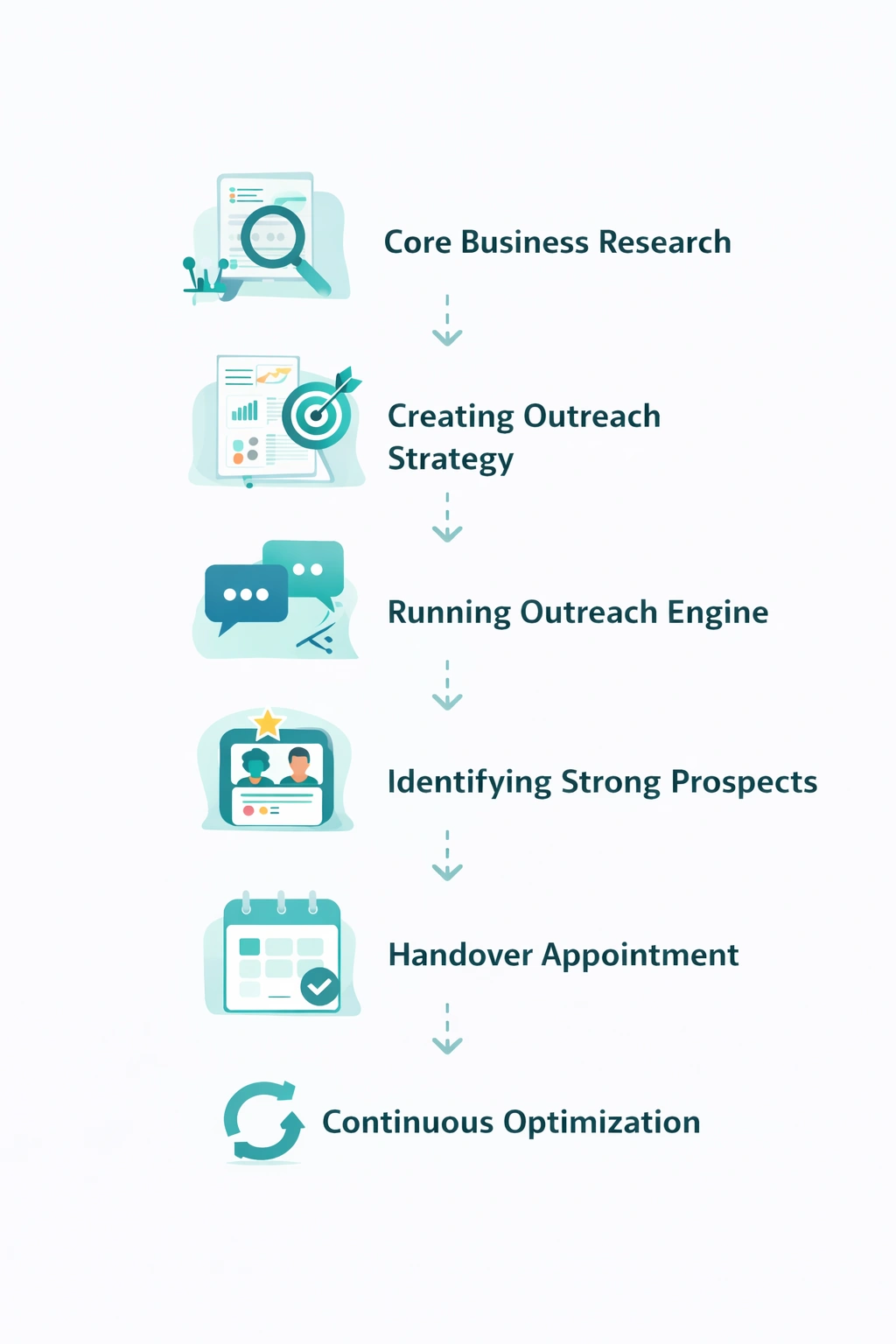
How LinkedoJet runs the system: market segmentation → org mapping → signal scoring → outreach → onboarding path
LinkedoJet isn’t a “send more messages” tool. It’s a prospect intelligence system plus an execution layer that runs a repeatable client acquisition workflow for life sciences staffing.
1) Segment your market (so your targeting matches buying reality)
We split your outreach into distinct pools—pharma/biotech/medtech employers, CROs, CDMOs/CMOs, and VC-backed biotech—because each has different gating, urgency signals, and committee structure.
2) Build and verify prospect lists in Sales Navigator
We set up your ICP filters, build segmented account lists, and create saved searches that separate TA/HR, procurement/MSP, and functional leadership. Then we do the unsexy part most firms skip: profile reading to verify authority and scope (global vs site, EMEA vs US, contingent workforce ownership, vendor management language).
3) Score accounts with buying signals (so your team knows what to do this week)
Funding, approvals/PDUFA milestones, trial ramp, plant expansions, leadership changes, and LinkedIn activity get translated into a prioritized weekly list—so you’re early, not late.
4) AI-assisted personalization that stays credible in a regulated world
We use AI to draft first-pass personalization anchored to the actual signal (not fluff), then refine it with operator rules: mention the catalyst, name the function likely impacted (QA/Validation, Clinical Ops, Regulatory), and make the ask realistic (intro + vendor path), not needy.
5) Outreach execution + reply handling + nurturing
LinkedoJet runs the cadence on LinkedIn and manages follow-up workflows. Replies get handled with a clear objective: move from “thanks” to a defined next step—capability deck, hiring pain clarification, vendor onboarding requirements, PSL/MSA path, or an introduction to procurement/MSP when needed.
6) Warm lead tracking, dashboards, and appointment generation support
You get visibility into outreach volume, reply rates, warm conversations, and booked meetings through dashboards. We also refine targeting and messaging based on what’s converting—by segment and by region—so your system gets sharper over time.
From identifying the right decision-makers to starting meaningful conversations and turning them into qualified appointments... LinkedoJet manages the entire outbound engine for your business.
Questions life sciences staffing leaders ask before they commit to outbound
Who is the real buyer in life sciences staffing: TA, procurement/MSP, or the hiring manager?
It depends on the employer’s size and how contingent labor is governed. Mid-market biotech often buys through TA/Head of People with strong functional influence. Enterprise pharma and many global CROs are gated by procurement/MSP for supplier onboarding, even if TA loves you. Functional leaders (Clinical Ops, Quality, Manufacturing, Regulatory) are rarely the signer, but they can create urgency and sponsor an introduction that changes your odds.
How do I sell into pharma accounts controlled by PSL/MSP without getting stuck in “send your details” limbo?
You need a dual-track motion: (1) a procurement/MSP track that respects process (compliance docs, rate card realities, supplier criteria), and (2) a functional sponsor track that ties you to a specific hiring event (validation shutdown coverage, tech transfer surge, trial acceleration). “Send details” only becomes progress when you attach it to a timeline, a pain, and a stakeholder who will feel the impact of delay.
How can I tell if a biotech is truly scaling versus posting roles opportunistically or under a freeze?
Look for clusters, not single postings: multiple roles across functions, consistent reposting, internal TA hiring, and leadership communication about growth. Cross-check negative signals—layoffs, rescinded offers chatter, “referrals only,” or a sudden drop in activity. Funding alone isn’t enough; combine it with hiring intensity and executive/People activity on LinkedIn.
What are the best LinkedIn and news signals for CRO staffing demand (clinical ops, data, biostats)?
Watch for trial pipeline expansion and project ramp language, plus the hiring of resource management/capacity planning leaders. On LinkedIn, decision-makers repeatedly sharing CRA/CTM, data management, biostats roles is a tell. In CROs, staffing pressure often shows up first as resourcing stress—then TA hiring—then external supplier demand.
How do I avoid companies that say “no agencies” while still finding winnable teams inside the same enterprise?
Separate “policy” from “practice.” If the language is hard-line and repeated across postings, treat it as a disqualifier for that division. If it’s inconsistent, map the org: different sites and functions can have different supplier options (especially in manufacturing/quality ramps). Your safest path is to start with the control point—TA leader or procurement category—then validate whether exceptions exist for niche or urgent coverage.
Build a weekly, signal-led lead map—and run outbound without guessing
This isn’t a generic “strategy chat.” We’ll show you what your outbound engine looks like when it’s built around life sciences buying signals, real vendor control points, and segmented targeting across pharma/biotech, CRO, CDMO, and VC-backed biotech.
What LinkedoJet operationally provides:
- ICP and targeting setup tailored to your desk coverage (US/UK/EU hubs, contract vs perm, clinical vs manufacturing/regulatory)
- Sales Navigator prospect list building with segmented account pools and saved searches (TA/HR + procurement/MSP + functional leaders)
- Org mapping so each account has a buying committee, not a single contact
- Signal-based prioritization (funding, approvals/PDUFA, trial ramp, plant expansion/tech transfer, leadership changes, LinkedIn activity)
- AI-assisted personalization that references the real catalyst and the right function (Quality/Validation, Clinical Ops, Regulatory, Manufacturing)—then gets human-reviewed for credibility
- Outreach execution on LinkedIn with a structured cadence designed to reach the control point and prompt a concrete next step
- Reply handling and lead nurturing so “sounds good” becomes a pathway: intro → capability deck → vendor requirements → PSL/MSA process → meeting
- Warm lead tracking + dashboards so you can see what’s working by segment, region, and persona—and refine monthly
- Appointment generation support to keep momentum through long vendor onboarding cycles (MSP/PSL friction included)
What happens after onboarding: we stand up your segmented targeting, build the initial prospect lists, implement signal scoring, and start campaigns with messaging angles tied to the catalysts you can actually deliver against (validation shutdown coverage, clinical data team ramp, regulatory submissions support, MSAT/tech transfer surges). You’re not left with a tool—you get a running system.
How targeting and list building work: we filter by industry + headcount + geography hubs + hiring intensity, then add buyer reachability filters (Posted on LinkedIn last 30 days, Changed jobs in last 90 days, Mentioned in the news). We also profile-read for vendor authority language so you don’t waste weeks on polite dead ends.
Why this is different from ordinary LinkedIn automation tools: automation sends messages. LinkedoJet builds the market map, qualifies accounts with signals, identifies the real control point (TA vs procurement/MSP vs function), runs outreach, manages follow-up, and tracks warm leads through to meetings—so revenue stops depending on random timing.
From identifying the right decision-makers to starting meaningful conversations and turning them into qualified appointments... LinkedoJet manages the entire outbound engine for your business.
Next step: get a signal-led target list your team can run every week
If you want less “busy work” and more conversations with people who can actually move you onto a vendor path, start here. We’ll build the segmented account map, identify the buying committee, and run the outbound workflow with tracking—so you know what’s moving and why.