
How to find leads for personal branding agencies on LinkedIn—without spray-and-pray
LinkedoJet helps personal branding agencies identify high-intent founders and executive buyers using Sales Navigator plus real buying signals (funding, role changes, content ramps), then turns it into a repeatable client acquisition system.
- Segmented lead lists by offer (founder branding vs exec programs vs creator authority)
- Buying-signal scoring so you talk to people in a buying window
- Sales Navigator filter stacks you can reuse instead of rebuilding the list every month
You know the feeling: delivery is busy, clients are happy, but the pipeline is behaving like a slot machine.
So you do the “responsible” thing and block two hours for outbound. You read profiles. You write thoughtful DMs. You hit send. And then… silence. Not because your offer is weak. Because you’re spending your best brainpower on people who either can’t buy, won’t buy, or aren’t buying now.
LinkedIn is loud. Exec inboxes are trained. And personal branding has been commoditized into “another ghostwriter.” The way out isn’t a prettier script. It’s selection: who actually owns the outcome, and what changed this month that makes your offer urgent.
Why most agency prospecting fails: wrong buyers, no urgency, and getting priced like a commodity ghostwriter
Most personal branding agencies don’t have a lead problem. They have a buyer identification problem.
They message “founders in SaaS” and wonder why reply rates are anemic. The list is full of:
- Founders with no urgency (“Sounds good—maybe later this year.”)
- Marketing managers without budget authority (can’t approve a retainer, can’t commit the exec’s time)
- Executives not accountable for visibility (they like the idea, but it’s not their KPI)
- People already working with a writer (they’re polite, then you get compared on price)
And when the wrong personas get mixed in one campaign, the message gets watered down until it sounds like everyone else: “thought leadership,” “content,” “posting consistently.” That’s how your offer gets filed under “ghostwriting vendor,” and discount pressure follows.
The hidden cost isn’t just low reply rates. It’s the morale tax: your team does real work, outreach feels like begging, and you start questioning positioning instead of fixing targeting and timing.
Who to target (and who to avoid): segment by offer, then confirm authority before you ever message
Personal branding sells for different reasons depending on who’s buying. Treating it like a single ICP creates false positives.
| Segment | Titles to target | What they actually buy | Authority check |
|---|---|---|---|
| Founder/CEO personal brand | Founder, Co-Founder, CEO, President, Managing Partner, Owner, Principal | Category credibility + inbound + sales velocity (especially around funding/hiring) | Are they still leading GTM decisions, or fully delegated to a team? |
| Comms-led executive branding | Head/Director/VP Communications, Head of Content, Brand Director, Head of Employer Brand, Chief of Staff | An exec content program that survives approvals, calendar chaos, and internal politics | Do they own the program budget and the exec’s time? |
| GTM thought leadership | CRO, VP Sales, CMO, VP Marketing, Head of Growth | Authority that supports pipeline (POV, category education, credibility with buyers) | Are they personally active on LinkedIn, or is this “nice to have”? |
| Creator/consultant authority | Fractional CMO/CRO/COO, Independent Consultant, Advisor, Speaker, Author | Lead flow + credibility assets (newsletter, flagship POV, repurposing) | Do they sell high-ticket services with real LTV, or low-ticket churn? |
| Investor/accelerator ecosystem | Head of Platform, Platform, Operating Partner, Partner, Principal | Portfolio program: founder visibility as a growth input across multiple companies | Do they run portfolio services, or only events/community? |
Who to avoid (save your team’s time):
- “Open to work” unless you sell career branding specifically
- Pre-revenue “building in public” with constant pivots and no budget signals
- Profiles that openly credit a ghostwriter/agency (“DM my content manager”)
- Obvious engagement-pod behavior or low-quality AI posting (hard to rehabilitate)
- B2C influencer deal-seeking when you sell B2B authority
- Geos/time zones you can’t support operationally
When you segment like this, your outbound stops sounding generic because you’re speaking to a clear buying job.
Sales Navigator filter recipes: reusable searches that keep personas from getting mixed
If your list is “everyone who could maybe want a personal brand,” your campaign will feel like a slot machine. Build separate searches per offer and keep them clean.
Recipe A: Funded founder branding (fast-moving buying windows)
- Geography: United States, Canada, United Kingdom (expand to Ireland, Netherlands, DACH, Nordics, Australia when capacity allows)
- Industry: Computer Software, Internet, Information Technology & Services, Financial Services (optional), Staffing & Recruiting (optional)
- Company headcount: 11–50, 51–200, 201–500
- Seniority: Owner, CXO, Partner
- Titles (include): Founder OR Co-Founder OR CEO
- Spotlights: Posted on LinkedIn in past 30 days; Changed jobs in past 90 days (optional); Mentioned in the news (if available)
- Company signals: Hiring on LinkedIn (company) and/or headcount growth (if available)
- Keywords (sparingly): AI OR platform OR seed OR Series
Recipe B: Comms-led executive branding (program buyers)
- Company headcount: 201–500, 501–1000, 1001–5000
- Function: Marketing; Media & Communication; Operations (for Chief of Staff); Human Resources (employer brand)
- Seniority: Director, VP, CXO
- Titles (include): Head of Communications OR Director of Communications OR VP Communications OR Head of Content OR Brand Director OR Chief of Staff
- Spotlights: Posted in past 30 days
Recipe C: GTM leader thought leadership (pipeline-adjacent authority)
- Industry: SaaS/IT/Services (use your best-fit industries: cybersecurity, fintech, AI/ML, dev tools, HR tech, healthtech)
- Seniority: VP, CXO
- Titles (include): CRO OR VP Sales OR VP Marketing OR CMO OR Head of Growth
- Spotlights: Posted in past 30 days
- Keywords (optional): pipeline OR revenue OR go-to-market OR community
Recipe D: Creator/consultant authority (high-ticket solo operators)
- Company headcount: 1–10
- Seniority: Owner
- Titles (include): Consultant OR Coach OR Advisor OR Fractional CMO OR Fractional CRO OR Speaker OR Author
- Geography: your delivery time zones
- Spotlights: Posted in past 30 days
Recipe E: VC/accelerator platform (portfolio programs)
- Industry: Venture Capital & Private Equity
- Company headcount: 11–200
- Titles (include): Platform OR Head of Platform OR Operating Partner OR Partner OR Principal
- Spotlights: Posted in past 30 days; Mentioned in news
LinkedoJet operationalizes these stacks into segmented lists so founder-branding prospects don’t end up getting a comms-program message (and vice versa). That’s how you protect positioning and keep outreach honest.
Buying signals that matter: prioritize trigger events, score activity, and read hiring like an adult
Personal branding is rarely purchased “because it’s a good idea.” It gets purchased when something changes and visibility suddenly has consequences.
Prioritized trigger checklist (with the angle it supports)
- New role in the last 90 days (new CEO/CMO/CRO/VP): “fast narrative” angle—how they show up now sets internal and market perception
- Funding / expansion / market launch: “announcement-to-authority” angle—turn the moment into category education, not a single post
- Content ramp (posting suddenly 2–4x/week, new banner/headline, newsletter): “consistency + editorial system” angle—help them keep the cadence without burning out
- Speaking / podcasts / press mentions: “repurpose + POV” angle—convert appearances into a content runway and a point of view library
- Hiring for brand/content/community: “content engine support” angle—signals they’re allocating budget to visibility, not experimenting
Activity signals to score before you message
- Frequency: 2+ posts/week or a clear ramp from inactive to active
- Engagement quality: comments from buyers, investors, operators (not only peers)
- Profile investment: updated Featured assets, newsletter tab, refreshed headline, stronger positioning language
- Format: frameworks, POV posts, carousels—signs they’re trying to teach, not just announce
Hiring interpretation (what it usually means)
- Hiring “Head of Content” / “Community Lead” / “Comms” = they’re building a system and likely have budget
- Hiring “Social Media Intern” = they want output, but may resist strategic work and executive time commitment
- No hiring but heavy posting ramp = founder is feeling the pain personally (good timing for a tight, founder-led offer)
The LinkedoJet workflow: segment → search → intelligence pass → intent score → angle hypotheses → weekly routine
LinkedoJet isn’t about blasting DMs. It’s an outbound operating system for agencies that want control: who you talk to, why now, and what angle earns a reply.
Step 1: Segment your offers (so you stop sounding generic)
We separate founder branding, exec programs, GTM thought leadership, and creator authority into distinct campaigns. Different buyers. Different urgency. Different proof.
Step 2: Build Sales Navigator searches per segment
We implement the filter recipes above as reusable searches with clean inclusion/exclusion rules so you don’t mix personas in one list.
Step 3: Prospect intelligence pass (profile + company context)
- Confirm authority: founder/owner vs delegated marketing manager; Chief of Staff running the logistics
- Identify offer-fit: About + Featured + last 5–10 posts to see what they’re trying to achieve
- Validate urgency: role change, funding, launch, speaking, newsletter start
- Budget proxies: headcount band, hiring, tools/process maturity (CRM, content ops, approvals)
- Voice/style: provocative POV vs conservative comms—your angle needs to match their risk tolerance
Step 4: Intent scoring (so your team isn’t guessing)
We score each prospect based on trigger strength + activity signals + fit. The goal is simple: your best messages go to your best odds.
Step 5: Angle hypotheses + follow-up logic
Instead of one “ghostwriting pitch,” we build 1–2 angles per segment and run follow-ups that reference reality (their post, the hire, the announcement) rather than repeating a template.
Step 6: Weekly routine that doesn’t eat delivery capacity
- Refresh trigger-based searches (new roles, news, hiring, posting activity)
- Add net-new prospects to each segmented list
- Prioritize top intent scores first; keep volume controlled
- Handle replies, nurture maybes, and track warm leads through to booked calls
- Review what converted and tighten filters/angles weekly
Operationally, clients work with LinkedoJet for ICP and targeting setup, Sales Navigator list building, AI-assisted personalization, LinkedIn outreach execution, reply handling and nurturing, warm lead tracking, appointment generation support, campaign dashboards, and ongoing refinement.
Example outreach angles (non-scripted): four ways to sound like you did your homework
These aren’t scripts. They’re angles. The difference matters: angles let you personalize without turning your team into copywriters.
1) Role change angle (new exec)
- What you noticed: “Congrats on the new role—looks like you’re stepping into a more public seat.”
- Why it matters now: “The first 60–90 days becomes the story people repeat about you internally and externally.”
- Offer-shaped point: “We help leaders capture POV quickly and publish consistently without turning it into a time sink.”
2) Funding / launch angle (founder visibility during growth)
- What you noticed: funding, new product line, expansion hiring
- Why it matters now: “Announcements fade. Authority compounds when you keep teaching the market what you’re building and why.”
- Offer-shaped point: “We build an editorial runway from the moment—operators, customers, and investors care about the narrative.”
3) Content ramp angle (consistency system)
- What you noticed: “Looks like you went from occasional posts to a real cadence.”
- Why it matters now: “Most ramps die at week 4 when meetings win.”
- Offer-shaped point: “We set up a capture-and-publish system: voice notes → drafts → approvals → scheduled cadence that still sounds like you.”
4) Comms leader angle (exec program + approvals workflow)
- What you noticed: multiple execs posting, brand/PR hiring, employer brand push
- Why it matters now: “If approvals are messy, exec content becomes sporadic and political.”
- Offer-shaped point: “We run an exec program with clear input capture, stakeholder alignment, and lightweight approvals so the team doesn’t drown.”
Personalization inputs that reliably land: a specific recent post, a funding/launch note, a new hire/job post, a podcast/speaking appearance, or a visible profile refresh (banner/headline/Featured).
The goal is to sound like a peer who noticed something real—not another “thought leadership” pitch.
FAQ
Is LinkedoJet an automation tool—or an intelligence and acquisition system?
LinkedoJet is an intelligence-first acquisition system. Automation is the smallest part. We build segmented prospect lists, score intent using trigger events and activity signals, execute outreach with AI-assisted personalization, handle replies and follow-ups, track warm leads, and support appointment generation. Volume stays controlled because the goal is conversion, not blasting.
Which titles convert best for founder branding vs executive branding vs LinkedIn ghostwriting?
Founder branding converts best with Founder/Co-Founder/CEO (and Managing Partner/Owner in services). Executive branding programs tend to convert through Head/Director/VP of Communications, Head of Content, Brand Director, and often Chief of Staff when they run the logistics. Ghostwriting/thought leadership tied to revenue converts well with CRO, VP Sales, CMO, VP Marketing, and Head of Growth—especially when there’s a clear trigger (new role, launch, content ramp).
What company size is the sweet spot for personal branding retainers (and when to go after comms-led enterprise)?
For founder-led retainers, 10–500 employees is the usual sweet spot in SaaS and professional services because there’s enough budget and urgency, but decisions are fast. For comms-led exec programs, 50–2000 employees is where you often see real process (approvals, stakeholder alignment) and a need for a managed program. Above that, you can win, but you need a comms-first angle and patience for procurement-style buying.
How do we avoid prospects who already have a ghostwriter or personal branding agency?
Use explicit exclusions and a profile-reading pass. We look for agency credits in Featured/About, references to “my writer/content manager,” and patterns that indicate outsourced production. If they already have support, the only worthwhile path is a clear wedge: executive program design, distribution strategy, or a POV system they’re missing—not “we’ll write posts.”
How many qualified leads can we realistically source per week without hurting deliverables?
Most agencies can comfortably add 25–75 qualified prospects per week across segments, then message a smaller subset based on intent score (often 10–40). The constraint isn’t LinkedIn volume—it’s your capacity to handle replies, follow-ups, and sales calls without distracting delivery. LinkedoJet is built to keep that balance.
If you want predictable retainers, stop guessing. Build an outbound engine you can run every week.
This isn’t a generic “strategy call.” We’ll show you exactly how LinkedoJet runs targeting, list building, AI-assisted personalization, outreach execution, nurturing, and appointment tracking for personal branding agencies—without turning your offer into a commodity pitch.
What LinkedoJet operationally provides: we set up your ICP and targeting by offer type, build Sales Navigator searches and segmented prospect lists, then run outreach with controlled volume and real personalization based on trigger events and profile context.
How targeting and prospect list building works: we create separate lists for founder branding, comms-led executive programs, GTM thought leadership, creator authority, and VC/platform buyers. Each list uses reusable filter stacks plus exclusions so you don’t mix buyers and dilute your message.
How AI-assisted personalization is used: AI helps draft first-pass message angles using specific inputs (recent post, role change, hiring signal, funding/launch, podcast/speaking). A human check keeps it grounded and on-brand—no generic “loved your profile” fluff.
How lead nurturing and follow-up workflows operate: replies get triaged, maybes get nurtured with context-aware follow-ups, and warm leads are moved through a clear next-step path (not spammed). The goal is to turn “not now” into “tell me more” without burning reputation.
How warm leads and appointments are tracked: you get visibility through dashboards that show list health, outreach volume, reply rates, warm lead counts, and booked meetings—so you can manage pipeline like an operator, not by vibes.
What happens after onboarding: once your segments, searches, and scoring rules are in place, LinkedoJet runs weekly: refresh trigger searches, add new prospects, execute outreach, handle replies, nurture, track warm leads, and refine filters/angles based on what converts.
Why this is different from ordinary LinkedIn automation tools: tools send messages. LinkedoJet runs the system around them—selection, timing, personalization inputs, reply handling, and appointment support—so you’re not buying “software,” you’re buying a managed outbound function.
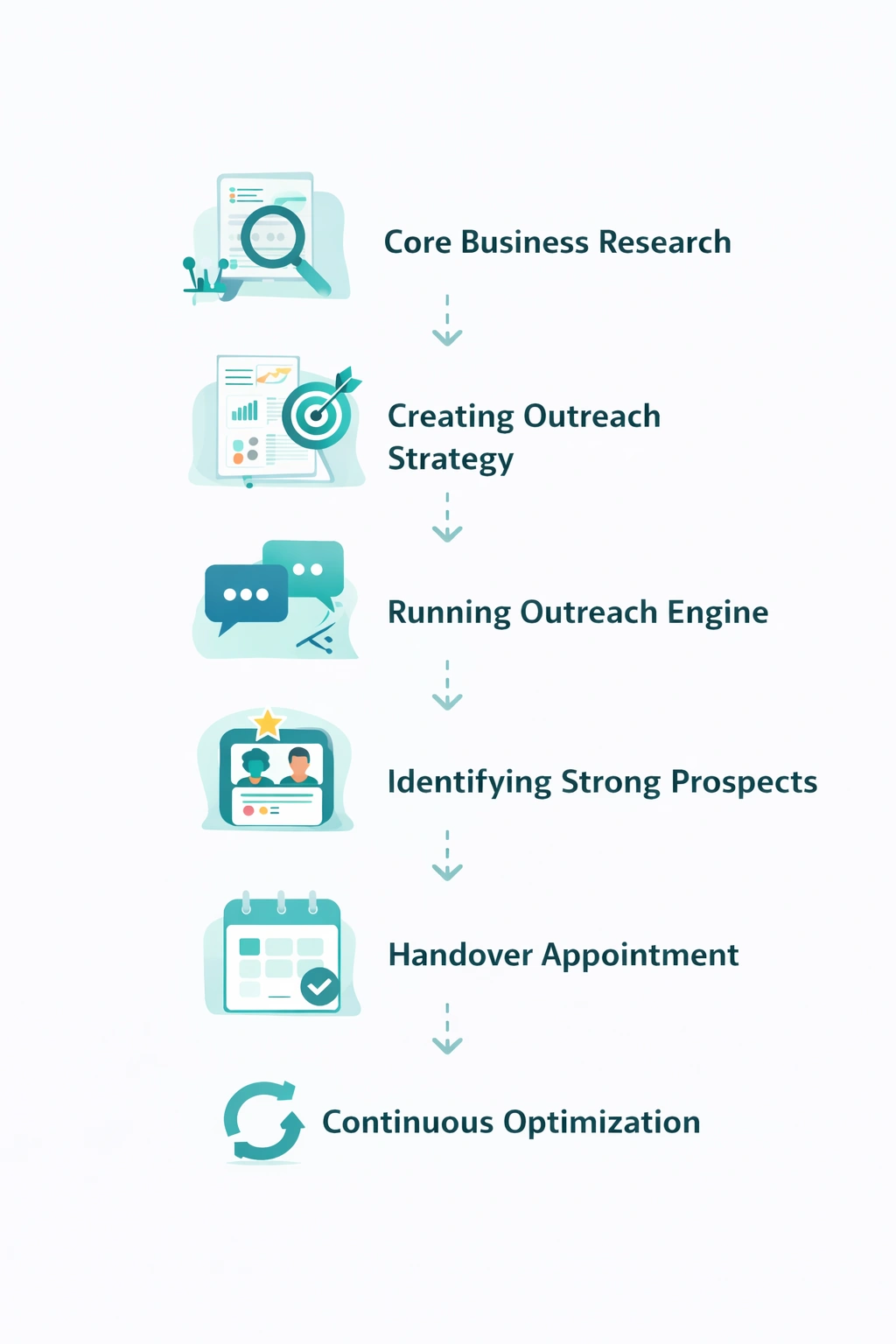
From identifying the right decision-makers to starting meaningful conversations and turning them into qualified appointments... LinkedoJet manages the entire outbound engine for your business.
Next step: get a lead plan you can actually execute
If your offer is strong but outreach feels like a morale tax, the fix is rarely “new copy.” It’s segmented targeting, intent scoring, and a weekly routine that creates conversations with buyers who have a reason to act.
When you move forward with LinkedoJet, you’re not left with a PDF. You get a working outbound engine: Sales Navigator filter stacks by segment, segmented lead lists, an intent scoring rubric built around real buying signals, AI-assisted personalization inputs, follow-up workflows, warm lead tracking, and appointment generation support—with clear campaign visibility and ongoing refinement.