
How to find leads for LinkedIn ghostwriting agencies—without spray-and-pray DMs
You don’t need more names. You need fewer, better targets—founders and execs already signaling they’ll post, can pay a retainer, and have a reason to move now. LinkedoJet turns Sales Navigator + LinkedIn activity into prioritized, segmented lead lists with a clear “why this person, why this week” attached to each record.
- Segmented lists by buyer type: founder-led B2B services, VC-backed B2B SaaS, professional services partners, high-LTV experts, PE-backed operators.
- Intent scoring from real triggers: funding, new role, hiring, launch/rebrand, posting cadence changes.
- Company qualification to protect margins: B2B model, headcount sweet spots, budget proxies, exclusions.
- Personalization angles pulled from their profile, Featured assets, and recent posts—so your opener reads like homework, not a template.
Your pipeline feels fragile because you’re spending agency hours on the wrong moment
You can have a great offer and still feel like you can’t plan hires month-to-month.
It usually isn’t because ghostwriting “doesn’t work.” It’s because most outreach is timing-blind. You’re pitching a retainer to someone who hasn’t decided LinkedIn is a priority yet—so they treat you like noise, not help.
Three failure modes show up over and over for ghostwriting agencies:
- Activity blindness: targeting “CEO” as a proxy for buyer intent, then learning on the call they haven’t posted in 18 months and don’t plan to start.
- Timing blindness: ignoring triggers (new role, funding, hiring, launch) that make thought leadership economically rational.
- Commodity pitching: “we help you build a personal brand” hits the same inbox as twenty other agencies. Even the right buyer will brush it off if you don’t anchor to their context.
- Low-LTV accounts: solopreneurs, DTC-heavy operators, and “cheap writer” shoppers who can’t sustain a monthly engagement.
The cost isn’t just low reply rates. It’s the hidden drag: senior attention wasted on dead-end threads, writers pulled into spec work, and a calendar full of calls that never had a chance to become retainers.
Retainer-ready ghostwriting buyers aren’t defined by title— they’re defined by distribution intent
Two people can look identical in Sales Navigator. One will happily invest in consistent thought leadership because it drives deals and recruiting. The other wants “a few posts” and disappears after week two.
Primary buyers (they feel the upside personally):
- Founder, Co-Founder, CEO, President
- Managing Partner, Partner, Principal
- Owner, Managing Director, General Manager
Co-buyers (they manage GTM, brand, or revenue pressure):
- CMO, VP Marketing, Head of Marketing, Director of Marketing
- Head of Growth, VP Growth, Demand Gen, Content Marketing Lead, Head of Content
- Director of Communications, Head of Brand, VP Communications
- CRO, VP Sales, Head of Sales, Revenue Leader
- Operating Partner, Platform Partner, Head of Portfolio Operations
Hard qualification checklist (use it before you send a message):
- B2B model (exclude DTC-heavy unless clearly enterprise services).
- Headcount sweet spot: 2–50 (founder-led services), 11–200 (growth-stage SaaS/services), 51–500 (PE-backed/scaling).
- Posting intent: posted in the last 30–90 days, or a clear trigger that makes “starting now” plausible.
- Budget proxy: hiring, multiple departments, funding, recognizable clients, multiple locations.
- Reason to move: new role, funding, launch/rebrand, hiring push, pipeline pressure posts.
Four Sales Navigator searches you can run today (and what to do next)
These searches are built for one outcome: a list that produces retainer conversations without burning your team on unqualified profiles.
Search A: Founder-led B2B services (high retainer likelihood)
Lead filters: Geography (your service region), Seniority: Owner, CXO, Partner; Title contains: Founder OR Co-Founder OR CEO OR Managing Partner OR Partner; Years in current position: 1–10; Posted on LinkedIn in past 30 days: Yes.
Account filters: Industry: Management Consulting, IT Services, Staffing & Recruiting, Legal Services, Accounting, Financial Services (selective); Company headcount: 2–50 or 11–50; Annual revenue (if available): $1M–$50M; Company type: Privately Held. Exclude: Marketing & Advertising (agency competitors).
Why it works: these buyers feel founder-led distribution pressure and can justify monthly spend when they’re already selling a high-LTV service.
Search B: VC-backed B2B SaaS execs (content-led pipeline)
Lead filters: Title contains: CEO OR Founder OR CMO OR VP Marketing OR Head of Growth; Seniority: CXO, VP; Function: Marketing (or Operations for CEOs); Posted in last 30 days: Yes; Relationship: 2nd degree.
Account filters: Industry: Computer Software, Internet, Information Technology & Services; Headcount: 11–200 or 51–500; Headcount growth (if visible): growing. Watch for funding language on the company page or in headlines (Seed/Series A/B, backed by, raised).
Why it works: when growth gets public, exec visibility becomes a GTM asset—not a vanity project.
Search C: Professional services partners (high-margin, relationship-driven)
Lead filters: Title contains: Partner OR Managing Partner OR Principal OR Managing Director; Seniority: Partner, Owner, CXO; Posted last 90 days: Yes.
Account filters: Legal Services, Accounting, Management Consulting, Financial Advisory, Staffing & Recruiting; Headcount: 11–200; Geography: major metros.
Why it works: these buyers win on trust. Thought leadership compounds faster than ads when the buyer cycle is relationship-heavy.
Search D: PE/VC operating ecosystem (timing-driven)
Lead filters: Title contains: Operating Partner OR Platform Partner OR Portfolio Operations OR CEO; Seniority: Partner, CXO; Posted last 30/90 days: Yes.
Account filters: Investment Management, Venture Capital & Private Equity; Headcount: 2–200.
Why it works: operators get measured. When the mandate is “grow this quarter,” executive distribution turns into a tactic, fast.
Do this next (15 minutes):
- Save each search.
- Create separate lead lists by segment (don’t mix them; the angle changes).
- Pull the top 25 profiles per list and scan Activity + Featured for intent.
- Add a one-line note: “trigger + angle” (example: “new VP Sales hire → exec-led demand narrative”).
Intent and timing signals to score (and the negatives that quietly waste weeks)
Founders and execs have learned to ignore ghostwriting pitches on sight. The only way through that filter is relevance: a signal they already put in public, reflected back with a clear reason it matters.
High-intent triggers (prioritize these):
- Promotion/new role into CEO/CMO/CRO (0–120 days)
- Funding announcement, “backed by…”, Seed/Series A/B language
- Launch signals: “we’re launching,” GA, v2, rebrand, new website
- Hiring: Head of Marketing/Content/Demand Gen/Comms, plus SDR/AE hiring spikes
- Pipeline pressure: posts about targets, inbound slowing, CAC, events/webinars to create demand
LinkedIn activity signals (proof they’ll actually post):
- Posted in the last 30 days (or consistent 1–3x/week cadence)
- Attempting real thought leadership (opinions, lessons, narrative posts), not only company reshared links
- Asking for feedback (“what’s your take?”), sharing drafts, experimenting with hooks
- Featured section has a lead magnet, newsletter, webinar, podcast—something distribution can amplify
Negative signals (don’t ignore them):
- “No agencies,” “no solicitations,” “DM pitches ignored” (handle differently, or deprioritize)
- Engagement pod behavior (generic emoji comments, unnatural engagement spikes)
- Inactive 6–12 months with no trigger event
- Price-shopping language (“cheap writer,” Fiverr-style requests)
- Open-to-work/job-seeker profiles (rarely retainer-ready)
This is the difference between a message that gets read and a message that gets archived.
Company intelligence that protects your margins (and a simple scorecard)
Ghostwriting is a retainer business. The fastest way to break morale is filling the top of funnel with accounts that were never capable of sustaining monthly work.
| Segment | Retainer-friendly firmographic range | Quick budget proxies to look for | Common traps to exclude |
|---|---|---|---|
| Founder-led B2B services | 2–50 employees (sometimes 11–50 sweet spot) | Small team + clear offer + case studies + hiring | 1-person generalists, “social media agency” competitors, DTC operators |
| VC-backed B2B SaaS | 11–200 (or 51–500 when scaling) | Funding language, headcount growth, GTM hires, event/webinar activity | Pre-product/idea-stage, tiny teams with no marketing owner |
| Professional services partners | 11–200 | Multiple offices, named partners, speaking/webinars, content footprint | Strict compliance blockers (flag), local-only low LTV |
| PE-backed operators | 51–500 | Mandate language, portfolio updates, hiring bursts, revenue leadership | Portfolio “noise” accounts with no operator accountability |
Mini scorecard (0–2 points each):
- Budget proxy: scale signals (hiring, multiple departments, funding, established clients)
- Urgency trigger: role change, launch, hiring, pipeline pressure
- Distribution intent: posting cadence, Featured assets, newsletter/podcast/speaking
- Fit exclusions: competitors, influencers selling courses, crypto/NFT pump accounts, pod behavior
If a prospect can’t score at least “some budget + some urgency + some intent,” you’re walking into a call that turns into a pricing debate.
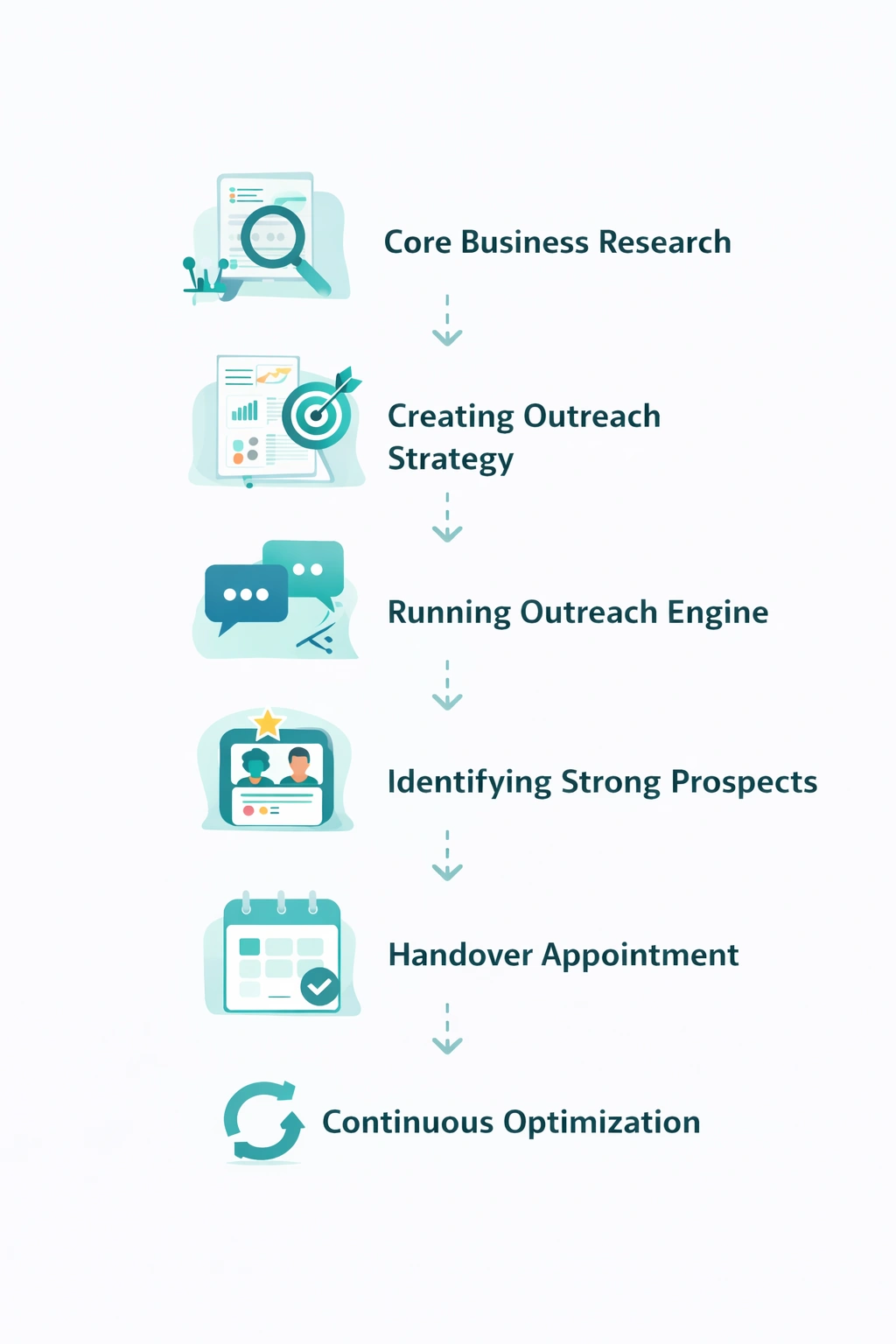
The LinkedoJet system: segments → searches → intelligence pass → intent ranking → messaging angles
When agencies say “outreach didn’t work,” what they usually mean is: “we contacted too many people who had no reason to buy.”
LinkedoJet is built to prevent that. Not by sending more messages—by making sure the list and the timing do the heavy lifting.
- Define segments + exclusions: separate lists for founder-led services, SaaS execs, partners, high-LTV experts, PE operators. Exclude agency competitors, pod accounts, job-seekers, and obvious price shoppers.
- Build Sales Nav searches (A–D): add geography, seniority, headcount, and “posted recently” so you’re not guessing who will participate.
- Prospect intelligence pass: scan headline/About for narrative, Featured for assets, Activity for cadence/themes, company page for hiring/funding, and mutuals for warm paths. We capture qualification notes and personalization angles you can actually use.
- Prioritize with intent scoring: triggers + activity + firmographic fit → ranked list. You focus on the top 50–200, not the full search export.
- Choose the right next action: connect, comment-first, warm intro request, or direct DM—based on how “agency allergic” they look.
- Message angles built from context: funding → credibility narrative; new role → point-of-view positioning; hiring → exec-led demand; launch → distribution plan; partner services → trust + authority themes. It stops sounding like “we do ghostwriting” and starts sounding like “here’s what you’re trying to achieve, and here’s how we’d execute it.”
The practical output is simple: segmented lists, ranked by intent, with notes that tell your team what to say and why now.
Questions agency owners ask before they commit to a repeatable outbound engine
What’s the best Sales Navigator filter combo for ghostwriting clients who can afford retainers?
Start with Posted on LinkedIn in past 30 days: Yes (or 90 days for partners), then constrain by seniority (Owner/CXO/Partner/VP), and use company headcount as your first budget proxy (2–50 for founder-led services, 11–200 for SaaS/services, 51–500 for PE-backed). Add industry filters that skew B2B and high LTV, and explicitly exclude Marketing & Advertising if you don’t want agencies.
Should we target CEOs/founders or CMOs/Heads of Growth first for LinkedIn thought leadership?
If you want faster retainer decisions, target the person who benefits personally (CEO/founder/partner) when they’re already posting or have a trigger. If you want smoother implementation and brand alignment, add the co-buyer (CMO/Head of Growth/Comms/CRO) into the thread early—especially in SaaS and PE-backed environments where messaging gets scrutinized.
How do we find founders who will actually post consistently (not just say they want a personal brand)?
Don’t ask them. Verify it. Filter for recent posting, then inspect Activity for cadence and effort: long-form attempts, narrative posts, asking for feedback, and non-corporate tone. Featured assets (newsletter, lead magnet, webinar) are also strong evidence they value distribution. If there’s zero posting history and no trigger event, you’re usually walking into a motivation problem.
How do we avoid low-budget “cheap writer” leads and one-off project requests?
Use firmographic constraints (headcount ranges, B2B industries) and budget proxies (hiring, funded, multiple departments, established clients). Then disqualify on signals: posts asking for “cheap” help, one-off content requests, or profiles that look like they rotate vendors constantly. Retainer buyers talk about outcomes (pipeline, recruiting, category position), not “need 10 posts.”
What if the prospect says “no agencies” on their profile—does outreach still work?
Sometimes—if you change the approach. Deprioritize direct pitches. Use comment-first, a warm intro path, or a trigger-based note that’s specific enough to feel like peer-to-peer (new role, launch, hiring). If their profile screams “DM pitches ignored,” the goal is to earn a conversation, not force one.
See what your next 50–200 retainer-ready prospects look like (with the reason each one should care now)
This isn’t a vague “strategy chat.” We’ll show you how LinkedoJet builds segmented lists for your agency, scores intent, and runs the outreach + follow-up workflow so your team spends time on real buyers—not ghosts.
What LinkedoJet operationally provides: we set up your ICP and exclusions, build Sales Navigator searches and lead lists by segment, run an intelligence pass on profiles/companies, and generate AI-assisted personalization angles based on real signals (Activity, Featured, hiring, funding, launches). Then we execute LinkedIn outreach with reply handling, nurturing, and follow-up sequences designed to convert “warm maybe” into booked conversations.
After onboarding, here’s what happens:
- Targeting system: segment definitions + account/lead filters + exclusion rules, so your lists stay clean.
- Prospect list building: Sales Navigator-ready searches turned into lead lists (typically 50–200 high-priority prospects per segment batch).
- AI-assisted personalization: we extract message angles from what they’ve already published (recent posts, Featured assets, role changes, company updates) and pair it with a trigger-based opener.
- Outreach execution: connection + messaging flows run consistently, without your team living in LinkedIn all day.
- Lead nurturing & follow-up: structured sequences for non-responders and “not now” replies, plus comment-first paths for agency-averse profiles.
- Warm lead tracking: dashboards that show list health, response patterns, warm leads, and which triggers are producing booked calls.
- Appointment generation support: we help push warm conversations to a scheduled meeting with clear handoff notes and context.
Why this is different from ordinary LinkedIn automation tools: tools send messages. LinkedoJet runs the full prospect intelligence + qualification + execution loop, so your outreach is aimed at the right buyer in the right window—and your team gets visibility into what’s working and what needs refinement.
From identifying the right decision-makers to starting meaningful conversations and turning them into qualified appointments... LinkedoJet manages the entire outbound engine for your business.
If you want predictable retainers, stop renting hope from random outreach
Get a segmented, intent-ranked prospect list built from Sales Navigator + real activity signals, plus the outreach and follow-up engine to turn warm replies into booked appointments—without burning your writers on low-fit calls.