
Find issuer-side decision makers for IR retainers using signals, not generic “public company” lists
The issuers that buy IR support rarely broadcast “we’re shopping.” They move in a narrow window—around earnings stress, a financing, an uplist push, or leadership turnover. The goal is to see that window early and show up with a reason that feels finance-native, not salesy.
- Build curated lists of CFO/CEO/Head of IR/GC at small-cap and micro-cap issuers (and IPO/uplist candidates) with Sales Navigator precision
- Prioritize outreach by stacked signals: job changes, increased issuer comms, conference activity, financing language, IPO/uplist cues
- Use compliance-aware angles tied to public information (not stock performance “promises”)
- Personalize without burning partner hours—keep the message grounded in the issuer’s event pressure
- Move faster from “activity” to actual issuer meetings
Why IR outreach fails: wrong titles, wrong timing, and the incumbent trap
If your pipeline feels random, it’s usually not because you lack leads. It’s because your prospecting isn’t synchronized with issuer-side urgency—and issuers don’t reward “persistence” when you show up late.
Most small-cap issuers don’t wake up wanting a new IR agency. They switch when a trigger hits—new CFO, a financing, an uplist push, a messy guide change, an IPO clock starting. When you’re not already in the conversation before that moment, you’re either irrelevant (“why now?”) or you accidentally raise compliance discomfort (“this feels like stock promotion”).
Then the incumbent wins by default. Not because they’re brilliant—because they’re already there when the board asks, “Who can fix the story before next quarter?”
- Volume activity masquerading as progress: broad issuer lists, generic connection asks, and a weekly “follow-up” that never earns a reply
- Mis-targeting: chasing marketing/comms titles while the CFO (or CEO) actually owns the decision and the risk
- Bad timing: reaching out after the financing is priced or after the earnings narrative is already set
- Messaging that triggers caution: any hint of “we can help your stock” ends the conversation fast
Signal-led prospecting fixes this by making timing the strategy. You’re not trying to out-message competitors. You’re trying to be early, specific, and safe.
Built for boutique to mid-market IR agencies selling real issuer outcomes
This playbook assumes you sell IR retainers and project work where the buyer cares about credibility, process, and execution under pressure—not marketing fluff.
Best fit: IR firms/agencies delivering retainers, earnings support, investor deck refreshes, roadshow and conference support, perception studies, shareholder communications, and capital markets communications for small-cap and micro-cap issuers (plus IPO/de-SPAC/uplist candidates).
Typical “we should talk” moments you can actually act on:
- First CFO/Head of IR hire, or a new finance leader inheriting a broken narrative
- Post-financing comms workload (ATM/registered direct/PIPE/convertible) and investor Q&A pressure
- Uplist preparation (reverse split chatter, governance clean-up, increased investor comms cadence)
- Upcoming earnings with volatility, guide change risk, or a packed catalyst calendar (biotech/mining/cleantech)
- International issuers listed in the US needing US investor reach and English-language materials
Not ideal for: teams focused only on large-cap issuers with mature, in-house IR; or anyone selling hype, guarantees, or “stock moving” language. That positioning doesn’t just underperform—it can create reputational risk.
Who to target inside issuers (and why the org chart lies)
Issuer-side buying is messy. Titles look neat on a website, but decisions get made by the person who carries the earnings/financing risk.
- CFO / Chief Accounting Officer / VP Finance: owns earnings readiness, disclosure process, financing comms, and the credibility of the investor narrative
- CEO / President / Executive Chair (small-caps): cares about story, visibility, and how the market interprets milestones—often the final say
- Head/VP/Director of Investor Relations (or first IR hire): runs day-to-day execution; commonly looks for overflow support, a tighter process, or a reset
- General Counsel / Corporate Secretary: proxy/annual meeting comms, governance messaging, and risk screening—especially when there’s activism noise
What to look for on LinkedIn profiles (quick checklist):
- New in role (0–90 days) or a recent internal promotion into finance leadership
- Prior public company experience (or lack of it—often where external support gets approved)
- Conference speaking, fireside chats, or posts that signal investor-facing comfort
- Mentions of “uplist,” “NASDAQ/NYSE American,” “S-1,” “de-SPAC,” “roadshow,” “earnings call,” “investor presentation”
- Noticeable change in posting cadence tied to milestones (financing, partnership, trial readout, contract wins)
One operator reality: at many micro-caps, “IR” is effectively the CFO plus a corporate comms person. If you only target formal IR titles, you miss the buyer.
Build an issuer universe that can be re-used every quarter
The win isn’t a one-time list. It’s a living issuer universe with saved searches and a qualification layer—so your team stops starting from zero every month.
Filter recipe (start broad, then tighten): Choose your primary geographies (US/Canada/UK/EU), then set issuer-friendly industries (biotech, mining & metals, energy, clean energy, software, semis, financial services, industrials—based on your niche). Use company headcount bands that mirror small/mid issuers (11–50, 51–200, 201–500, 501–1000). Set seniority to CXO/VP/Director. Then run title strings that catch how issuers actually label roles.
Title strings that work in practice: “Chief Financial Officer” OR CFO OR “VP Finance” OR Controller OR “Chief Accounting Officer” OR CAO OR “Head of Investor Relations” OR “VP Investor Relations” OR “Director Investor Relations” OR “Corporate Secretary” OR “General Counsel” OR “Corporate Communications”.
Use Spotlights when available: “Posted on LinkedIn in last 30 days” (timing) and “Changed jobs in last 90 days” (trigger). If “Mentioned in the news” is available, treat it as a prioritization hint—not a substitute for reading what the news actually is.
Three saved search templates to keep:
- Small-cap issuer CFO/CEO: CXO + VP/Director; headcount 11–1000; industries aligned to your agency; spotlight: posted recently
- New Head of IR (0–90 days): titles include Head/VP/Director IR + “Changed jobs in last 90 days”
- IPO/uplist readiness finance leaders: CFO/VP Finance/Controller/CAO/GC/Corp Sec + keywords “IPO,” “S-1,” “uplist,” “NASDAQ,” “NYSE American,” “de-SPAC,” “investor deck,” “roadshow”
Account qualification checks (fast, but disciplined):
- Issuer fit: public company / listed issuer / newly listed (use company description and visible cues; don’t pretend you have perfect exchange filters)
- Thin comms: inconsistent investor materials, outdated deck language, press releases without a cohesive narrative arc
- Headcount trend: sudden growth or contraction often correlates with financing pressure, re-forecasting, or narrative reset needs
- Announcement cadence: spike in PRs, new investor presentation, or refreshed IR page language can be a “we’re gearing up” tell
Prioritize outreach by issuer triggers (and know what to avoid)
You don’t need more messages. You need better timing—and a reason to speak that feels safe in a regulated context.
Triggers that reliably correlate with near-term IR spend:
- New CFO/CEO/Head of IR hired (last 90 days): the “narrative reset” window—new leader evaluates vendors and wants quick wins before the next call
- Financing announced: ATM setup, registered direct, PIPE, secondary, convertibles—comms workload rises and investor questions get sharper
- IPO / de-SPAC / newly listed: the first few quarters as a public company are where process gaps show up fast
- Uplist prep cues: “NASDAQ/NYSE American” language, governance clean-up talk, reverse split chatter, increased investor presentation activity
- Earnings pressure: upcoming earnings date, prior miss, guide change risk, or unusually heavy catalyst calendar
- Conference activity: issuer/team posting about fireside chats, investor conferences, non-deal roadshows—signals they care about investor-facing execution
- Hiring signals: roles in IR, SEC reporting, FP&A, corporate communications—often means internal load is rising
- Comms refresh: new investor deck, IR site updates, higher LinkedIn posting cadence from leadership or the company page
Negative signals (disqualifiers or “slow down” flags):
- Exclusive agency language: “agency of record” posts, explicit “no vendor changes”—log it, don’t chase it
- Mature large-cap IR org: if they have deep in-house coverage and established processes, you’re fighting inertia unless you sell a specific project wedge
- Hype-seeking language: anything that smells like “pump,” “retail frenzy,” or performance promises—protect your brand by walking away
FAQ
Can LinkedoJet help us target newly public companies, de-SPAC issuers, and uplisting candidates?
Yes. We build issuer universes using Sales Navigator company and profile signals (keywords like IPO/S-1/de-SPAC/uplist/NASDAQ/NYSE American, leadership changes, posting cadence, conference mentions) plus a repeatable saved-search structure. You’ll get a working target list and a trigger layer you can refresh weekly, not a one-off spreadsheet.
How do you find the right decision maker when there’s no formal IR department?
We map decision ownership, not org charts. In many micro-caps, the CFO carries IR accountability, with the CEO heavily involved and a corporate comms lead doing execution. We build a decision-maker map per account (CFO/CEO/finance leadership/GC/Corp Sec/IR titles when present) and route outreach to the role most likely to own the outcome and risk.
How do you keep LinkedIn outreach compliance-aware and avoid “stock promotion” vibes?
We don’t write messages about stock price. We anchor outreach to public, observable events and operational pressure: earnings readiness, investor Q&A workflows, deck/IR site coherence, conference execution, financing communications load, and leadership transitions. The tone is process-focused and risk-aware—closer to “help you run this cleanly” than “help you get attention.”
Can we filter out companies that already have an exclusive IR agency of record?
There isn’t a perfect platform filter for “exclusive incumbent,” but we can reduce wasted cycles. We add disqualifier checks into the qualification layer (company posts, IR site language, press-release boilerplate, leadership background signals) and we build routing logic: deprioritize “locked” accounts, while keeping a light-touch nurture list for moments when triggers override inertia (new CFO, financing, uplist prep).
Which LinkedIn/Sales Navigator signals actually correlate with near-term IR spend (financing, earnings, leadership changes)?
The strongest clusters are: (1) leadership change in finance/IR, (2) financing announcements and related comms load, (3) uplist/IPO/de-SPAC readiness language, (4) increased issuer communications activity (deck/website refresh, posting cadence), and (5) conference/roadshow participation. We prioritize accounts where multiple signals stack—those are the ones where an IR partner gets considered quickly.
See what LinkedoJet would run for your IR agency—targets, triggers, angles, and the workflow behind it
This isn’t a generic “discovery call.” We’ll show you exactly how we build an issuer universe, prioritize by signal, and run compliant-aware outreach that converts into issuer meetings—without turning your brand into noise.
What LinkedoJet operationally provides: we set up your targeting system, build Sales Navigator prospect lists, create AI-assisted personalization tied to issuer signals, execute LinkedIn outreach, handle replies and follow-up, track warm leads, and support appointment generation—while you stay focused on delivery and closing.
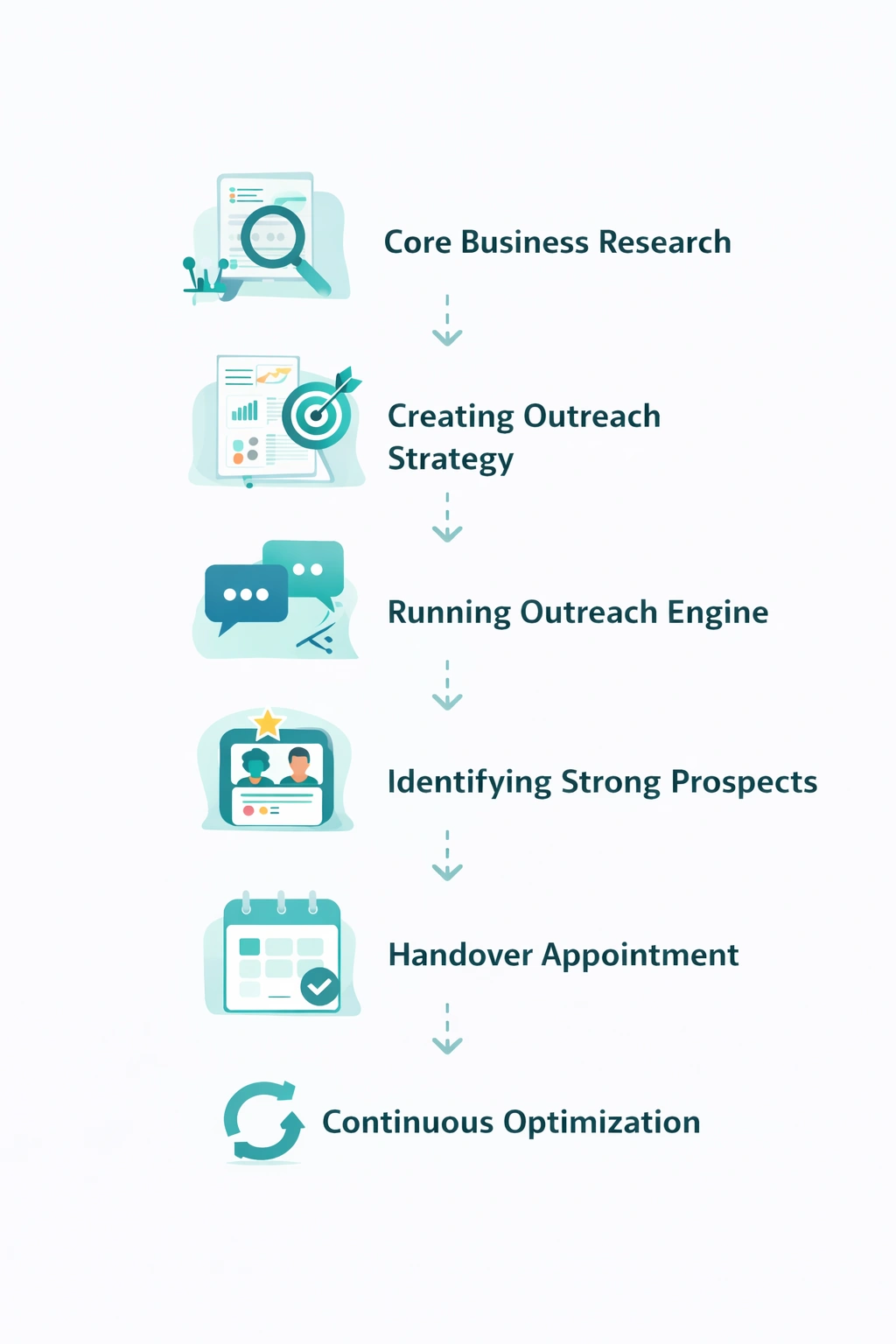
What happens after onboarding:
- We define your IR sweet spot (sector focus, issuer profile, geography, retainer wedge) and translate it into repeatable Sales Navigator searches
- We build your issuer account universe and map decision-makers (CFO/CEO/IR/GC/Corp Sec) with a clean tagging structure
- We layer triggers (financing, earnings pressure, IPO/uplist cues, leadership changes, conference activity, hiring) and score/prioritize accounts weekly
- We generate compliant-aware outreach angles and message variants that reference public context (no “stock moving” language)
- We run the outreach sequences, manage lead nurturing and follow-ups, and route qualified replies to you with context
- We track warm leads, conversations, and booked meetings in dashboards so you can see what’s working and why
- We refine targeting and messaging based on response signals—so quality improves over time, not just volume
How targeting and prospect list building work: we build saved searches for your core issuer roles and separate lists for high-intent scenarios (new CFO/first IR hire, newly listed/de-SPAC, financing cycles, uplist readiness). You receive a living list you can trust, not a random export.
How AI-assisted personalization is used: we use AI to draft first-pass personalization anchored to the trigger (e.g., new finance leader, conference appearance, new investor presentation). Then we apply operator guardrails so the final message reads like a capital-markets professional wrote it—tight, specific, and safe.
How lead nurturing and follow-up workflows operate: issuers often won’t say “yes” on message one. We run sequenced follow-ups tied to the same trigger window (earnings/financing/leadership change) and shift to lighter-touch nurture when timing isn’t right—so you’re present when the next trigger hits.
How warm leads and appointments are tracked: every account has a status (new, contacted, engaged, warm, meeting booked, nurture) and trigger notes. You can see which signals are producing conversations and where deals are stalling.
Why LinkedoJet is different from ordinary LinkedIn tools: tools send messages. LinkedoJet runs the system—issuer universe + trigger layer + compliant-aware angles + execution + reply handling + visibility—so your pipeline is driven by timing and relevance, not hope.
Next step: get a 30-day issuer target set your team can actually work
You’ll walk away with a prioritized list of CFO/CEO/IR leaders, the signals that put them in motion, and compliant-aware angles your team can send without second-guessing tone or risk. From identifying the right decision-makers to starting meaningful conversations and turning them into qualified appointments... LinkedoJet manages the entire outbound engine for your business.