
How to find leads for Healthcare SaaS companies—using LinkedIn prospect intelligence (not spray-and-pray)
Build a weekly refreshed list of qualified healthcare SaaS accounts, the right stakeholders (revenue + integrations + security/privacy), and the specific trigger that makes outreach relevant right now—interop moves, compliance milestones, hiring, and ecosystem partnerships.
- Sales Navigator filters included (with exclusion logic that actually works in healthtech)
- Decision-maker + stakeholder mapping per account (not just “find a CRO”)
- Buying-signal prioritization: hiring, integrations, compliance, expansion
- Company qualification to avoid providers, practices, and consultancies unless you want them
Get Healthcare SaaS Lead Targets | See the LinkedIn Prospect Intelligence System
If your reps can’t explain—per account—(1) why this is a vendor you actually sell to, (2) who will block the deal (integrations/security), and (3) what changed this month that makes it worth a conversation, you don’t have a lead gen problem.
You have a prospect intelligence gap. And in healthcare, that gap doesn’t just hurt reply rates—it burns quarters.
Why healthcare SaaS prospecting breaks: vendor vs provider noise, integration dependencies, and compliance gatekeepers
Healthcare isn’t “slow” because people are lazy. It’s slow because deals have gravity.
One missed stakeholder becomes a late-stage stall: you build momentum with a revenue owner, then integration feasibility turns into a surprise, then security review shows up like a trap door. Months of meetings end with “we’re not ready” or “we can’t take on another interface right now.”
Most outbound motions fail earlier, though—at the list.
- Category tagging is messy. “Hospital & Health Care” includes providers, vendors, MSPs, staffing firms, and consultancies. If your team is pulling lists by industry alone, you’re paying reps to chase the wrong company type.
- Integration posture matters more than your pitch deck. Two companies can look identical on paper. One has FHIR/HL7 language, an Epic marketplace listing, and an integrations team hiring. The other is “API-first” in marketing only. The first might talk; the second wastes your cycle.
- Compliance isn’t a checkbox. HIPAA is table stakes. SOC 2 Type II and HITRUST language show up when vendors are aiming upmarket. If you can’t spot those signals, you’ll keep approaching accounts with the wrong expectations—and sound generic when the buyer is thinking about BAAs and risk.
- Partnership motions are common. A lot of healthtech growth runs through ecosystems (EHRs, RCM platforms, clearinghouses). If you only target sales titles, you’ll miss the people who actually create distribution.
The real frustration is the feeling of flying blind while someone else shows up with context: “I saw you’re staffing integrations for Epic and you just updated your security page—looks like you’re pushing into larger provider groups.” That doesn’t feel like outbound. It feels like competence.
Who to target (and exclude): healthcare SaaS segments, qualification rules, and the list that doesn’t rot
In regulated markets, prospecting is a qualification + timing problem disguised as a contact-finding problem.
Start by choosing the segment you can win in with a clear wedge. Your targeting and your hooks should change based on it.
- Provider-facing SaaS: clinical workflow, care coordination, patient engagement, scheduling, provider operations
- RCM/finance SaaS: coding, billing, denials, eligibility, payments, prior auth workflows
- Data/interoperability: HL7/FHIR integration, data platforms, interface engines, interoperability tooling
- Security/compliance: PHI security, access/audit, risk, monitoring, policy workflows
- Payer-focused SaaS: claims, UM, prior auth, member engagement, risk adjustment
Qualification rules that keep your list clean:
- Vendor proof: company page and website language reads like software (product, platform, customers), not a provider org or service firm
- Integration posture: mentions of FHIR/HL7, EHR/EMR integrations, Epic/Cerner/Oracle Health, Meditech, athenahealth, eClinicalWorks, NextGen, marketplace/partner programs
- Enterprise readiness cues: SOC 2, HITRUST, ISO 27001, HIPAA/BAA language, security page depth
- GTM motion clarity: direct sales vs partnerships/channel (look for alliances language, partner managers, ecosystem posts)
- Activity: hiring, leadership updates, product announcements, conference presence (HIMSS/HLTH/ViVE) or consistent team posting
- Size band fit: 11–200 (founder-led speed), 201–1000 (process + integrations), 1000+ (procurement + platforms)
Hard exclusions (unless you explicitly request them): we filter out providers/clinics/practices, healthcare IT staffing/recruiting firms, general consultancies, and D2C-only patient apps with no B2B buying motion.
Decision-maker mapping: revenue owner + integrations lead + security/privacy gatekeeper (and when each matters)
Healthcare SaaS deals rarely die because the revenue owner disliked your demo. They die because the deal was never structurally viable—and nobody uncovered that early.
Map the stakeholder triangle up front. You can still start with one person, but you should know who the other two are before you invest a quarter of your calendar.
| Stakeholder | What they care about | Titles to target | When they’re the priority |
|---|---|---|---|
| Revenue owner | Pipeline, new bookings, expansion, time-to-value | CEO/Founder (smaller), CRO, Chief Growth Officer, VP Sales, VP Business Development, Head of Growth | Direct sales motion; new GTM leader; growth push (SDR/AE hiring) |
| Integrations / product-technical owner | EHR/EMR dependencies, FHIR/HL7 reality, implementation capacity, roadmap impact | CTO, CPO, VP Product, VP Engineering, Head/Director of Integrations, Interoperability Lead, Solutions Architect | Anything with Epic/Cerner/Meditech/athena; API claims; marketplace/partner programs; interface-heavy deployments |
| Security / privacy / compliance gatekeeper | PHI exposure, BAA terms, SOC 2/HITRUST posture, vendor risk review | CISO, VP/Director Security, Privacy Officer, Compliance Officer, Risk Officer | Enterprise buyers; payer/provider adjacencies; recent compliance milestones; security hiring |
Quick profile-read checklist before outreach:
- Do they mention HIPAA/PHI, SOC 2, HITRUST, or BAAs in About/Featured?
- Any recent role change (last 90 days), promotion, or “building the team” posts?
- Do they talk about interoperability, EHR marketplaces, implementation lessons, or security reviews?
- Are they posting or hiring? Silence often means “not a priority.”
Sales Navigator filtering plays: account search, lead search, and EHR ecosystem/partner discovery
You’re not trying to find “healthtech.” You’re trying to find vendors with a reason to care this quarter—and the people inside them who will move the deal forward (or block it).
Play A: Account Search (find healthcare SaaS vendors, not providers)
- Geography: US/Canada/UK/AU (adjust to your compliance footprint)
- Industry: Computer Software, Information Technology & Services; add Hospital & Health Care cautiously for mixed-tag vendors
- Headcount: 11–200, 201–500, 501–1000 (split lists by band; your hooks change)
- Headcount growth: positive over last 6–12 months (signals budget + urgency)
- Keywords include: healthcare, EHR, EMR, RCM, revenue cycle, FHIR, HL7, interoperability, patient engagement, prior auth, claims, HIPAA, HITRUST
- Exclude keywords: hospital, clinic, medical center, practice, physician, dental (to avoid providers)
Play B: Lead Search (pull the stakeholder triangle inside those accounts)
- Seniority: C-suite, VP, Director (and select Manager roles for integrations/security)
- Functions: Sales, Business Development, Product, Engineering, Information Technology, Security, Operations
- Title contains (OR list): CRO, VP Sales, Head of Sales, VP Partnerships, Strategic Alliances, Head of Integrations, Interoperability, Solutions Architect, CISO, Privacy Officer, Compliance
- Saved searches + alerts: set alerts for job changes and new hires in those titles—healthcare buying windows often open when teams change
Play C: Ecosystem / Partner Search (high-yield in healthcare)
- Account keywords: Epic, Cerner / Oracle Health, Meditech, athenahealth, eClinicalWorks, NextGen + partner, marketplace, integration
- Lead titles: Partnerships, Alliances, Channel, Platform, Developer Relations, Integrations
- Prioritize: mentions of marketplace listings, integration certifications, and partner program announcements
Request a filter pack + sample target list | See the LinkedIn Prospect Intelligence System
Intent signals (and negative signals): what to prioritize, what to ignore, and how to write a relevant hook
Your edge isn’t more activity. It’s being early to the right reason.
Signals worth acting on
- Hiring signals (GTM or delivery demand): SDR/AE/RevOps roles (growth push); Integration Engineer / Implementation / Solutions Consultant roles (interface load); Security/Compliance roles (enterprise readiness).
Hook: “Saw you’re hiring integration engineers with Epic/FHIR experience—are you scaling partner onboarding or implementation capacity right now?” - Integration/interoperability signals: posts about FHIR APIs, HL7 interfaces, new EHR-specific integration guides, marketplace listings, interoperability webinars.
Hook: “Noticed your team is publishing deeper FHIR/Epic material—are you standardizing implementation patterns, or still handling it account-by-account?” - Compliance/trust signals: SOC 2 Type II, HITRUST mentions, BAA language updates, security page refreshes, ISO 27001 additions.
Hook: “Congrats on the SOC 2 milestone—usually that’s when vendor risk reviews shift from ‘later’ to ‘now.’ Are you seeing more security questionnaires from larger buyers?” - Expansion signals: new region, new vertical (payers vs providers), new module (prior auth, denials, engagement), rebrand/pricing page update, leadership hire (new CRO/VP Partnerships).
Hook: “Saw the new pricing/module page—looks like a packaging change. Are you moving upmarket or widening use cases?” - Market presence signals: conference sponsorship/speaking (HIMSS/HLTH/ViVE), customer story cadence, executives posting implementation lessons.
Hook: “Caught your HIMSS post on implementation—curious where integrations are slowing deals for you right now: data mapping, EHR variance, or security review timing?”
Negative signals (don’t waste the cycle)
- Provider orgs and practice groups when you sell to vendors (company language reads like care delivery)
- Healthcare IT staffing/recruiting firms hiding under “healthcare technology”
- Stealth companies with no product clarity, no buyers, and zero activity
- D2C-only apps with no B2B motion (unless that’s explicitly your market)
- Non-buyer titles for your motion (interns, students, recruiters; purely clinical roles when you’re targeting vendors)
The point is to show up with a reason, not a template. In healthcare, generic outreach doesn’t just get ignored—it gets remembered.
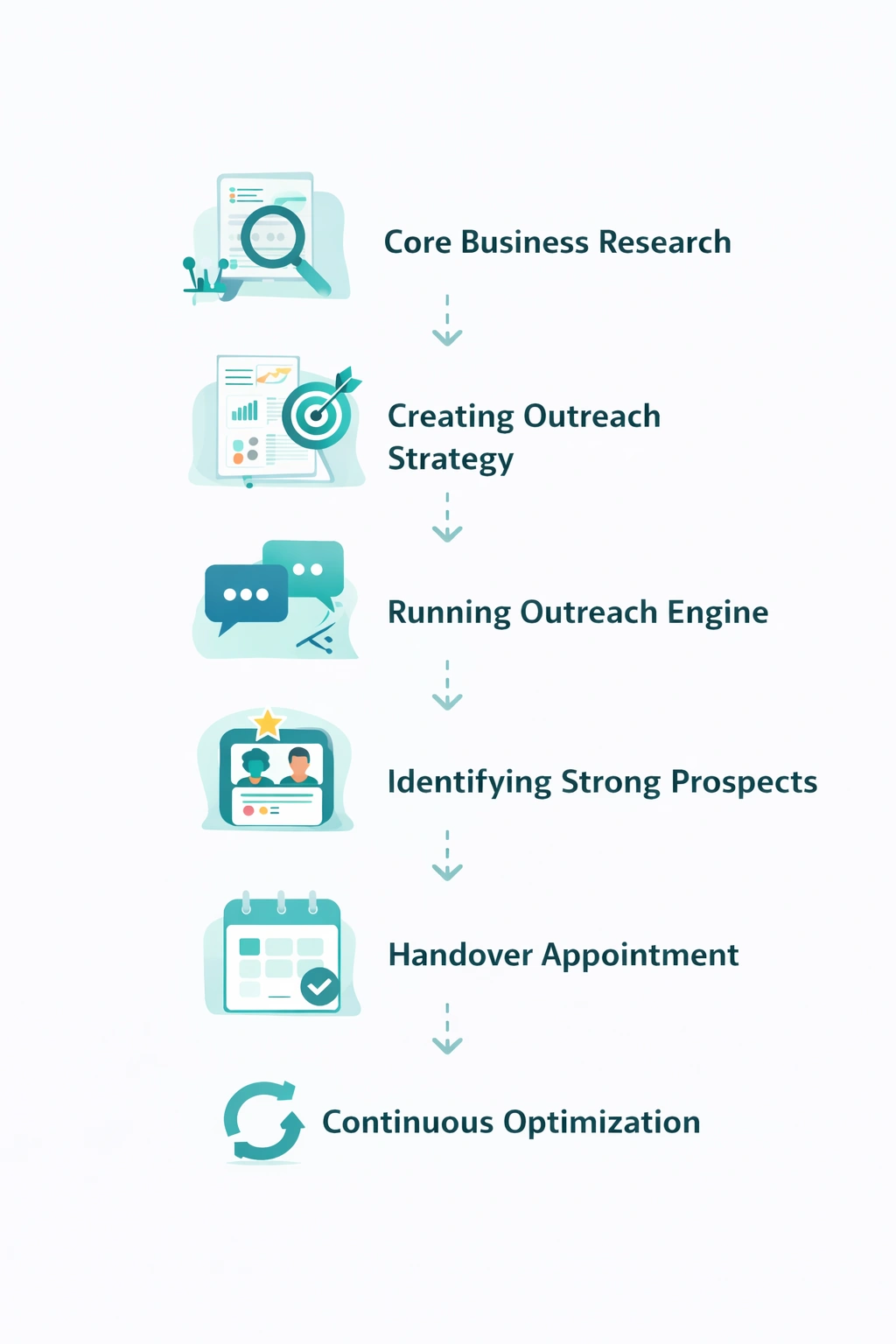
The LinkedoJet system: define motion → build searches → signal-score → map stakeholders → deliver a refreshed target list + outreach angles
LinkedoJet is built for teams that want predictable outbound in a regulated market without turning their reps into full-time researchers.
Here’s how the system runs in practice:
- Define your motion (and what “fit” means): RCM vs interop vs security vs payer; direct sales vs partnerships. This drives who we target and what signals matter.
- Build repeatable Sales Navigator searches: account + lead searches with healthcare-specific inclusion and exclusion logic (vendor vs provider cleanup, staffing/consultancy removal, D2C exclusions if needed).
- Signal-score accounts weekly: hiring, integration announcements, compliance milestones, leadership changes, and real LinkedIn activity—not vanity keywords.
- Map the stakeholder triangle per account: revenue owner + integrations lead + security/privacy gatekeeper, with notes on who likely controls timeline vs risk.
- Package conversation-ready outreach angles: short context on the trigger (“why now”), what to reference, and what not to say in a HIPAA/SOC 2/HITRUST-aware message.
- Execute and manage follow-up: LinkedIn outreach execution, reply handling support, and lead nurturing workflows that keep momentum without sounding like a sequence.
- Track warm leads and appointments: visibility through dashboards so you can see who’s engaging, who’s warm, and where conversations stall—then refine targeting and hooks.
This is designed to support human-led outreach with relevant context in regulated environments. No spray-and-pray. Just qualified targets and the reason now.
FAQ
Can you separate healthcare SaaS vendors from providers, clinics, and consultancies?
Yes. We treat “vendor vs provider” as a first-class qualification step, not a best-effort filter. We combine Sales Navigator filters with keyword exclusions (hospital/clinic/practice language), quick company-page validation (product vs services), and role patterns (e.g., staffing/recruiting signals). If you want a provider list for partnerships, we can build that intentionally—separately.
Does this work for partnerships (Epic/Cerner/athena/Meditech ecosystems) as well as direct sales?
Yes—and partnerships often convert faster when your outreach is anchored to ecosystem reality. We build specific searches for marketplace/partner language and prioritize alliances/platform/integrations stakeholders, not just sales leaders. You get account notes tied to partner triggers (new listings, certification work, integration hiring, partner program announcements).
What LinkedIn intent signals matter most for healthcare SaaS right now (hiring, interop, compliance, expansion)?
The most reliable signals are observable operational moves: integrations and implementation hiring (capacity and demand), security/compliance milestones (SOC 2/HITRUST/BAA language), ecosystem announcements (EHR marketplace/partner moves), and leadership changes (new CRO/VP Partnerships). Titles alone are weak; signals tell you timing.
How do you handle security/compliance-heavy conversations (HIPAA, SOC 2, HITRUST, BAAs) without sounding generic?
We don’t open with compliance buzzwords. We reference the specific cue we saw (a security hire, a trust page update, an enterprise push) and frame it as operational reality: vendor risk review timing, BAA/legal steps, and security questionnaires. The message stays short, credible, and tied to their current motion—not a lecture.
What company sizes does this work for (11–200, 201–1000, and enterprise vendors)?
It works across bands, but the play changes. For 11–200, we prioritize founder/CRO and clear wedge signals. For 201–1000, we map integrations and implementation capacity because that’s where deals bottleneck. For enterprise vendors, partnerships, platform teams, and security stakeholders matter earlier—procurement and risk processes shape timelines.
See what your Healthcare SaaS target list looks like when it’s built on signals—not guesses
Use this session to get commercial clarity fast: which accounts to pursue, who to contact inside them (revenue + integrations + security), and what specific trigger you can reference without sounding generic in a regulated market.
What LinkedoJet operationally provides: we set up your ICP and targeting system, build Sales Navigator searches and lists, apply healthcare-specific qualification rules (vendor vs provider cleanup), and then run outreach workflows with AI-assisted personalization so messages reference real triggers (interop, compliance, hiring, partnerships) instead of templates.
After onboarding, you receive:
- A weekly refreshed, signal-scored account list (with exclusions handled so the list doesn’t rot)
- Lead lists per account that map the stakeholder triangle: revenue owner + integrations + security/privacy
- Account notes and conversation starters tied to the exact signal (what changed, why now)
- AI-assisted personalization to draft relevant openers that still sound like your team
- LinkedIn outreach execution plus follow-up/nurture workflows to keep threads moving
- Warm lead and appointment tracking in dashboards so you can see what’s working and refine quickly
How targeting and prospect list building works: we start with your segment and motion (RCM vs interop vs security; direct vs partnerships), then build repeatable Sales Navigator account + lead searches using inclusion keywords (FHIR/HL7, EHR ecosystems, SOC 2/HITRUST cues) and hard exclusions (providers, staffing/consultancies, irrelevant motions). The output is a prioritized list with the “reason now” attached.
Why this is different from ordinary LinkedIn automation tools: tools send. LinkedoJet qualifies, prioritizes, maps stakeholders, and manages the follow-through. You’re not buying activity; you’re buying a managed prospect intelligence and outbound execution system designed for healthcare buying realities.
From identifying the right decision-makers to starting meaningful conversations and turning them into qualified appointments... LinkedoJet manages the entire outbound engine for your business.
Next step: stop guessing, start running a weekly prospect intelligence cadence
When healthcare SaaS outbound works, it feels calm: a clean vendor list, clear stakeholders, and a real reason to reach out this week. That’s the outcome we build and run with you—targeting, personalization, execution, nurturing, and visibility.