
How to find leads for executive coaching firms (without generic blasting)
Most coaching firms don’t have a “lead problem.” They have a wrong-person, wrong-time problem. LinkedoJet uses Sales Navigator plus real buying signals (role changes, hiring, internal initiatives) to identify HR/People buyers and executive sponsors—then produces prioritized account/contact lists with the context you need to start credible conversations.
You can be a premium operator and still end up running a fragile pipeline. One quiet month, and suddenly you’re checking the calendar like it’s a stock ticker: coaches on the bench, revenue lumpy, and a creeping urge to discount just to get something moving.
The painful part isn’t that you’re invisible. It’s that you’re visible to the wrong people at the wrong moment. You can send 200 messages to “CEO” and get silence, while a lower-quality provider wins because they showed up right after a new CHRO landed, or when a Director of Leadership Development role went live.
- Target the actual buying committee: CHRO/CPO, Head of L&D, Director Leadership Development, HRBP leadership, plus an executive sponsor (COO/Chief of Staff/CEO depending on the offer).
- Prioritize by triggers: new exec in role, leadership program buildout, hiring velocity, reorg/M&A signals, consistent leadership content on LinkedIn.
- Multi-thread per account: 3–6 contacts so you’re not betting your quarter on one inbox.
- Personalize with proof of attention: their post themes, what they’re hiring for, role scope, and what “first 90 days” likely looks like for them.
Get a custom Executive Coaching lead list. See the Executive Coaching prospecting system.
Why most coaching outreach fails: wrong person, wrong time, wrong trigger
Executive coaching isn’t hard to explain. It’s hard to sell at the moment budgets are being formed and priorities are being set.
Most outreach misses because it treats the market like a static directory: pull titles, send messages, hope. But coaching spend is usually a change-event purchase. It shows up after a new leader arrives, after a reorg, during a growth spurt, post-acquisition, or when a People team is retooling manager capability.
Three common failure modes I see over and over:
- CEO-only targeting: You land in a crowded inbox with no internal context. Meanwhile HR/L&D is the one building the program and socializing vendors.
- No trigger discipline: You pitch “leadership coaching” to someone whose quarter is about cost control and hiring freezes. Even a well-written message dies there.
- Single-thread conversations: You get a “sounds interesting” from an HR Director with no budget, then the deal stalls because you never engaged the sponsor who can actually greenlight.
LinkedIn is noisier now, and HR is more defensive. Templated pitches trained them to ignore anything that isn’t timely and specific. If your approach doesn’t carry a credible “why now,” your brand pays for it—even if your work is excellent.
Who actually buys executive coaching: decision maker + committee map (and the 3–6 contact rule)
In real deals, “the buyer” is a small committee with split incentives. HR might sponsor. A business leader might hold budget. Someone else runs procurement. If you only talk to one persona, you’re gambling.
| Role in the deal | What they care about | Typical titles to target |
|---|---|---|
| Budget owners | Outcome, risk, executive performance, retention | CHRO, CPO, VP HR/People, CEO, COO, CFO, President, Managing Director |
| Champions / operators | Program design, rollout, vendor management, measurement | Head/Director L&D, Head/Director Leadership Development, Talent Management, Organizational Development (OD), Chief Talent Officer |
| Influencers | Day-to-day pain, stakeholder alignment, adoption | HRBP Leader (Director/VP), Head of Culture, People Analytics, Chief of Staff, Operating Partner (PE) |
The 3–6 contact rule: build every account list with 3–6 people, not one. A simple pattern that works well:
- One People budget owner (CHRO/CPO/VP People)
- One program owner (L&D/Leadership Dev/OD)
- One HRBP leader close to the business
- One executive sponsor (COO/Chief of Staff/CEO or functional sponsor like CRO/CTO based on your offer)
Regional title variants matter. “People Ops” and “Head of People” show up more in scale-ups. “Organizational Development” is more common in enterprise. In the UK/EU you’ll see “Head of Talent” and “L&D Manager” doing work a US “Director” might do.
Qualify the right accounts fast: headcount bands, HR maturity, and disqualifiers
Executive coaching firms waste months in polite conversations because the account was never qualified. Not “do they like us?”—do they have the maturity and budget path to buy the offer you’re selling.
Start by choosing 1–2 primary offers to anchor targeting. Example: (1) HR-sponsored leadership coaching programs, and (2) exec transition coaching for new C-suite/VPs. Your filters, triggers, and message angles should change based on that choice.
| Band | Best-fit offers | Fast qualification signals |
|---|---|---|
| 50–500 employees (scale-ups) | Exec transitions, founder-to-CEO scaling, VP-to-C-suite acceleration | New CPO/CHRO, hiring leaders fast, Chief of Staff present, leaders posting about “manager growth” or “culture reset” |
| 200–2,000 employees (mid-market) | Leadership programs, manager capability cohorts, high-potential development | L&D/Leadership Development titles exist, multiple HRBPs, active hiring for HR/Talent, leadership offsite posts |
| 2,000+ (enterprise) | Formal coaching programs, enterprise L&D/OD initiatives, global leadership rollouts | OD function present, structured L&D team, program managers, frequent internal comms / employer brand activity |
Quick disqualifiers (save your time and brand):
- <25 employees with no People function (unless you sell founder coaching intentionally)
- Coaching firms, HR consultancies, recruiters/staffing (unless you target them)
- Accounts in visible distress: mass layoffs + public cost freezes (deprioritize; or change your offer to transition support)
- Leadership team with near-zero LinkedIn presence (hard to use LinkedIn as the entry channel)
Fast check rubric (2 minutes per account): headcount band → L&D/Leadership Dev presence → recent leadership changes → hiring velocity → company page activity.
Sales Navigator plays you can copy: 4 filter sets for HR programs, exec transitions, PE portfolios, and scale-ups
Sales Navigator is only useful when it’s treated like a weekly operating system: saved searches, saved account lists, and a repeatable build process. If you’re rebuilding lists from scratch every month, pipeline will always feel random.
Play A: HR-sponsored leadership coaching programs (mid-market/enterprise)
- Account filters: Geography (NA/UK/EU) • Company headcount 200–10,000+ • Industry (your sweet spots) • optional: seniority density (bigger management layer)
- Lead filters: Function = Human Resources • Seniority = Director, VP, CXO • Titles include: Head/Director L&D, Head/Director Leadership Development, Talent Management, Organizational Development (OD), CHRO/CPO
- Spot check: L&D org exists, employer brand posts, leadership event/offsite mentions
Play B: Executive transition coaching (new execs)
- Account filters: Company headcount 50–5,000 • Industry focus • Geography focus
- Lead filters: Seniority = VP, CXO • Changed jobs in last 90 days • Titles: CEO, COO, CFO, CHRO, CRO, CTO/CIO, Managing Director, General Manager, VP [Function]
- Angle you’re hunting for: “first 90 days,” stakeholder alignment, building the new leadership cadence
Play C: PE-backed / portfolio acceleration (optional)
- Account approach: build a saved account list from known PE firms’ portfolio pages, then segment by headcount 100–5,000
- Lead filters: Operating Partner, Portfolio People/Talent Partner, Head of Portfolio Ops, plus portfolio CEO/CFO/CHRO
- Why it works: operating partners care about leadership bench, speed-to-impact, and retaining executives through change
Play D: Scale-up People leader + exec sponsor (50–500)
- Account filters: headcount 50–500 • privately held (when available) • industry (SaaS/tech is common, not required)
- Lead filters: Head of People/VP People/CPO • Chief of Staff • COO • HR Director • seniority Director+
- What you’re scanning for: first-time People leader, new exec hires, “we’re promoting managers fast” signals
Non-negotiables: save searches for each play, and save accounts into lists by segment (e.g., “SaaS 200–2,000 HR Programs,” “New CHRO 90-day window,” “Scale-up COO sponsors”). That’s how you get a consistent weekly build, not a burst-and-crash cycle.
Buying signals that mean “budget is forming now” (and when to deprioritize)
The best coaching conversations start with context, not a pitch. Context comes from triggers—signals that priorities are moving and budgets are being shaped.
Signals that usually mean “now”
- Leadership change: new CHRO/CPO, new CEO/COO, first-time VP, internal promotion into an exec seat (often the most coachable moment)
- Org change: reorg announcements, new business unit launch, post-merger integration activity
- Growth + complexity: hiring HRBP/L&D roles, recruiting managers, expanding locations, scaling new teams
- Initiative signals: posts about leadership offsites, manager training, culture reset, performance management revamp, competency frameworks
- LinkedIn activity cues: they post/comment weekly about leadership, burnout, team performance, change management; company page consistently talks about people initiatives
Two clean, non-cringey personalization lines you can adapt (the point is the trigger, not the wording):
- “Congrats on stepping into the CHRO seat—often the first 90 days is when leadership development priorities get defined. If it’s useful, I can share a simple 30-60-90 structure we’ve seen work to stand up coaching without it turning into a forever-project.”
- “Noticed you’re hiring a Director of Leadership Development. That’s usually the moment the internal ‘build vs buy’ conversation gets real. Happy to send a quick framework for launching coaching cohorts that HR can actually manage.”
Deprioritize (or shift the offer)
- Mass layoffs / repeated cost-cut statements
- Public “budget freeze” messaging from leadership
- Explicit long-term vendor lock-in (don’t always exclude—approach as an add-on or niche program)
- Very low LinkedIn presence across the committee (LinkedIn can still work, but it’s rarely the best first channel)
The LinkedoJet system: turn LinkedIn signals into prioritized lead lists and credible outreach angles
The goal isn’t “more activity.” It’s a weekly list of accounts where coaching is likely to get funded, paired with the exact people who can move it forward.
LinkedoJet is built for that. Not as a set-and-forget tool, but as an intelligence-led outbound engine that keeps your targeting tight and your timing honest.
How it works in practice
- Offer-to-market mapping: we anchor targeting to 1–2 core offers (programs vs transitions vs scale-up leadership), so your list isn’t a random mix of maybes.
- Account list build with qualification rules: headcount band, industry, geography, HR maturity signals, and clear exclusions.
- Committee mapping (3–6 contacts per account): CHRO/CPO + L&D/Leadership Dev + HRBP leader + executive sponsor (COO/Chief of Staff/CEO or functional sponsor).
- Trigger scoring: job change + hiring signals + initiative/activity cues create a ranked list, not a flat spreadsheet.
- Outreach intelligence pack: for each priority account/contact, we capture what happened, why it matters, and a credible angle tied to the trigger.
- Execution + follow-up workflows: AI-assisted personalization supports speed without turning you into a template factory; multi-threaded sequences run with human review points where it matters.
- Reply handling, nurturing, and tracking: warm leads are tracked, follow-ups are scheduled, and booked conversations are visible in a dashboard so nothing gets lost.
What you get is operational clarity: which accounts we’re going after, who we’re speaking to inside each one, what the “why now” is, and how the conversations are progressing.
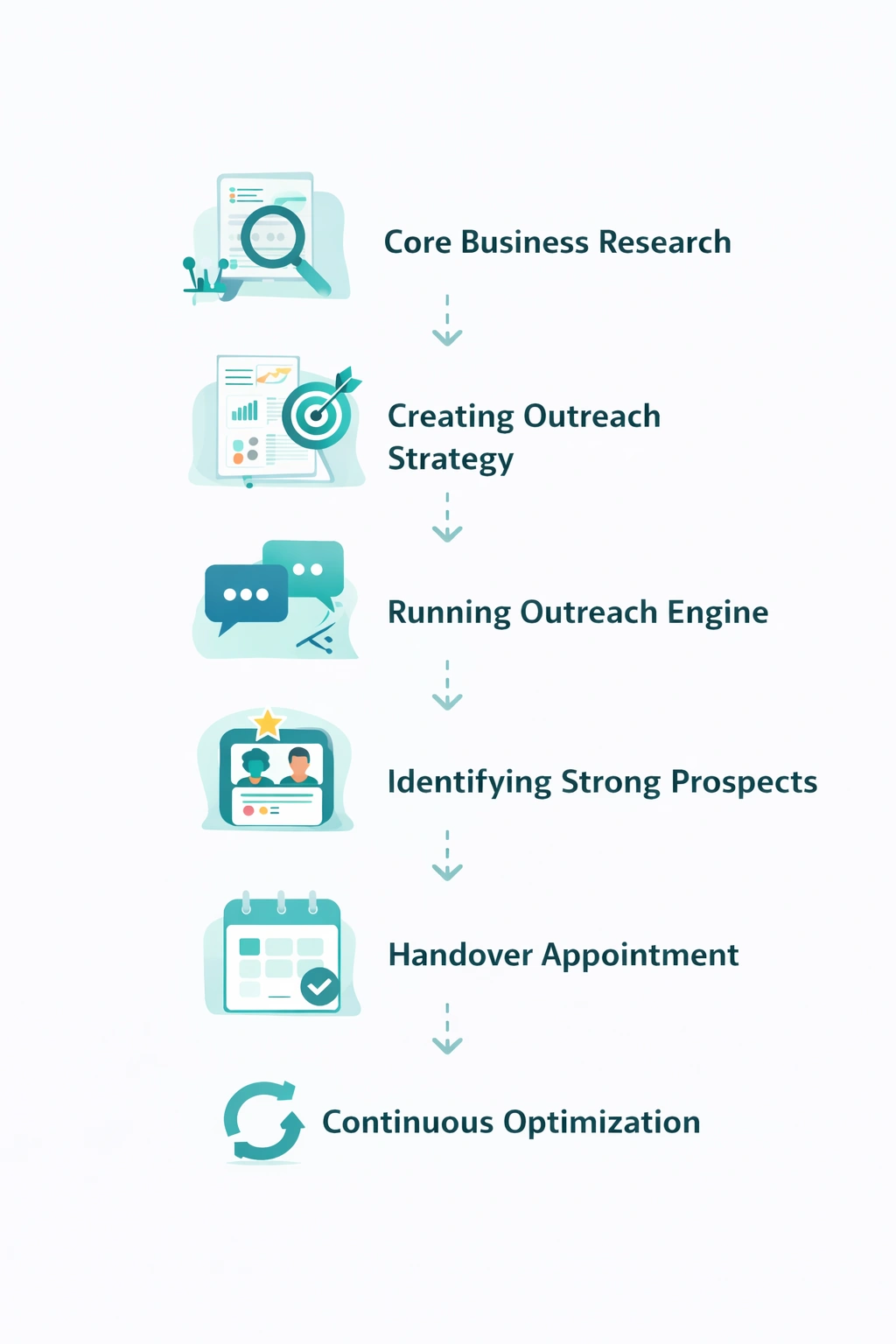
From identifying the right decision-makers to starting meaningful conversations and turning them into qualified appointments... LinkedoJet manages the entire outbound engine for your business.
FAQ
Should we target HR/L&D or the CEO first for executive coaching deals?
Start with the committee, not a single persona. If you sell HR-sponsored programs, lead with CHRO/CPO and L&D/Leadership Development as the operator thread, while looping an executive sponsor (COO/Chief of Staff) for alignment. If you sell transition or functional exec coaching, start with the new exec and
Can this system work for independent executive coaches selling retainers (not just firms)?
Yes—often better, because independents can specialize tightly. The constraint is focus: pick 1–2 offers and a narrow set of triggers (e.g., “new VP Sales in seat” or “new CHRO building leadership agenda”), then run multi-threading so you’re not dependent on a single exec replying. LinkedoJet helps by building the lists, scoring triggers, and running the follow-up so your time stays on calls and delivery.
How do you find companies with leadership development budgets on LinkedIn?
You don’t guess—you look for maturity signals: L&D/Leadership Development/OD titles in the org, multiple HRBPs, hiring for Talent/L&D roles, and initiative language on posts (“manager program,” “leadership offsite,” “performance framework”). In Sales Navigator, that translates into account bands (200–10,000+ for programs) plus lead filters for L&D/Leadership Dev/OD at Director+.
How do you use “changed jobs in the last 90 days” without sounding opportunistic?
Don’t treat it like a gotcha. Treat it like a timing window and offer a relevant asset. New leaders are building priorities, meeting stakeholders, and setting operating rhythm. A simple “first 90 days” framing—paired with something concrete (a short framework, a checklist, a cohort rollout plan)—lands as helpful, not predatory.
How many accounts and contacts should we add weekly to keep pipeline stable?
For most coaching firms selling B2B retainers, a steady baseline is 25–50 new accounts/week with 3–6 contacts per account (so 75–300 new leads/week), then prioritize outreach by trigger score rather than trying to message everyone. The right number depends on ACV, sales cycle length, and how narrow your offer is—but consistency beats bursts every time.
See what LinkedoJet would run for your coaching firm
This isn’t a generic “strategy chat.” We’ll show you the exact targeting, triggers, and multi-thread workflow we’d deploy—then what you receive after onboarding (lists, context, execution, follow-up, and tracking).
If you’re tired of building lists that look good on paper but don’t turn into qualified intro calls, this is the fastest way to get clarity.
On the session, we’ll walk through:
- Your 1–2 core offers (programs vs transitions vs scale-up leadership) and the headcount bands they actually fit
- The buying committee for your deals (HR/L&D + executive sponsors) and the 3–6 contact rule per account
- The Sales Navigator plays we’ll use to build saved searches and saved account lists for your segments
- The trigger signals we’ll score: role changes (last 90 days), hiring for L&D/HRBP, reorg/M&A cues, and LinkedIn activity indicators
After onboarding, LinkedoJet operationally provides: ICP and targeting setup, Sales Navigator prospect list building, AI-assisted personalization, LinkedIn outreach execution, reply handling and lead nurturing, warm lead tracking, appointment generation support, and campaign visibility through dashboards—plus ongoing refinement as we learn what your market responds to.
Targeting and list building aren’t “one and done.” We build account lists by segment (e.g., mid-market HR programs, new CHRO window, scale-up COO sponsors), map 3–6 contacts per account, and attach trigger notes so outreach starts with context.
AI-assisted personalization is used to draft message variants based on trigger and profile cues (role scope, tenure, recent posts), with guardrails so it stays human and specific. Follow-up workflows keep conversations alive without turning your brand into background noise.
Warm leads and booked appointments are tracked in a simple view: who replied, where they are in nurture, what the objection was, and what the next touch should be. You’re not guessing what’s working—you can see it.
Why this is different from ordinary LinkedIn automation tools: automation can send messages. It can’t decide who is in-market, why now, which thread to pull inside the account, or how to keep a real conversation moving. LinkedoJet is the system that runs that whole loop.
Next step: get a prioritized lead list built around real buying signals
If you’re selling premium coaching, you can’t afford to spend weeks talking to non-buyers. We’ll build a tight account list, map the committee, score triggers, and run the outreach + follow-up engine so your calendar isn’t dependent on referrals and hope.
From identifying the right decision-makers to starting meaningful conversations and turning them into qualified appointments... LinkedoJet manages the entire outbound engine for your business.