
How to find leads for cybersecurity companies (without burning credibility with generic outreach)
Build security-budget account lists and map the buying committee using LinkedIn + Sales Navigator signals—so every message has a reason to exist.
Cybersecurity outbound fails in a uniquely painful way: you can do a lot of “activity” and still feel nothing move.
Your reps connect with CISOs, get polite replies, maybe even book a few calls—and then the deal dies in committee because you never found the real program owner, the compliance driver, or the internal urgency. Meanwhile, your brand becomes “another vendor ping” to people who remember everything.
- Account intelligence: who fits, plus why now (hiring, leadership change, audits, incidents, tooling shifts)
- Buying committee mapping: CISO/SecOps/GRC/IAM-Cloud/IT/Procurement—3–6 real stakeholders per account
- Signal-based prioritization: you stop guessing which accounts are in motion and which are just “nice logos”
No generic automation—get a prioritized list with rationale and messaging angles.
What you get: tiered account lists, decision-maker maps, buying signals, and first-message angles grounded in observable evidence.
Why cybersecurity prospecting fails: crowded inboxes, committee sprawl, and a “busy” pipeline that never converts
Security buyers are tired. Tool sprawl turned into consolidation. Budgets now come with proof requirements. And CISOs get a constant drip of “quick question” messages that all read the same.
So when your outreach is even slightly off—wrong persona, wrong timing, no trigger—your shot is gone. Not for a week. Often for a year.
Here’s what I see most often inside vendor and MSSP teams:
- One-persona targeting (only the CISO) while the deal actually moves through SecOps, GRC, IAM/Cloud, IT, and procurement.
- One-contact-per-account lists, which guarantees you lose to whoever multi-threads.
- No “why now”—just ICP fit. Security leaders can smell guessing instantly.
- Weak disqualification: you end up targeting other vendors, consultancies, or accounts with no security function.
- Activity inflation: more connects, more sequences, more noise—while meeting-to-opportunity conversion drops.
The shift is simple: LinkedIn isn’t the lead source. It’s the intelligence layer.
LinkedoJet uses observable LinkedIn and company signals to find accounts that are already moving—then we map the committee so you’re not trying to win a six-figure security decision through one inbox.
Buyer map: build the real cybersecurity buying committee (and stop treating the CISO as the whole deal)
Most security purchases don’t stall because the vendor is “bad.” They stall because the vendor never found the internal owners and blockers early.
Committee mapping is not optional in cyber. It’s how you create momentum before procurement shows up with a spreadsheet and no context.
| Committee lane | Common titles to map | What they care about (the angle that lands) |
|---|---|---|
| Economic / program owner | CISO, VP Information Security, VP Cybersecurity, Head of Security, Director of Information Security | 90-day wins, risk narrative, board pressure, consolidation plans, vendor accountability |
| Operators | Director Security Operations, Head of SecOps, SOC Manager, Incident Response Manager, Detection & Response Lead, Threat Hunter, Security Engineering Manager | Alert fatigue, coverage gaps, false positives, MTTR, runbooks, integration pain, staffing limits |
| Risk / compliance | Director GRC, Compliance Manager, Privacy Officer, Internal Audit Director (sometimes CRO/VP Risk) | SOC 2/ISO 27001 timelines, HIPAA/PCI/GDPR/NIS2 pressure, evidence collection, audit readiness |
| Identity / cloud | Director IAM, IAM Manager, PAM Manager, Director Cloud Security, Cloud Security Architect, Director DevSecOps, AppSec lead | Zero Trust programs, identity sprawl, privileged access, cloud control gaps, modernization projects |
| IT co-owners (mid-market) | CIO, VP IT, IT Director, Infrastructure Director, Network Security Manager | Budget tradeoffs, platform standardization, operational burden, “keep the business running” constraints |
| Commercial blockers | VP Procurement, Strategic Sourcing, Vendor Management, Finance Director | Cost justification, renewal timing, consolidation, contract structure, risk/compliance language |
The rule: 3–6 contacts per account. One economic owner, at least one operator, and the relevant risk/identity lane based on the program you’re selling (MDR, IAM/PAM, SIEM/XDR, SASE/ZTNA, CNAPP, GRC, DLP, vuln/ASM).
Account qualification: what a good cybersecurity target account looks like (scoring + hard disqualifiers)
ICP fit is table stakes. What you want is security-budget probability—accounts with the structure and pressure that cause decisions to happen.
Here’s a practical scoring model you can run before outreach. We use this logic to tier accounts and decide how aggressive (or quiet) to be.
| Signal bucket | What to look for on LinkedIn / company pages | How to score it |
|---|---|---|
| Firmographics | Employee bands: 50–200, 201–1000, 1001–5000, 5000+; region fit (US, UKI, DACH, Nordics, ANZ); multi-location footprint | +1 if in your sweet spot; +1 if multi-location / complex environment |
| Regulatory pressure | Industry: healthcare, fintech/banking, insurance, SaaS, e-commerce, manufacturing, logistics, critical infrastructure, government contractors; keywords: SOC 2, ISO 27001, HIPAA, PCI DSS, GDPR, NIS2, FedRAMP, CMMC | +2 if regulated + compliance language is visible |
| Security maturity | CISO/VP Security exists; security org on LinkedIn; security certifications in profiles (NIST, CIS Controls, MITRE ATT&CK); security postings | +2 if leadership exists; +1 if team/hiring visible |
| Change / complexity | Headcount growth (6–12 months), cloud migration language, remote workforce, M&A posts, new product launches, government contract announcements | +1 to +2 based on intensity |
| Intent / movement | New security leader (0–180 days), recent posts about incidents, tabletop exercises, tool consolidation, RFP/vendor selection language (“migrating from”, “replacing”, “consolidating”) | +3 when you can point to a clear “why now” |
Hard disqualifiers (don’t waste shots)
- Security vendors, MSSPs, consultancies (unless you’re running a channel/alliances motion)
- No IT/security presence (no IT leaders, no security roles, no hiring, no signals)
- Very small teams with no packaged SMB offer (often <25 employees)
- Non-buyer titles in your primary motion: “Student”, “Freelance”, “Advisor”, generic “Consultant”
- Clear hiring freeze / layoffs unless your angle is consolidation and cost reduction
Once you score, you don’t treat every account the same. Tier 1 gets committee mapping + multi-threaded outreach. Tier 3 gets light-touch monitoring until a trigger shows up.
Sales Navigator filter recipes: copyable stacks for regulated buyers, new leaders, hiring surges, GRC pushes, and identity modernization
Most teams do one search, export a list, and call it targeting. That’s how you end up with a thousand “CISOs” and zero conviction.
Use account lists, not one-off searches. Build lists by signal, then attach lead searches to those lists to map the committee.
Recipe A: Regulated Mid-Market Buyers (security-budget + compliance pressure)
- Account filters: Geography (your market) + Industry (healthcare, fintech, insurance, SaaS, manufacturing) + Company headcount (200–2000) + Headcount growth (past 6–12 months)
- Account keywords: “SOC 2”, “ISO 27001”, “HIPAA”, “PCI”, “GDPR”, “NIS2”
- Lead filters: Seniority (CXO/VP/Director/Manager) + Function (Information Technology, Operations, Engineering) + Title contains (“CISO”, “Information Security”, “GRC”, “Compliance”) + Posted on LinkedIn in last 30 days
Recipe B: New Security Leader Trigger (change agent window)
- Lead filters: Title contains (CISO / VP Security / Head of Security / Director of Information Security) + Years in current position (0–2) + Changed job in last 90 days (or spotlight equivalent) + Relationship (2nd degree when possible)
- Account add-on: Company headcount (500–5000) to avoid micro-orgs unless you sell SMB
Recipe C: SecOps Hiring Surge (MDR/SOC tooling motion)
- Account filters: Headcount (500–5000) + Department headcount (Information Technology) + Headcount growth (6–12 months)
- Account keywords: “SOC”, “SIEM”, “XDR”, “incident response”, “ransomware”
- Lead filters: Titles (Director SecOps, SOC Manager, Security Operations Manager, IR Manager, Detection Engineering) + Posted on LinkedIn in last 30 days
- Exclusions: recruiters / staffing titles
Recipe D: GRC / Compliance Push (deadline-driven programs)
- Account keywords: “SOC 2”, “ISO 27001”, “HIPAA”, “PCI DSS”, “NIS2”, “FedRAMP”, “CMMC”
- Lead filters: Director GRC, Compliance Manager, Security Governance, Privacy Officer, Internal Audit Director + Seniority (Director/Manager)
Recipe E: Identity Modernization (IAM/PAM / Zero Trust)
- Account keywords: “Zero Trust”, “Okta”, “Entra”, “Azure AD”
- Lead filters: Director Identity & Access Management, IAM Manager, PAM Manager, Security Architect (Identity), Cloud Security Architect
Organize the output into tiers: Tier 1 (high signal + high fit), Tier 2 (fit, weaker timing), Tier 3 (monitor). If you can’t explain why an account is Tier 1 in one sentence, it isn’t.
We deliver the account lists, committee maps, and signal notes—so your team isn’t building this from scratch every week.
Why-now signals: detect active initiatives and attach a credible outreach angle
Security buyers don’t respond to “Can I have 15 minutes?” They respond to “I see what you’re dealing with, and I have a specific way to help.”
That requires a trigger. Not a fantasy trigger. An observable one.
| Signal | How it shows up | Credible outreach angle |
|---|---|---|
| New CISO / VP Security hired | Job change (0–180 days), “excited to join” posts, leadership reshuffle | 90-day wins, security roadmap support, consolidation decision framing |
| Security hiring (by role type) | Open roles: SOC/IR/Detection, GRC analyst, IAM engineer, Cloud security | Coverage gaps and initiative alignment (e.g., MDR for 24/7, GRC tooling for evidence, IAM/PAM for identity sprawl) |
| Compliance / audit language | SOC 2/ISO readiness, HIPAA/PCI references, NIS2/FedRAMP/CMMC mentions | Deadline-driven program help: evidence, control mapping, continuous monitoring, audit prep |
| Incident pressure | Leadership posts about ransomware, tabletop exercises, response lessons, breach commentary | Response readiness, detection gaps, resilience, containment speed—without fear-mongering |
| Consolidation / alert fatigue | Posts/comments about too many tools, noisy SOC, “rationalizing vendors” | Cost + operational efficiency framing (platform consolidation, better signal-to-noise) |
| Funding / expansion / M&A | New funding, market expansion, acquisitions, new regions (EU), new enterprise customers | Scaling controls fast, integration risk reduction, identity and cloud control standardization |
Negative signals (de-prioritize or change the ask)
- Layoffs / public budget freeze posts (unless your angle is consolidation and savings)
- Accounts that are clearly vendors/MSSPs/consultancies (wrong motion)
- “Security theater” content with no program markers (posts aren’t intent)
The goal isn’t to be clever. It’s to be credible. In cyber, credibility is your conversion rate.
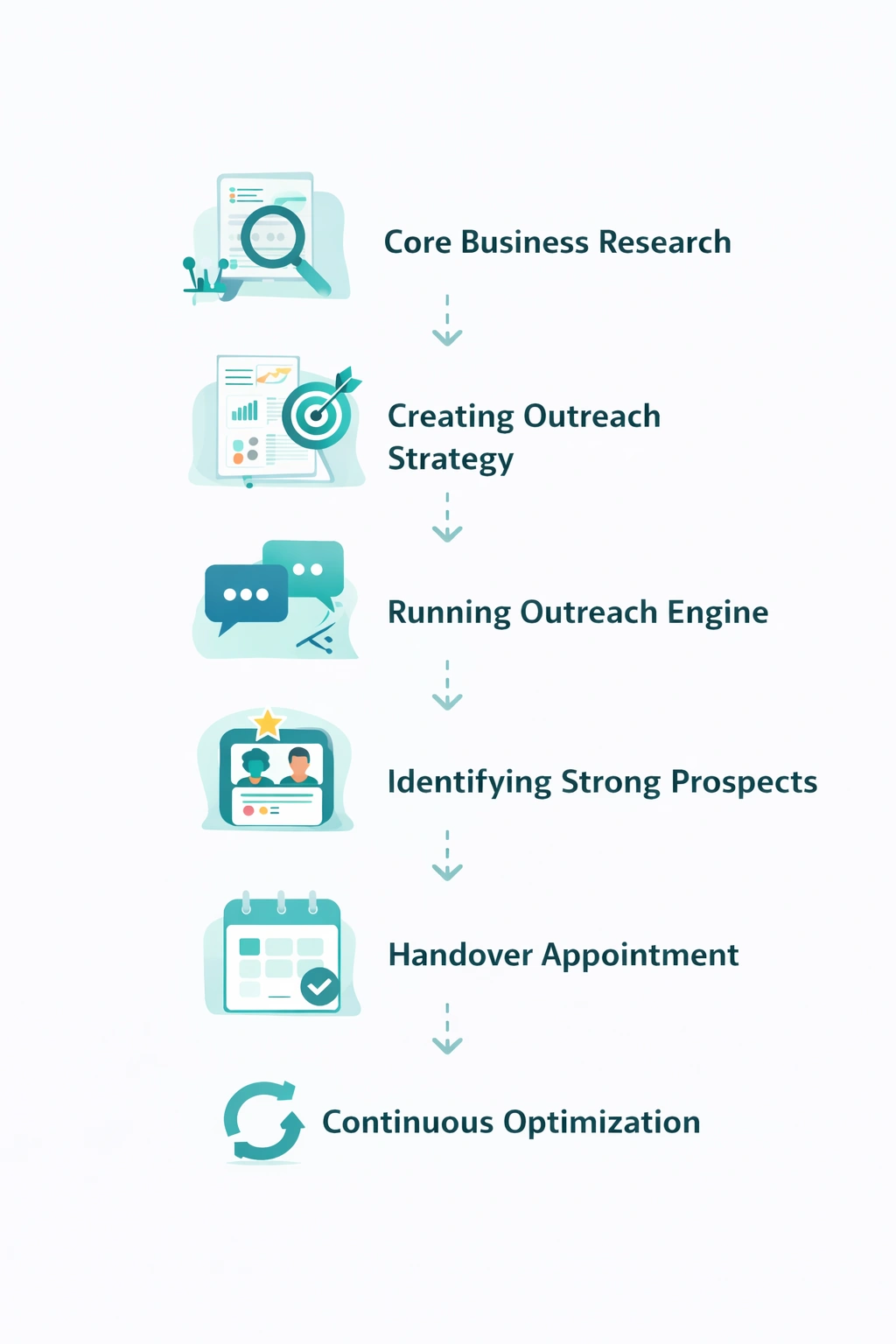
How LinkedoJet works: ICP → tiered account lists → evidence capture → prioritized leads with rationale + angles
LinkedoJet is not a Chrome extension that sends more messages. It’s an outbound operating system built around account intelligence.
We take the messy parts your team avoids (signal capture, disqualification, committee mapping, follow-up discipline) and turn it into a repeatable engine.
The system (4 steps)
- Define ICP + exclusions
We set your segments (MSSP/MDR, SIEM/XDR, IAM/PAM, SASE/ZTNA, CNAPP, GRC, DLP, vuln/ASM), regions, headcount bands, and we build explicit exclusion logic (security vendors, MSSPs, agencies/consultancies, competitor lists). - Build tiered account lists in Sales Navigator
Using the filter recipes above, we produce Tier 1/2/3 account lists and keep them clean. This is where most teams quietly bleed hours. - Capture evidence and map the committee (3–6 per account)
We read profiles for real buying authority (security roadmap, vendor management, tool selection), tenure (new leader vs long-tenured), and context (cloud-first, regulated ops, global footprint). Then we map operators + GRC + IAM/Cloud + IT + procurement where relevant. - Deliver prioritized leads + run outreach + nurture replies
You receive a prioritized list where each account comes with: the trigger, the committee map, and suggested first-message angles. Then LinkedoJet executes LinkedIn outreach, handles replies and follow-ups, tracks warm leads and booked meetings, and refines targeting weekly based on what converts.
What clients actually receive:
- Sales Navigator account lists with tiers (and ongoing list hygiene)
- Buying committee maps (2–6 contacts per account)
- Signal notes (hiring, compliance, incidents, tooling change, growth events)
- AI-assisted personalization that stays grounded in real evidence (not generic “nice post” lines)
- Outreach + nurturing workflows with reply handling
- Dashboard visibility: what was sent, who replied, warm leads, and appointments
- Ongoing refinement: message angles and targeting updated as signals change
Near the end of the day, this is the difference: you stop asking reps to “do more LinkedIn,” and you start feeding them accounts that are already in motion—with a credible reason to talk.
From identifying the right decision-makers to starting meaningful conversations and turning them into qualified appointments... LinkedoJet manages the entire outbound engine for your business.
Questions cybersecurity teams ask before they fix LinkedIn prospecting
Can this work for MSSPs/MDR providers as well as product vendors (SIEM/XDR, IAM/PAM, SASE, CNAPP, GRC, DLP)?
Yes. The difference is the signal and committee lane you prioritize. MDR/MSSP performs best when you focus on coverage gaps (SecOps hiring, 24/7 needs, IR pressure) and map operators early. Product motions often hinge on a program trigger (identity refresh, consolidation, audit readiness) and require tighter alignment between the economic owner and the technical lane.
Do you only target CISOs, or do you map SecOps, GRC, IAM/Cloud, IT, and Procurement too?
We map the committee. Typically 3–6 contacts per account: the economic/program owner plus at least one operator, and the relevant risk/identity lane. For mid-market deals, IT leadership is often a co-owner. For enterprise, procurement and vendor management tend to appear late—so we plan for it instead of acting surprised.
Which LinkedIn and company signals matter most for regulated industries (SOC 2, ISO 27001, HIPAA, PCI DSS, GDPR, NIS2, FedRAMP, CMMC)?
The highest-converting signals are deadline-driven and structural: visible compliance language (company page, leadership posts, employee profiles), GRC/privacy hiring, government contract language (FedRAMP/CMMC), EU expansion (GDPR/NIS2), and evidence that a security program exists (security leadership, SecOps team). We tie outreach to the program and timeline, not generic “security posture” talk.
How do you avoid targeting other security vendors, MSSPs, and consultancies when building account lists?
We build explicit exclusion layers: industry and keyword exclusions, curated “do-not-target” account lists, and ongoing cleanup when new vendor-like accounts show up. We also disqualify accounts with obvious vendor signals (security product language, partner pages, “we provide managed security” positioning) unless your motion is channel/alliances.
How do you handle long enterprise cycles and multi-stakeholder deals on LinkedIn without becoming noise?
We don’t treat LinkedIn like a one-shot sequence. We multi-thread across the committee, keep messaging anchored to observable triggers, and run follow-up workflows that change as signals change (new hire, new audit language, consolidation posts). The goal is to stay relevant and timely—not frequent.
See what LinkedoJet would run for your cybersecurity GTM—targeting, signals, committee maps, and outreach execution
This isn’t a vague “strategy chat.” You’ll leave with a clear view of how we’d build your account lists, what signals we’d watch, and how we’d turn that into qualified conversations.
What LinkedoJet operationally provides is the full outbound engine on LinkedIn for cybersecurity teams: ICP setup, Sales Navigator list building, AI-assisted personalization, outreach execution, reply handling and nurturing, warm lead tracking, appointment generation support, and weekly refinement with dashboard visibility.
After onboarding, we stand up your targeting system and campaign workflows:
- Targeting & prospect list building: we build tiered account lists (Tier 1/2/3) using Sales Navigator filters for regulated industries, new security leaders, hiring surges, GRC pushes, and identity/cloud modernization—plus exclusion logic to avoid vendors/MSSPs/consultancies.
- Committee mapping: we map 3–6 stakeholders per account (CISO/VP Security, SecOps, GRC, IAM/Cloud, IT, procurement as needed), so you’re not betting the deal on one inbox.
- AI-assisted personalization: we use AI to draft relevant openers, but it’s always anchored to evidence we captured (tenure change, hiring patterns, compliance language, tooling shift signals). No generic “loved your post” filler.
- Outreach + nurturing: we execute LinkedIn outreach, manage follow-ups, and handle replies so warm conversations don’t die in a rep’s backlog.
- Tracking & visibility: you get clear tracking of who was contacted, which accounts are warm, what angles are working, and which appointments were generated—so outbound isn’t a black box.
- Ongoing refinement: we adjust filters, tiers, and messaging angles based on real response patterns and new signals (new CISO hires, new audit language, incident chatter, consolidation moves).
Why this is different from ordinary LinkedIn automation tools: tools send more messages. LinkedoJet produces prioritized accounts with rationale, maps the committee, and runs the follow-up system that converts interest into meetings—without turning your brand into noise.
Next step: stop guessing which security accounts are real
If you want fewer dead cycles and higher meeting-to-opportunity conversion, start with signal-based qualification and committee mapping—then run outreach with discipline.
Outcome you should expect: a tiered list of security-budget accounts already showing movement, 3–6 mapped stakeholders per account, and message angles tied to observable triggers (hiring, compliance timelines, incidents, consolidation, identity/cloud programs).