
How to find leads for commercial real estate firms—using LinkedIn signal intelligence, not spray-and-pray
CRE isn’t a volume game. It’s timing + context. This system helps tenant rep, landlord rep, investment sales, and property management teams surface in-market owners, investors, and corporate occupiers in your metros—before the deal gets shopped.
- Decision-maker maps (so you’re not pitching the wrong person)
- Buying-signal targeting (so you’re early, not late)
- Metro + asset-class precision (so your queue stays clean)
You can feel deals moving around you—new leases, expansions, dispositions, repositionings. The frustration isn’t “we need more leads.” It’s watching quarters get decided by access and timing while your team burns hours on names that were never real shots on goal.
Why CRE outreach keeps missing: stale lists, wrong titles, and timing that’s already gone
Most CRE teams aren’t short on activity. They’re short on signal. The list is noisy, the “decision-maker” is close-but-wrong, and the outreach shows up after another shop already got the first meeting.
- Stale owner lists: ownership changes, mandates shift, portfolio coverage moves—your list doesn’t update fast enough to matter.
- Wrong titles: you hit “Real Estate” when Ops/Finance/Workplace is actually driving the tenant move, or you pitch a broker when you needed the principal.
- Hard-to-verify context: who owns what, who covers the region, what asset class they actually touch—missing or assumed.
- Timing mismatch: by the time you learn about the vacancy, the expansion, the fund deployment, the repositioning… the room is already full.
- Distributed decisions: occupiers multi-thread across workplace/facilities/COO/CFO; owners split across principal/asset management/leasing; investors reshuffle acquisition mandates constantly.
Volume outreach fails in CRE because the market punishes generic. If your “lead gen” can’t tell you (1) who controls the decision, (2) what they own/cover, and (3) what just changed that makes them act, you’re doing cold outreach with a prettier list.
Who this system is for (and how to segment by metro + asset class)
This works best for boutique to mid-market CRE firms (roughly 10–500 employees) where you win on being earlier, sharper, and more relevant—not on having the biggest call center.
- Tenant rep teams: corporate occupiers likely to relocate, expand, consolidate, or re-negotiate footprint.
- Landlord rep / leasing teams: owner-operators and landlords with active vacancy, lease-up pressure, or repositioning plans.
- Investment sales teams: acquisitions leaders, principals, and investment managers actively deploying capital (or quietly preparing dispositions).
- Property management business development: owners and asset managers where service changes, portfolio transitions, or operational headaches create openings.
Segmentation rule: don’t run one giant search. Build separate queues by:
- Metro: where the asset is or where the occupier is expanding (not where the HQ happens to sit).
- Asset class: industrial vs office vs retail vs multifamily (keep them separated end-to-end, including messaging angles).
- Motion: leasing (tenant/landlord) vs investment (acquisitions/dispositions) vs management (operations/service switch).
That separation is what prevents “lookalike contamination”—where a handful of decent accounts gets buried under hundreds that were never going to transact with you.
Decision-maker maps that match how CRE decisions really get made
CRE targeting breaks when you treat it like a single-contact sport. The best outcomes come from building a small, accurate account map—then threading the conversation where the decision actually sits.
| Segment | Primary decision-makers to map | What you’re trying to confirm from profiles |
|---|---|---|
| Corporate occupiers | Head/VP/Director of Real Estate, Corporate Real Estate Manager, Workplace/Facilities Director, Head/Director of Workplace, Operations Director, COO, CFO (mid-market) | Multi-site footprint, site selection / workplace strategy exposure, region coverage, timeline clues (move/renewal/buildout) |
| Owners / landlords / operators | Managing Partner, Principal, Founder, CEO/President, Asset Manager / Director of Asset Management, Portfolio Manager, Head of Leasing / Leasing Director / VP Leasing, Director of Property Management, Regional Property Manager, COO/CFO | Portfolio size, asset class focus (industrial/office/retail/multifamily), who controls leasing vs capital decisions, which metros they actively operate |
| Investors | Managing Director, Principal/Partner, Head/Director/VP of Acquisitions, Investments Director, Investment Manager, Real Estate Investment Manager, Capital Markets Director | Mandate language (core/core-plus/value-add), check size, target markets, “deploying capital” timing, dispositions responsibility |
Operator reality: the “most visible” LinkedIn profile is often the least useful for a deal. LinkedoJet verifies the real buyer—not just the most visible profile—by reading role scope, geography coverage, and portfolio cues before a contact ever enters your outreach queue.
Sales Navigator filter playbooks (keep tenant, owner, and investment buyers separate)
Start with Sales Navigator. Then add LinkedoJet’s qualification + signals layer so you’re not just “finding people”—you’re identifying accounts with a reason to talk this quarter.
Tenant rep: corporate occupier search (per metro + asset class)
- Geography: your metro(s). (For multi-location companies, don’t rely on HQ alone—verify regional presence in the profile/company page.)
- Company headcount: 50–5000 (adjust to your deal size).
- Headcount growth: positive over past 6–12 months.
- Industry: match your practice (e.g., logistics/3PL for industrial; healthcare; SaaS; manufacturing; retail).
- Spotlights: Job opportunities; Posted on LinkedIn in past 30 days (and Recently funded where it’s relevant).
- Company keywords: distribution, warehouse, manufacturing, regional headquarters, call center, R&D, showroom, clinic, expansion, new location, grand opening, relocation, lease, footprint.
- Seniority / function: Director/VP/CXO; Real Estate, Operations, Finance, Facilities.
- Title includes: Head of Real Estate, Director of Real Estate, Corporate Real Estate Manager, Real Estate & Facilities Manager, Workplace Director, Facilities Manager, Head of Workplace.
Landlord / owner / property management: owner-operator search
- Industry: Real Estate, Commercial Real Estate, Real Estate Investment, Investment Management.
- Company headcount: 2–500 for many owner-operators; 500–5000 for institutional platforms.
- Company keywords: owner, owner-operator, property management, asset management, industrial, office, retail, multifamily, REIT, real estate fund, self storage, student housing.
- Titles: Principal, Asset Manager, Director of Asset Management, Portfolio Manager, Head of Leasing, Leasing Director, VP Leasing, Director of Property Management, Regional Property Manager, COO/CFO.
- Geography: where assets are located (use location as a starting point; confirm coverage in profile/about).
Investment buyers: acquisitions / capital deployment search
- Industry: Real Estate, Investment Management, Private Equity, Financial Services (selectively).
- Company keywords: acquisitions, real estate fund, value-add, core-plus, development, 1031, opportunity zone.
- Titles: Head of Acquisitions, Director of Acquisitions, VP Acquisitions, Investments Director, Investment Manager, Principal/Managing Director.
- Spotlights: Changed jobs in past 90 days (new leader building pipeline); Posted on LinkedIn in past 30 days.
Want a list of in-market owners/investors/occupiers in your metro? Book a CRE Lead Intel Demo.
In-market signals + a qualification rubric that keeps your weekly queue clean
Lease expirations are nice when you have them. Most teams don’t. The alternative is running a consistent proxy-signal system so you can spot motion early—before the RFP is formal, before the tour schedule is packed, before the asset hits every broker’s inbox.
In-market signals checklist (by segment)
- Corporate occupiers: headcount growth; location announcements; hiring Workplace/Facilities/Real Estate roles; operations expansion; leadership hire tied to CRE/workplace; hiring spikes in sales/manufacturing/ops in your metro.
- Owners / landlords: posts about availability, lease-up, vacancy, new tenant signed; renovation/repositioning and capital improvements; refinancing/loan maturity chatter; hiring Leasing/Asset/Property Management roles.
- Investors: fund closes; “deploying capital” language; acquisition mandate posts; hiring acquisitions roles; 1031 exchange themes; leadership changes that reset pipeline priorities.
LinkedIn activity signals (fast relevance test)
- Posted or engaged in the last 30 days
- Commenting on local CRE news / business journal stories / market threads
- Active in NAIOP, ICSC, BOMA, ULI, CCIM, SIOR circles (groups, events, interactions)
Simple qualification rubric (so you stop wasting reps’ best hours)
| Tier | Criteria | Outcome |
|---|---|---|
| Must-have | Target metro; asset class match; a real decision-maker present; minimum scale indicators (portfolio/doors/sqft/check size implied via role scope, About section, or website) | Eligible for outreach |
| Nice-to-have | Hiring/growth; recent post/press; catalyst language (expansion, vacancy, repositioning, capital deployment); active on LinkedIn | Priority sequencing |
| Exclude | Residential-only; out-of-market with no expansion; junior titles only (unless multi-threading); competing brokerages (when conflict applies); tiny occupiers (<10 employees) unless that’s your niche | Keep out of the queue |
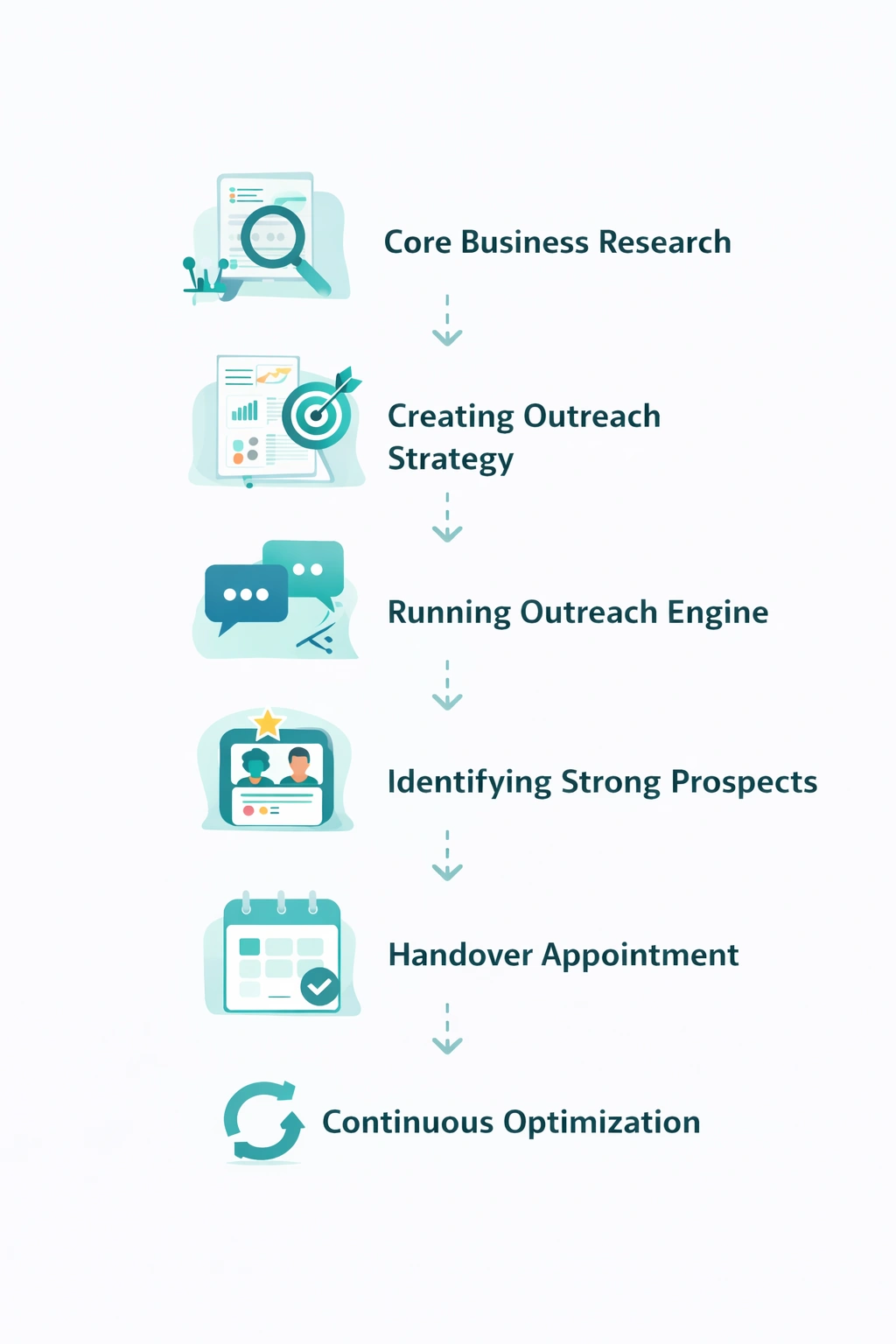
The LinkedoJet workflow: from saved searches to a weekly in-market lead queue and trigger-based outreach
Sales Navigator finds profiles. It doesn’t run your prospecting system. LinkedoJet sits on top of your targeting and turns it into a repeatable operating rhythm: clean segments, verified decision-makers, signal scoring, and outreach that’s anchored to what just changed.
- Segment the pipeline by motion (tenant/owner/investor/property management) and by metro + asset class.
- Build saved searches in Sales Navigator using the filter playbooks above (separate searches; no “mega list”).
- Validate role scope with profile reading: LinkedoJet reviews profiles for portfolio/region coverage, multi-site footprint, asset class exposure, and mandate language (acquisitions pipeline, lease administration, site selection, NNN/build-to-suit, etc.).
- Apply signal scoring using hiring, growth, announcements, leadership changes, and LinkedIn activity—so outreach goes to accounts with motion, not just “fits on paper.”
- Produce weekly outputs your team can actually work:
- a clean In-Market CRE Lead Queue (per segment and per metro)
- a decision-maker map per account (so you can multi-thread intelligently)
- Trigger-based outreach execution: LinkedoJet runs the LinkedIn outreach workflow with AI-assisted personalization (grounded in the trigger + role scope), manages follow-ups, and handles early reply routing so warm conversations don’t die in someone’s inbox.
- Warm lead tracking + appointment support: track who engaged, who’s warming up, and which accounts are approaching meeting-ready—visible in dashboards, with ongoing refinement as your market feedback changes.
Message angles aren’t generic. They’re tied to the moment: expansion hiring in your metro, a repositioning announcement, a leasing push, a capital deployment statement, a new acquisitions lead building their pipeline.
Questions CRE teams ask before they commit to a signal-driven system
Can this work for a single metro team, or does it require multi-market coverage?
Single metro is often the fastest win because you can keep segments tight and validate signals quickly. Multi-market works too, but only if you run separate saved searches and separate queues per metro + asset class. The system breaks when everything gets mixed into one “national” list.
How do you avoid targeting the wrong side of the deal (broker vs principal / owner vs manager)?
Two controls: (1) segment definitions that explicitly separate principals/asset management/leasing/property management, and (2) profile verification. We look for scope language like “portfolio,” “covers X region,” “owns/operates,” “asset management,” “leasing strategy,” “acquisitions mandate.” If it reads like an intermediary when you need the balance-sheet decision, it doesn’t enter the queue.
Can you focus only on industrial, office, retail, or multifamily—and keep each queue separate?
Yes—and you should. The filters, signals, and messaging hooks differ by asset class. LinkedoJet keeps separate saved searches, separate scoring, and separate outreach sequences so an industrial owner-operator doesn’t get an office repositioning angle.
How do you detect buying intent without lease expiration data?
Proxy signals: hiring patterns (Facilities/Workplace/Real Estate), headcount growth, location announcements, leadership changes, “expanding/moving/buildout” language, vacancy/lease-up posts, fund closes, “deploying capital” statements, and LinkedIn activity that indicates they’re paying attention to the market. It’s not perfect data. It’s early data—and that’s the point.
Will this support investment sales and leasing, or do you need separate workflows?
It supports both, but the workflows stay separate. Investment sales targets different titles, different company types (funds, family offices, PE RE teams), and different triggers (capital deployment, acquisitions hiring, dispositions). Leasing targets different catalysts (vacancy, repositioning, tenant growth). LinkedoJet runs them as parallel queues so each team gets clean at-bats.
Book a CRE Lead Intel Demo (see your in-market queue before you scale effort)
This isn’t a generic “strategy call.” We’ll show you what it looks like when targeting, signals, personalization, follow-up, and appointment support operate as one system—so your reps stop guessing and start working a clean weekly queue.
What LinkedoJet operationally provides: we set up ICP and targeting, build Sales Navigator prospect lists by metro + asset class, apply AI-assisted personalization, execute LinkedIn outreach, manage follow-ups and nurturing, track warm leads, and support appointment generation—backed by dashboards and ongoing campaign refinement.
How targeting and list building works: we create segmented saved searches (tenant/owner/investor/management) and keep them separated by metro + asset class. We don’t hand you a single spreadsheet of names. We maintain a living prospect system you can run every week.
How AI-assisted personalization is used: personalization is anchored to real context—role scope, portfolio/region cues, and the trigger signal (hiring, expansion, repositioning, capital deployment). It’s not mail-merge fluff. It’s relevance at scale without turning your brand into noise.
How lead nurturing and follow-up works: most CRE conversations don’t close in one message. LinkedoJet manages sequenced follow-ups, routes replies, and keeps warm accounts in motion so interest doesn’t die between a broker’s showings and a Monday inbox.
How warm leads and appointments are tracked: you get visibility into who engaged, which accounts are warming up, and where meetings are being set—so you can forecast effort vs outcomes and refine targeting based on what the market is actually telling you.
Why this is different from ordinary LinkedIn automation tools: tools blast messages. LinkedoJet runs the operating system: segmentation, verification, signal scoring, decision-maker mapping, outreach execution, nurturing, and iteration—so your pipeline gets earlier and cleaner over time.
Next step: turn LinkedIn into a weekly in-market CRE lead queue
When this is set up correctly, your team stops living off legacy relationships and starts creating new, qualified shots on goal—per metro, per asset class, tied to real catalysts.
From identifying the right decision-makers to starting meaningful conversations and turning them into qualified appointments... LinkedoJet manages the entire outbound engine for your business.