
How to find leads for corporate training companies
A repeatable way to identify the real HR/L&D budget owners and the accounts that are already in motion—using LinkedoJet prospect intelligence and Sales Navigator search logic, so you reach out with initiative context instead of “we do training.”
- Target the exact titles that own training budgets (CLO, VP L&D, Sales Enablement, Compliance, HRD).
- Prioritize accounts showing real training demand (hiring, program launches, enablement initiatives, LMS changes).
- Start conversations with initiative-based context—not generic pitches.
Speak to our Experts Create my Roadmap to Success
Most training pipelines don’t fail because the programs are weak. They fail because the list is wrong and the timing is worse.
Why training pipeline feels random (and what it costs you in quiet months)
You can do all the “activity” and still have nothing credible to forecast. That’s the part that grinds teams down.
Corporate training is especially brutal because the org chart lies. “Learning” can sit under HR, Talent, People Ops, Enablement, Ops, Compliance, even Customer Support. So you hit the most obvious titles, get polite replies, and then the conversation dies when you realize you’re speaking to someone who can sponsor a pilot but can’t move budget.
And even when you find the right person, you’re often late. Vendor discovery starts months before an RFP—through LinkedIn posts, hiring, internal program announcements, and peer recommendations. By the time procurement is asking for a deck, the decision has shape. You’re now competing in a beauty contest you didn’t influence.
- L&D titles are noisy: “Learning Partner” and “Head of Talent” might mean budget owner or zero buying power.
- Training demand is episodic: onboarding spikes, compliance updates, enablement resets, change initiatives.
- Generic positioning collapses differentiation: “leadership/sales/compliance training” sounds the same in an inbox.
- Gatekeepers appear fast: once the initiative is formal, you get routed to procurement or a preferred vendor list.
The fix isn’t more volume. It’s turning LinkedIn into a signal engine: find the initiative first, then attach the right persona to it.
Who actually buys: the L&D/HR/Enablement/Compliance decision map
“Training buyer” is a committee label, not a person. Your lead system should reflect that.
| Group | Common titles | What they control | Best-fit offers |
|---|---|---|---|
| Budget owners | CLO, VP/Head of L&D, HR Director/VP People, Head of Talent Development, OD Director | Portfolio budget, vendor shortlist, prioritization across programs | Leadership cohorts, manager essentials, capability frameworks, blended learning programs |
| Program owners | Training Manager, Learning Program Manager, Learning Ops Manager, Instructional Design Manager, LXD lead | Program delivery, content build/buy, LMS adoption, rollout logistics | Custom eLearning, train-the-trainer, onboarding academies, facilitator benches |
| Adjacent sponsors | Sales Enablement Director/VP, VP Sales, Sales Ops, Customer Success leader, Contact Center Director, Ops Director | Performance outcomes (ramp, quota attainment, AHT/CSAT), urgency | Sales enablement, onboarding/ramp, customer service training, coaching systems |
| Risk & compliance owners | Chief Compliance Officer, Compliance Director/Manager, Risk Manager, Safety/EHS Manager | Mandatory training, audit readiness, completion rates | Compliance refresh, safety/EHS training, policy rollouts, tracking/attestation support |
The operator move: match persona to the initiative. A Sales Enablement leader doesn’t want a “leadership catalog.” They want faster ramp and consistent deal execution. A Compliance head doesn’t want inspiration; they want evidence, audit trails, and adoption.
If you want us to build this persona map + targeting for your offers, book a session.
Ideal accounts, disqualifiers, and the “in-house academy” tells
Most wasted time in corporate training sales comes from two places: accounts that will never buy externally, and accounts that could buy but won’t buy now.
High-probability account traits
- Headcount fit: 200–5,000 employees (faster cycles) or 5,000–50,000 (bigger programs, longer cycles).
- Recurring training pressure: Financial Services, Insurance, Healthcare, Pharma/Medical Devices, Manufacturing, Logistics, Retail, Hospitality, SaaS/Tech (enablement), Contact Centers/BPO, Energy/Utilities, Professional Services.
- Org complexity: multi-site, regulated roles, frontline operations, distributed sales teams.
- Growth context: rapid hiring, new locations, acquisitions, restructures (onboarding/change training shows up fast).
- Learning infrastructure signals: LMS/LXP mentions (Workday Learning, Cornerstone, Docebo, SAP SuccessFactors, Moodle, TalentLMS, Absorb, Degreed, EdCast) in job posts and employee profiles.
Deprioritize (unless you have a sharp wedge)
- Layoffs + hiring freeze with public “cost reset” messaging (compliance can be an exception; flag as cautious).
- Training competitors (keep an exclusion list in Sales Navigator).
- Vendor consolidation announcements (harder to break in without a unique niche or existing champion).
“In-house academy” tells (so you don’t guess)
- Multiple Learning Ops + Instructional Design + internal facilitator roles across regions.
- Leaders posting “built internally” language: internal academies, internal certification programs, internal content studio.
- Job posts for Learning Content Producer, Curriculum Architect, Learning Analytics, LMS Product Owner—not just a single Training Manager.
Sales Navigator recipes (mid-market vs enterprise) + title Boolean examples
Don’t start with a massive lead list. Start with two tracks and keep them clean: a mid-market motion and an enterprise motion. Different buying behavior, different titles, different timelines.
Recipe A: Mid-market (200–5,000) — find budget owners who can move fast
- Account search: Geography (NA/UK/EU/ANZ), headcount 200–5,000, target industries, positive headcount growth (6–12 months), exclude staffing/recruiting + training competitors.
- Lead search: Seniority Manager–CXO, Functions Human Resources / Education / Operations / Sales, relationship 2nd-degree, posted on LinkedIn in last 30 days, years in role 0–2 (new leader signal).
- Titles to emphasize: HR Director, VP People, Head of Talent Development, Director of Training, Head of L&D, HRBP (mid-market can be a real buyer).
Recipe B: Enterprise (5,000–50,000) — find program owners + global stakeholders
- Account search: headcount 5,000–50,000, multi-region presence, HR department size (where available), transformation triggers (hiring + reorg + M&A chatter), regulated industries for compliance training.
- Lead search: Director/VP/CXO, add keywords like “Global”, “Enterprise”, “Learning Operations”, “Leadership Development”, “Sales Enablement”, years in role 0–2.
- Enterprise nuance: you often need two leads—portfolio owner (VP L&D/CLO) and program owner (Learning Ops/Program Manager). One approves; the other makes it real.
Title Boolean example (Lead search current title): ("Learning" OR "L&D" OR "Training" OR "Enablement" OR "Talent Development" OR "Organizational Development" OR "Leadership Development" OR "Compliance") AND ("Director" OR "VP" OR "Head" OR "Manager")
LinkedoJet takes these searches and turns them into a working queue: the right accounts, the right personas, and notes on why this account is worth touching this week.
Buying signals on LinkedIn that predict training spend
Titles tell you who. Signals tell you when. If you only target titles, you’ll keep pitching into dead quarters.
- New L&D / Talent leader hired: 0–6 months is the “listening tour” window where vendors get evaluated quietly.
- Hiring for L&D / Enablement / Learning Ops: indicates program build-out, new cohorts, or capacity gaps they’ll patch externally.
- Hiring for LMS Admin / Implementation / LXP roles: often means rollout or migration—content conversion + adoption training follows.
- Posts about skills frameworks, competencies, upskilling/reskilling: usually precede a budget discussion; they’re shaping the narrative.
- Sales kickoff / enablement refresh language: “new messaging”, “methodology”, “manager coaching”, “ramp time” = performance pressure.
- Compliance/regulatory updates: mandatory timelines create funded urgency; the buyer cares about completion + audit readiness.
- Rapid frontline hiring / new locations: onboarding and safety training become operational, not “nice to have.”
- Event participation: speaking at ATD/SHRM/Learning Technologies, running webinars, asking for vendor recommendations—these are early procurement signals.
One more practical filter that gets ignored: prioritize people who have posted or commented in the last 30 days. If they’re not active on LinkedIn, your outreach becomes a coin flip.
The LinkedoJet daily system: prioritized queues, reason-coded intent, and initiative-based talk tracks
LinkedoJet isn’t “a tool that sends messages.” It’s the operating system behind a corporate training outbound motion: targeting, prioritization, relevance, follow-up, and visibility.
A simple 4-step framework that holds up in the real world
- Define ICP + segments: Enablement, Leadership, Compliance/EHS, Onboarding (and the industries where each is funded).
- Build Sales Navigator searches: account lists + persona-mapped lead lists (budget owner + program owner pairs where needed).
- Add signal monitoring + reason codes: new leader, hiring, LMS change, program launch posts, event speaking, vendor-evaluation language.
- Run initiative-based outreach: short, specific angles tied to the signal—then structured follow-up and nurturing when they don’t reply yet.
Talk track angles (concepts, not scripts)
- New L&D leader: “Saw you just stepped into the role—when teams inherit a mix of leadership programs, onboarding, and enablement, the first 90 days is usually prioritization + quick wins. Want a short benchmark on what peers roll out first and what they defer?”
- Hiring instructional design / Learning Ops: “When you hire Learning Ops/ID, it’s often because internal demand outpaced capacity. If you’re building while shipping, an external sprint (content conversion, blended cohort, facilitator bench) can keep timelines intact.”
- Sales enablement kickoff: “If SKO is driving a reset, the risk is inconsistent manager coaching after the event. We’ve seen the win come from the 30/60/90 reinforcement—not the kickoff deck.”
This is where corporate training companies win: you show up early with a point of view on the initiative, not a brochure of courses.
FAQs
Which titles actually control training budgets in mid-market vs enterprise?
Mid-market (200–5,000): HR Director/VP People, Head of Talent Development, Head of L&D, and sometimes an HRBP with a broad remit can control budget. Enterprise (5,000+): budget authority often sits with CLO/VP L&D or a Talent/Learning portfolio leader, while program ownership lives with Learning Ops, Program Managers, Enablement leaders, or regional L&D heads. Your best outbound list usually pairs a portfolio owner with the program owner tied to the initiative.
How do we avoid accounts with big in-house academies (without guessing)?
Look for evidence, not vibes: multiple internal facilitator roles, Learning Ops headcount across regions, job posts for curriculum architects/learning analytics/LMS product owners, and leaders posting about internal academies and “built internally.” Those accounts can still buy, but you’ll need a specialist wedge (capacity during peak hiring, compliance refreshes, LMS migration content, high-stakes enablement) rather than generic leadership programs.
Can this work for compliance training and safety/EHS—not just leadership development?
Yes—often better, because timelines and audit pressure create urgency. The persona set shifts: Compliance Director/Manager, Risk, Safety/EHS, Ops leadership, plus L&D for rollout logistics. Signals to watch include regulatory updates, incident-reduction initiatives, frontline expansion, and job posts tied to safety/compliance operations.
How do we spot an LMS/LXP rollout or migration on LinkedIn (before an RFP)?
Three reliable places: job posts (LMS Admin, Learning Systems, Docebo/Cornerstone/Workday Learning experience), employee profiles adding those platforms, and Learning Ops leaders posting about “platform consolidation,” “learning ecosystem,” “content migration,” or “adoption.” Those signals show up well before procurement publishes anything.
What company sizes and industries convert best for corporate training services?
For faster cycles, 200–5,000 employees is the sweet spot. For larger ACV programs, 5,000–50,000 can be excellent with the right initiative signals and stakeholder map. Industries with consistent training demand include Financial Services, Insurance, Healthcare, Pharma/Medical Devices, Manufacturing, Logistics, Retail, Hospitality, SaaS/Tech (enablement), Contact Centers/BPO, Energy/Utilities, and Professional Services.
See your next 30 days of training demand—before it becomes an RFP
This isn’t a generic “discovery call.” We’ll show you how LinkedoJet builds a prioritized, signal-led outbound engine for corporate training—so your team is talking to real budget owners with a clear reason to engage now.
What LinkedoJet operationally provides: we set up your ICP and segments (Enablement, Leadership, Compliance/EHS, Onboarding), build Sales Navigator account and lead searches, and turn them into daily prospect queues that prioritize who’s actually in-market.
How targeting and list building works: we map the decision chain (portfolio owner + program owner + sponsor) and build clean lead lists by region, industry, and headcount band—then attach reason codes like new leader, hiring, LMS change, program launch posts, or enablement reset. You don’t just get “a list.” You get a ranked queue with context.
AI-assisted personalization (used the right way): we generate outreach angles that reference the observed initiative (not fake compliments). The point is relevance: onboarding ramp, manager cohort rollout, compliance refresh deadlines, SKO reinforcement, LMS adoption—whatever is actually happening inside the account.
Execution + nurturing: LinkedoJet runs the LinkedIn outreach workflow, handles follow-ups, and supports reply handling so warm leads don’t die in someone’s inbox. When timing isn’t right, we keep light-touch nurturing running against the right persona set.
Tracking and visibility: you see what’s happening through dashboards—who was contacted, what reason code drove the outreach, who replied, who became warm, and which conversations are moving toward a meeting.
Appointment generation support: when a lead turns warm, we help push toward a clear next step (intro call, scoped workshop, pilot cohort) and keep the thread moving until a meeting is booked.
Why this is different from ordinary LinkedIn automation tools: automation sends. LinkedoJet prioritizes, contextualizes, and manages the full workflow—so you’re not spraying messages at HR titles and hoping procurement magically appears.
If you want a system where outreach is driven by initiative timing (not guesswork), book a session below. You’ll leave with a clear view of what we’d build, what we’d run, and what you’ll see each week once it’s live.
Next step: turn LinkedIn into a predictable training pipeline
Get a prioritized list of HR/L&D buyers and accounts showing training demand this month—ranked by signal, mapped to the right personas, and ready for initiative-based outreach.
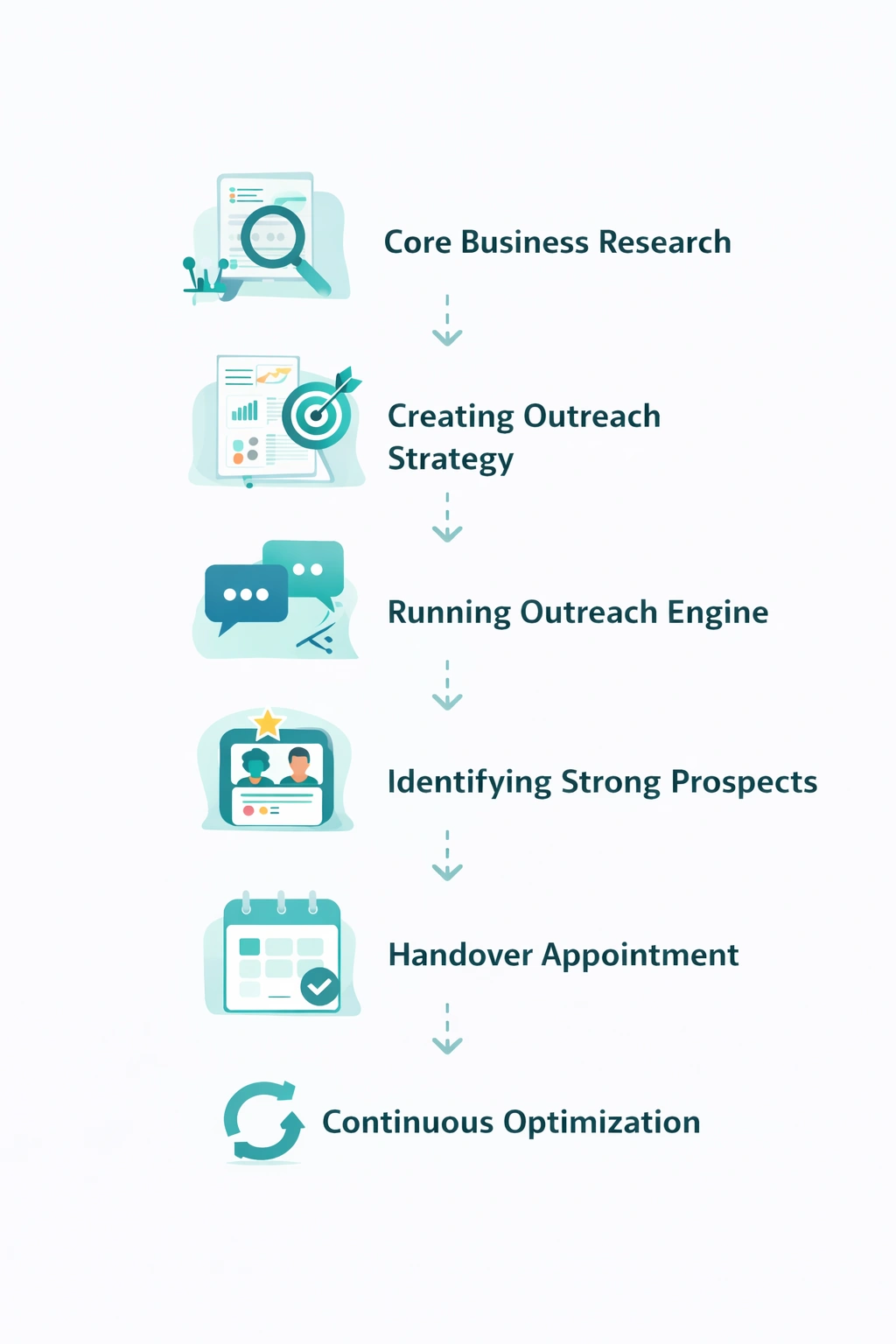
From identifying the right decision-makers to starting meaningful conversations and turning them into qualified appointments... LinkedoJet manages the entire outbound engine for your business.
After onboarding, you’re not left with “a strategy doc.” You get targeting systems, persona-mapped lists, AI-assisted personalization, outreach execution, lead nurturing, warm-lead tracking, appointment support, and clear campaign visibility—improving week over week.