
Find AI automation leads with LinkedIn signals (not bigger lists)
Most agencies don’t lose deals to competitors. They lose them to timing and role mismatch. The fix isn’t more volume—it’s a repeatable way to spot change and route it to the operator who owns the outcome.
You can feel it when the pipeline goes soft. The team is capable of serious delivery—agents, LLM integrations, RPA modernization, system integrations—and you’re still spending Monday morning sorting through profiles that will never buy.
Worse: you take “nice” calls with curious people. No integration complexity. No budget owner. No forcing function. You do the dance, you send a recap, and you get the same line two weeks later: “Sounds interesting—maybe later.”
A signal-led system changes the game because it answers two questions consistently:
- Intent: Is the company already in motion (hiring, tooling change, leadership change, initiative language)?
- Owner: Are you talking to the person who actually owns the workflow/system outcome and can sponsor change this quarter?
LinkedIn is noisy now. “AI automation” reads like a commodity phrase. But Sales Navigator plus the right signals still gives you an unfair advantage—if you stop treating it like a directory and start using it like an early warning system.
Get My AI Automation Agency Lead List or see the Prospect Intelligence System.
- Sales Navigator targeting
- Buying + hiring signals
- Outreach angles based on what they’re doing right now
Why AI automation outreach fails (even when the offer is strong)
Most weeks, the real enemy isn’t competition. It’s wasted motion: scraping, pitching, explaining, and then watching the thread die because the account wasn’t in a change window.
Here’s what’s usually happening under the hood:
- Wrong role: You default to CEO/Founder because it feels “senior,” but they don’t own the systems backlog day-to-day. You end up selling the category instead of attaching to a specific operational initiative.
- No trigger: You reach out when nothing is changing. No new leader. No hiring. No stack migration. No pain showing up in job descriptions. So your message has to create urgency from scratch (it won’t).
- Tool-first pitch: You talk Make/n8n/Zapier/RPA/agents. Operators hear risk, maintenance, and vendor noise. They buy outcomes: cycle time, SLA risk, quote-to-cash, ticket deflection, onboarding throughput.
- Weak qualification: You end up in “Zapier-only” land because you didn’t screen for stack complexity, data maturity, and integration reality.
When those four stack up, you compensate by blasting more. Higher activity, lower confidence. That’s where forecasting breaks and hiring gets scary.
LinkedoJet fixes this by starting with intent signals and role fit, then building outreach angles that match what the account is already trying to ship.
Who to target (and who to avoid): the operators who own workflows, systems, and budget
If you sell complex automation outcomes, you don’t need “more decision-makers.” You need the right sponsor: the person who gets paged when operations fall behind, data doesn’t match, or handoffs break.
Priority target groups (with the “when”)
- Ops leaders (COO, Head/VP/Director of Operations, Chief of Staff): best when the problem crosses teams—order-to-cash, onboarding, fulfillment, internal tooling, compliance workflows.
- Business Systems / IT owners (Head/Director of Business Systems, Enterprise Apps, Head of IT, IT Manager, CTO in SMB/MM): best when integrations, governance, security reviews, and system ownership matter.
- RevOps / Sales Ops / Marketing Ops (Head of RevOps, RevOps Manager, Sales Ops, Marketing Ops): best for CRM hygiene, lead routing, forecasting reliability, lifecycle automation, attribution plumbing.
- Support/CX leaders (VP Support, Head of Support, Director of CX, Support Ops): best for ticket deflection, agent assist, knowledge workflows, SLA risk reduction.
- Data/AI leaders (Head/Director of Data/AI, Data Engineering Manager, ML Engineering Manager): best for RAG/agent initiatives, data access patterns, evaluation/guardrails, and “don’t break prod” constraints.
- Finance ops owners (CFO, Controller, Finance Ops Manager): best for AP/AR workflows, reconciliation, approvals, revenue recognition plumbing in ERP-heavy environments.
Avoid targeting (unless it’s a deliberate play)
- Founders at very small companies: they’ll love the idea and never prioritize it, or they’ll try to DIY it in a weekend.
- Other agencies / automation freelancers: filter out unless you want partnerships.
- Interns/juniors: they can be helpful for intel, but they won’t sponsor spend or timing.
Niche note: in AI agent deals, the sponsor is often Ops or Support, while Data/AI is the risk gate. Don’t confuse gatekeepers with budget owners—build a map, then message accordingly.
Company qualification that protects your calendar
Your calendar is your most expensive resource. If you don’t screen for complexity and change, you’ll keep educating people who aren’t ready to buy.
Headcount bands (and what changes)
| Band | What usually makes automation buyable | Common risk |
|---|---|---|
| 11–50 | High-velocity, productized wins (RevOps cleanup, support deflection starter, internal tooling) | Budget volatility; founder-led prioritization swings |
| 51–200 | First real systems sprawl; Ops/RevOps gets pressure to “make it work” | Too many partial tools; unclear system ownership |
| 201–500 | Integration backlog becomes visible; teams feel handoffs and SLA pain | Internal politics; longer buying path |
| 501–2000 | Multi-system reality (CRM + helpdesk + ERP + data stack); real governance | Security/compliance reviews; procurement |
Stack complexity indicators (quick read)
- Multi-system: Salesforce/HubSpot + Zendesk/Intercom + NetSuite/ERP + Snowflake/Databricks is usually real integration pain.
- Workflow tools present: Jira/Asana/Airtable everywhere = process exists, but it’s duct-taped.
- Data access mentioned: “single source of truth,” “event tracking,” “warehouse,” “reverse ETL” = agent/LLM work has a place to land.
Change events that create a buying window
- New COO/Head of Ops/RevOps (0–6 months tenure is a real window)
- Funding, acquisition, or re-org (systems break during growth)
- Tool migration or new platform rollout (CRM, ERP, helpdesk, ServiceNow)
- Hiring for systems/automation/data roles (they’re admitting the backlog exists)
Fast priority checklist
If 3+ are true, push them to the top:
- 51–2000 employees
- At least 3 systems in the workflow (CRM/helpdesk/ERP/data)
- Hiring for RevOps/Business Systems/Automation/Data
- New ops/systems leader in the last 90 days
- Job posts or posts mention manual processes, backlogs, or handoffs
Sales Navigator plays (ready-to-run): searches, spotlights, and saved alerts
Sales Navigator works when you treat it like a monitoring layer. You’re not just filtering titles—you’re watching for change, then catching the right owner while they’re building momentum.
Play 1: Ops-led Automation (COO / VP Ops)
- Geography: US/Canada/UK/EU/ANZ (match delivery coverage)
- Company headcount: 51–200, 201–500, 501–2000
- Seniority: CXO, VP, Director, Manager
- Function: Operations
- Titles (OR examples): COO OR “Head of Operations” OR “VP Operations” OR “Director of Operations” OR “Operations Manager” OR “Business Operations” OR “Chief of Staff”
- Spotlights: Posted on LinkedIn in last 30 days; Changed jobs in last 90 days
- Optional keywords: “process improvement” “workflow” “systems” “automation”
Play 2: Business Systems + RevOps Automation
- Function: Information Technology, Operations, Sales
- Company headcount: 51–500 (HubSpot/RevOps sweet spot) and 201–2000 (Salesforce/NetSuite complexity)
- Titles (OR examples): “Director of Business Systems” OR “Business Systems Manager” OR “Enterprise Applications” OR “RevOps Director” OR “RevOps Manager” OR “Sales Ops Manager” OR “Marketing Ops Manager”
- Keywords: “Salesforce admin” “RevOps” “business systems” “integrations” “GTM systems”
- Spotlights: Posted on LinkedIn in last 30 days
Play 3: AI Agents / LLM Initiatives (when you can deliver beyond demos)
- Company headcount: 201–2000
- Titles (OR examples): “Head of Data” OR “Director of Data” OR “Head of AI” OR “Director of AI” OR “Data Engineering Manager” OR “ML Engineering Manager”
- Keywords: LLM OR GenAI OR “AI agent” OR RAG OR Anthropic OR OpenAI
- Industry: SaaS, FinTech, customer support-heavy businesses, platforms with high ticket volume
- Spotlights: Posted in last 30 days; Changed jobs in last 90 days
Play 4: Support Automation (ticket deflection + agent assist)
- Company headcount: 51–2000
- Titles (OR examples): “VP Customer Support” OR “Head of Support” OR “Director of Customer Experience” OR “Support Operations”
- Keywords: Zendesk OR Intercom OR “deflection” OR “knowledge base” OR “chatbot”
- Spotlights: Posted in last 30 days
Non-negotiable habit: save these searches and turn on alerts. Job changes and posting activity are the free intent feed most agencies ignore.
Speak to our Experts to get a list built around your offer and delivery constraints—so your team stops taking low-probability calls.
What “in-market” looks like: signals, angles, and disqualifiers
“Interested in AI” isn’t a buying signal. In-market looks like motion: someone is accountable for an operational outcome and something changed that makes doing nothing expensive.
1) Hiring signals (they’re admitting the backlog exists)
- Automation Engineer, Integration Engineer, Solutions Architect
- Business Systems Analyst / Business Systems Manager
- RevOps / Sales Ops / Marketing Ops roles (especially newly opened leadership)
- Data Engineer / Analytics Engineer / ML Engineer / AI Engineer
- RPA Developer, Process Improvement / Lean roles
2) Tooling signals (migration = budget + urgency)
- CRM: HubSpot or Salesforce rollouts, admin hiring, territory/routing rebuilds
- Support: Zendesk/Intercom consolidation, deflection targets, knowledge base overhauls
- ERP/workflows: NetSuite, Workday, ServiceNow implementations
- Data: Snowflake/Databricks adoption, “warehouse first” language, reverse ETL mentions
3) Initiative language (steal their words, not your category)
- “reduce manual work” / “spreadsheet-driven”
- “integration backlog” / “handoffs” / “process breaks”
- “standardize workflows” / “scale ops” / “rebuild RevOps”
- “agentic workflows” / “RAG” / “productionizing GenAI”
- “ticket volume” / “SLA risk” / “onboarding time” / “quote-to-cash”
4) Activity signals (they’re mentally on the topic)
- Recent posts about ops, internal tools, AI productivity, CX metrics, RevOps rebuilds
- Engaging with communities around HubSpot/Salesforce/Zendesk/ServiceNow/Make/n8n
- Profile updates: new role, promotion, “building,” “transforming,” “standing up systems”
Disqualifiers (protect your time)
- Team is too small for your delivery model (unless you sell a productized offer)
- No stack complexity: single tool + no handoffs + no data flow
- Public “no vendors / no DMs” stance (may need a different channel)
- Heavily staffed internal automation/AI platform team (unless you sell specialized speed-to-value)
- Regulated enterprise requirements you can’t meet (HIPAA/SOC2/GxP, etc.)
The fastest way to raise reply rates is not “better copy.” It’s selecting accounts where your message names a real initiative already underway.
How LinkedoJet delivers: signal-based lead lists + trigger-mapped outreach that books qualified calls
LinkedoJet isn’t “set-and-forget automation.” It’s a managed prospect intelligence + outbound engine built for agencies selling complex automation outcomes. The difference is discipline: we build your pipeline around role fit, change windows, and concrete operational angles—then we run it every week.
Here’s the workflow, end-to-end, without the fluff:
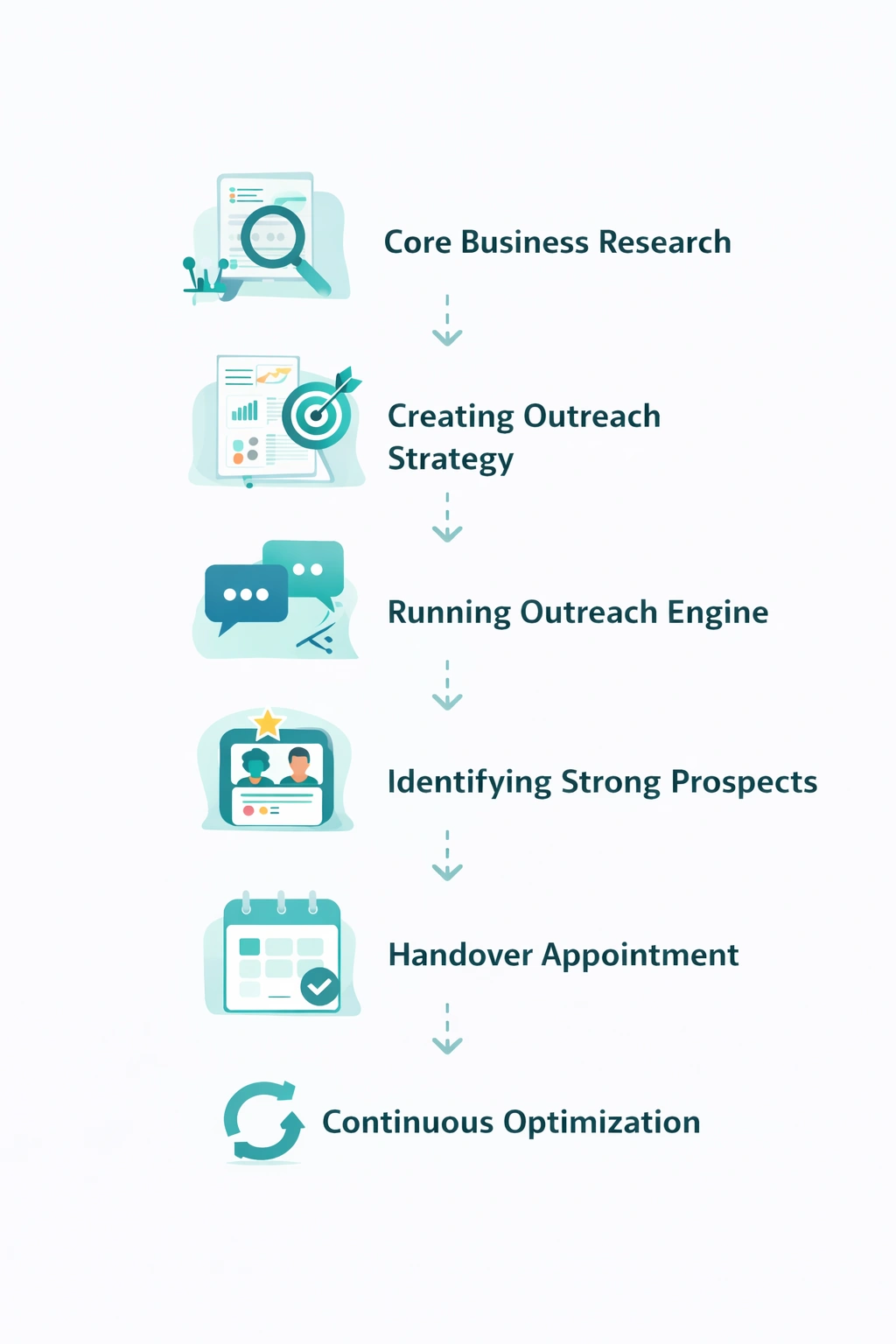
1) We pin down what you actually sell (RevOps automation, support deflection, AI agents/RAG, integrations, RPA+AI modernization) and where you win. 2) We build Sales Navigator searches around the right titles and headcount bands for that offer. 3) We layer in triggers—hiring, funding, job changes, tooling clues, initiative language—so you’re not messaging static org charts. 4) We read profiles and company context to extract 1–2 real personalization hooks (stack, hiring, “building” language, metrics, tenure). 5) We produce a qualified lead list with segment tags like “Hiring RevOps,” “New COO,” “Zendesk+HubSpot,” “NetSuite rollout,” so your outreach is specific by default. 6) We give you outreach angles mapped to each trigger (integration backlog, ticket deflection, quote-to-cash, onboarding throughput, SLA risk) and execute LinkedIn outreach with AI-assisted personalization that still sounds like a human operator. 7) We handle replies, run follow-up and nurturing workflows, track warm leads and booked meetings, and refine targeting weekly based on what’s converting.
You get visibility through dashboards: who was targeted, what segments are replying, what angles are landing, and where meetings are coming from—so you can forecast instead of hoping.
From identifying the right decision-makers to starting meaningful conversations and turning them into qualified appointments... LinkedoJet manages the entire outbound engine for your business.
Get My AI Automation Agency Lead List and tell us your offer + target market. We’ll come back with a signal-based list, segmentation, and the trigger angles we’ll run—so the calls you take are the ones that can turn into scoped work.
FAQs
Should an AI automation agency target CEOs or operators on LinkedIn?
Operators first in most cases. COO/Head of Ops, Business Systems/IT, RevOps, Support Ops, and Finance Ops are closer to the pain and usually own the workflow outcomes. CEOs can work when the company is small (or when the project is a major cross-functional bet), but “CEO-only targeting” tends to create curiosity calls, not scoped initiatives.
What headcount band converts best for workflow automation and systems integration projects?
For most agencies: 51–2000. 51–200 is where sprawl starts and teams feel the cost of manual work. 201–500 is where integration backlog becomes obvious and budgets appear. 501–2000 is where governance and multi-system workflows create durable projects (if you can handle the buying process).
How do we find companies that actually have active automation initiatives (not just curiosity about AI)?
Look for motion: hiring for systems/RevOps/automation/data, new ops leadership in the last 90 days, tool migrations (CRM/helpdesk/ERP/data), and initiative language in posts or job descriptions (“manual,” “backlog,” “standardize,” “deflection,” “quote-to-cash”). Then map that trigger to the owner who carries the metric.
How do you qualify for integration complexity and avoid low-value “Zapier-only” work?
Screen for multi-system workflows and ownership. If there’s no real stack (CRM + support + ERP + data), no handoffs between teams, and no named system owner, you’re likely in lightweight territory. We also watch for governance signals: enterprise apps titles, admin hiring, security language, and “platform” or “systems” responsibility in profiles.
Can we segment leads by tech stack (HubSpot/Salesforce, Zendesk/Intercom, NetSuite/ServiceNow, Snowflake/Databricks)?
Yes. We segment by stack clues from Sales Navigator/company pages, profile mentions, job posts, and common tooling language. That segmentation feeds the outreach angle (e.g., “Zendesk deflection + QA,” “NetSuite approvals + reconciliation,” “Salesforce routing + data hygiene,” “Snowflake-backed agent workflows”).
See the signal-led outbound engine working for an AI automation agency
This isn’t a generic “strategy call.” We’ll show you how we turn LinkedIn signals into a qualified lead list, trigger-mapped outreach, and meetings your team actually wants to take.
What LinkedoJet operationally provides: ICP + targeting setup, Sales Navigator prospect list building, AI-assisted personalization, LinkedIn outreach execution, reply handling and nurturing, warm lead tracking, appointment generation support, and campaign visibility through dashboards.
What happens after onboarding: we build and save your core searches, add alert-driven intent layers (job changes, posting activity, hiring/tooling triggers), and create segmented lead lists (e.g., “Hiring RevOps,” “New Head of Ops,” “Zendesk+HubSpot,” “NetSuite rollout,” “LLM initiative”). Those segments drive the messaging angles and follow-up paths.
What you receive: a ready-to-run prospecting system, weekly refreshed lead lists, trigger-based outreach angles tailored to your offer (support deflection, quote-to-cash, integration backlog, onboarding throughput, data/agent initiatives), and a dashboard view of targeting, replies, warm leads, and booked meetings.
How targeting and list building works: we don’t pull “AI interested” titles and hope. We map the process/system owners (Ops, Business Systems/IT, RevOps, Support Ops, Data/AI, Finance Ops), then layer in evidence the account is in motion—hiring, stack changes, initiative language, and leadership transitions.
How AI-assisted personalization is used: we extract real hooks (hiring role, tool mention, initiative phrase, tenure in role) and generate message variants that stay grounded in operational outcomes. It reads like an operator wrote it, not a bot trying to sound friendly.
How nurturing and follow-up works: we handle replies, route interested prospects into a warm lead stage, and run follow-up sequences tied to the trigger (not “just checking in”). If timing is wrong, we keep the thread alive until the change window opens.
How tracking works: every contacted segment, warm lead, and booked meeting is visible—so you can see which triggers and stacks are producing qualified conversations and where to focus next.
Why LinkedoJet is different from ordinary LinkedIn automation tools: tools send messages. LinkedoJet runs the system—signal detection, list building, personalization, execution, reply handling, nurturing, and weekly refinement—so your pipeline is built on intent and owner fit, not hope and volume.
Next step: stop pitching “AI automation.” Start targeting change.
If you sell complex automation outcomes, you don’t need more conversations—you need the right operators, at the right accounts, in the right moment.
Tell us your offer and where you win. We’ll build a signal-based lead list, segment it by trigger and stack, and run LinkedIn outbound with AI-assisted personalization, reply handling, and nurturing—then track warm leads and appointments in a way you can actually forecast against.
From identifying the right decision-makers to starting meaningful conversations and turning them into qualified appointments... LinkedoJet manages the entire outbound engine for your business.