
How to find leads for employer branding agencies—without generic ‘marketing agency’ lists
If your pipeline depends on referrals and “someone sent me a list,” you’re not selling—you're waiting. The agencies that actually buy don’t label themselves cleanly, the buyer title changes by shop, and they only reply when something is happening. This is the Sales Navigator + signal-reading workflow that finds the real agencies, the real decision-makers, and the accounts with a reason to talk this week.
- Build segmented account lists (EB specialists, recruitment marketing hybrids, PR/brand shops with an EB practice)
- Identify decision-makers despite title drift (people brand, candidate experience, client services, partnerships)
- Tag buying windows using visible LinkedIn signals (wins, hiring waves, new leaders, stack shifts)
- Message with a trigger-based angle that makes sense to agencies (capacity, capability gap, partner fit)
- Run a repeatable workflow that doesn’t burn the market with generic outreach
Why typical targeting fails (and why you keep hitting in-house teams, staffing shops, and dead accounts)
Most people think they have a lead volume problem.
They don’t. They have a misclassification problem.
“Employer brand” shows up everywhere on LinkedIn: HR leaders posting, internal comms teams sharing culture stories, recruiters talking candidate experience, and agencies using the phrase as content bait without actually selling employer branding services. If you aim a wide net, you get polite silence—and the occasional annoyed response that costs you more than a missed meeting. Agency circles are smaller than they look.
What’s really happening:
- Agencies hide under broad categories. Many sit inside Marketing & Advertising, PR, Staffing & Recruiting, or Management Consulting—even when 80% of their revenue is EVP and talent marketing.
- Titles don’t match the org chart. The buyer may be a Managing Director one month, then a Head of Talent Marketing in the next shop. Sometimes the “Employer Brand Director” is delivery-only and can’t approve partners.
- Posting ≠ purchasing. Thought leadership about EVP is cheap. A new client win, a hiring wave, a new partnerships hire, or a tech stack mention is not.
The win comes from three things done in the right order: (1) correct classification (real agencies vs in-house), (2) correct titles (people who can buy/partner), and (3) correct triggers (why now).
Who to target inside agencies: owners, practice leaders, and delivery buyers (with title variations that actually show up)
If you message only founders, you’ll miss the shops where practice leadership runs partner decisions. If you message only “Employer Branding” titles, you’ll miss the shops that renamed the function to talent marketing, people brand, or candidate experience.
| Persona | Common titles you’ll actually see | When to lead with them |
|---|---|---|
| Owners / Growth | Founder, Co-Founder, Managing Partner, Partner, CEO, President, Managing Director, Agency Owner, Head of Growth, VP Growth, Director of Business Development | Best for partnerships, white-label, co-sell, and new capability offers (they care about margin and positioning). |
| Practice leaders | Head of Employer Brand, Employer Brand Director, Director of Employer Branding, Head of Talent Marketing, Talent Marketing Director, Head of Recruitment Marketing, Director of Recruitment Marketing, Head of People Communications, Head of Brand Strategy, Strategy Director | Best when your offer plugs into delivery (research, EVP work, career site, paid media, measurement) and you need service fit. |
| Delivery buyers (overflow partners) | Creative Director, Head of Creative, Content Director, Head of Production, Studio Director, Project Director, Head of Delivery, Operations Director, Client Services Director, Account Director, VP Client Services | Best for overflow: video, design, copy, production, dev, implementation. They feel capacity pain first. |
Title variations to include in lead searches (because “Employer Branding” is often missing): People Brand, Talent Brand, Candidate Experience, Culture Communications, People Communications, Talent Attraction, Recruitment Marketing, EVP Strategy.
Quick operator rule: if you’re selling a partner/white-label offer, start with Owners/Growth or Partnerships. If you’re selling overflow delivery, start with Client Services/Delivery leadership. If you’re selling software/tech, start with Growth + the practice lead who owns outcomes.
Qualify the agency before you message: service proof, maturity, partner-stack fit, and red flags
The fastest way to damage credibility is pitching a “capability partner” to a shop that doesn’t sell that capability—or pitching an agency that’s actually an in-house team with a nice LinkedIn page.
Before you write a single message, look for proof in three places: Company About, Services/Website, and the founder/practice lead’s Featured section. You’re looking for evidence they sell employer branding (not just post about it) and a reason your offer fits their delivery reality.
Fit checklist (60 seconds per account)
- Service scope: explicitly mentions EVP / employer branding / talent marketing / recruitment marketing / candidate experience / career site.
- Maturity band: headcount 5–200 is the sweet spot for partner conversations (5–50 moves fast; 50–200 has budget but needs justification).
- Momentum: positive headcount growth or visible hiring activity (creative, strategy, account, paid media, partnerships).
- Proof of work: case study drop, campaign launch, award entry, webinar, or a “new partnership” announcement.
- Partner-stack fit: mentions tools or badges (LinkedIn, Glassdoor, Indeed, Workday, Phenom, SmartRecruiters, Greenhouse, Lever, Webflow) or team members list them in profiles.
- Capability gap: they talk strategy but show little production; or they show creative but no research; or they run campaigns but don’t mention measurement—this is where vendors win.
Red flags (exclude or deprioritize)
- In-house only: company is a single employer brand team at one corporation (not an agency).
- Staffing-only: placement shop with no recruitment marketing / talent marketing services.
- Inactive presence: no posts, no hires, no case studies, no recent movement.
- Layoffs/flat growth: not always a “no,” but don’t lead with an upsell when they’re shrinking.
Sales Navigator recipes: build segmented account lists, then pivot to decision makers inside each account
Your best results won’t come from one mega search. Build four account lists that reflect how this market is actually structured, then run lead searches inside each list.
Company search recipe 1: Employer branding specialist agencies
- Geography: choose your target markets (common: United States, Canada, United Kingdom, Ireland, Australia, Netherlands, Germany)
- Industry: Marketing & Advertising; Public Relations & Communications; Management Consulting
- Company headcount: 2–10, 11–50, 51–200 (optionally 201–500 if you can handle longer cycles)
- Headcount growth: Past 6 months = Positive; Past 1 year = Positive
- Company type: Privately Held
- Keywords (company): “employer brand” OR “employer branding” OR “EVP” OR “employee value proposition” OR “people brand” OR “culture communications”
- Exclude keywords: in-house, internal, university, government, nonprofit, HR department, job board
Company search recipe 2: Recruitment marketing / talent marketing hybrids
- Industry: include Staffing & Recruiting with constraints (you’re hunting marketing-led agencies, not placement-only shops)
- Keywords (company): “recruitment marketing” OR “talent marketing” OR “candidate experience” OR “careers site”
- Exclude keywords: “temporary staffing” “employment agency” “payroll” (tune to your market)
- Headcount growth: Positive (prioritize)
Company search recipe 3: PR/brand shops with an employer brand practice
- Industry: Public Relations & Communications; Marketing & Advertising
- Keywords (company): “employer brand” OR “people communications” OR “internal comms” OR “culture” (then validate service pages)
- Spotlights (if available): mentioned in the news; headcount growth
Account list strategy: save each segment as its own account list: (A) EB specialists, (B) recruitment marketing agencies, (C) creative studios with EVP/culture work, (D) PR shops with EB practice. Add a separate “partner-first” list for accounts showing vendor badges or explicit partnerships.
Pivot to leads inside each target account
- Seniority: Owner, Partner, CXO, VP, Director, Head (add Manager for Account Directors)
- Function: Business Development, Marketing, Operations, Media & Communication
- Spotlights: posted in last 30 days; changed jobs in last 90 days; mentioned in the news
- Years in current position: < 2 years (change window) and 2–5 years (building phase)
Exclusions that save your sanity: “Employer Branding Manager” at a single corporation, recruiters with placement quotas, and anyone whose profile screams delivery-only with zero partner responsibility.
Speak to our Experts | Create my Roadmap to Success
CTA microcopy: Get a ready-to-message list of employer branding agency decision makers based on real triggers.
Buying signals to prioritize this week: what to watch, what it means, and how to open
If you message agencies when nothing is happening, you’re competing with their inbox filter.
If you message when a trigger is live, you’re offering relief.
Prioritize accounts using these signals (and match your angle to what the agency is dealing with):
- New client win / case study posted → angle: “Congrats on the win. If delivery speed becomes the bottleneck, we can extend your capability without changing your process.”
- Hiring: designers, strategists, producers, copywriters → angle: “Looks like capacity is the constraint. We can act as overflow so you ship the EVP/culture work on time while you hire.”
- Hiring: partnerships/BD/growth → angle: “This reads like a partner push. We support co-sell and referral motions with clean handoffs and shared case study credit.”
- New Head of Employer Brand / Talent Marketing / Growth → angle: “New leaders build shortlists fast. Here’s a specific way we help agencies deliver quick wins in the first 30–60 days.”
- News/award/webinar/event announced → angle: “Congrats. If you want to turn this into pipeline, we can co-produce something useful (not a sales pitch) and follow up cleanly with warm attendees.”
- Stack shift or tool mentions (Workday/Phenom/Greenhouse, career site tools, Glassdoor) → angle: “If you’re standardizing tooling, we plug into your current stack and reduce delivery friction.”
Then add activity cues to raise reply odds: posted in the last 30 days, commenting on EVP/candidate experience topics, or sharing behind-the-scenes delivery posts. Those people are in motion—and in motion beats “perfect persona” every time.
The LinkedoJet system: prospect intelligence → signal tags → ready-to-message angles → consistent conversations
This niche punishes generic outreach. You’re selling to people whose job is literally messaging and positioning. If your note reads like a template, you’re done.
LinkedoJet is built for that reality. Not as a “send more DMs” tool, but as a prospect intelligence + client acquisition system that keeps relevance high and volume under control.
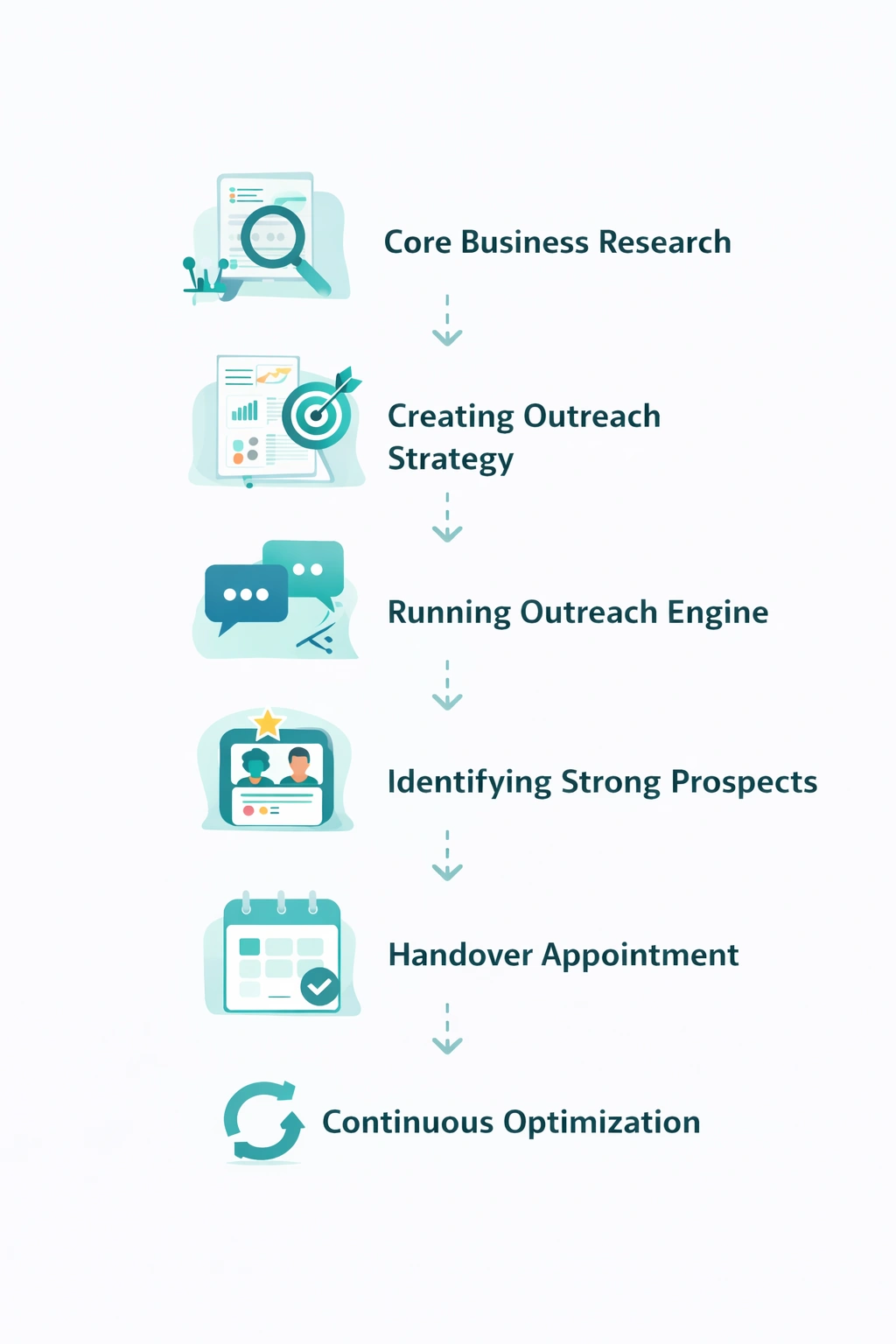
How the workflow runs
- Define segments + exclusions. EB specialists, recruitment marketing hybrids, PR/brand shops with EB practice, creative studios with EVP/culture work. Exclude in-house teams and placement-only staffing.
- Build precise Sales Navigator searches + account lists. We set up the company filters, save searches, and maintain segmented account lists so you always know what list a lead came from—and why they’re on it.
- Read context and tag signals. We review company pages and profiles for proof of services, partner-stack signals, and triggers (new win, hiring wave, new leader, expansion). Each account gets tags that drive the message angle and priority.
- Generate angles and run the conversation workflow. AI-assisted personalization turns those tags into specific openers (not fluffy compliments), then we execute outreach, handle replies, nurture non-ready leads, and track warm interest through dashboards.
What you get is not a random list. It’s a living pipeline: segmented accounts, decision-makers mapped, signals marked, and conversations started when the timing is real.
Get a ready-to-message list of employer branding agency decision makers based on real triggers.
FAQ
How do I separate employer branding agencies from in-house employer brand teams on LinkedIn?
Start with company search, not people search. An agency will show service language (EVP, employer branding, talent marketing, recruitment marketing) plus proof of work: case studies, campaigns, awards, client logos, or partner pages. In-house teams will usually have one employer brand function inside a single company, with titles tied to that employer and no external service proof. Use exclusions (in-house, internal, HR department) and then verify via the company’s About/Website and the team’s Featured section before outreach.
What titles should I target when there’s no “Employer Branding” title?
In this market, the buyer often sits in talent marketing, client services, strategy, or growth. Practical targets: Founder/Managing Partner/Managing Director; Head/Director of Talent Marketing; Head/Director of Recruitment Marketing; Head of People Communications; Strategy Director; Head of Client Services/Account Director; Head of Partnerships/BD. Add title variants like People Brand, Talent Brand, Candidate Experience, Culture Communications.
How do I know an agency is buying versus just posting thought leadership?
Look for “delivery reality” signals: new client win/case study posts, hiring waves (especially production/creative/strategy), a new partnerships or growth hire, tech stack mentions, or repeated capacity language (“busy quarter,” “looking for freelancers,” “growing the team”). Pair that with recency (posted in last 30 days) and you’ll spend time where budgets and urgency actually exist.
Can this work for partnerships/white-label offers instead of direct selling?
Yes—often better. Target Owners/Growth and Partnerships titles, then prioritize triggers like “hiring partnerships,” new service launches, new regions/verticals, and partner badges on the website. Your message angle changes: co-sell, referral, white-label delivery, and shared case study outcomes—rather than a one-way vendor pitch.
What company size range works best for employer branding agency outreach?
5–50 headcount tends to move fast, values overflow partners, and makes decisions with fewer layers. 50–200 is where you see bigger retainers and repeatable partner programs, but you’ll need cleaner positioning and stronger proof. Use Sales Navigator headcount bands to run both motions in parallel and compare conversion.
Get a trigger-based list of employer branding agency decision-makers—built and messaged for you
This isn’t a generic “strategy call.” If you sell into employer branding and recruitment marketing agencies, we’ll show you exactly how we build segmented account lists, tag live buying signals, and start conversations that sound like you understand how agencies actually buy.
What LinkedoJet operationally provides: we set up your ICP and targeting system, build Sales Navigator account lists by segment, map the real decision-makers inside each agency, and run outreach with AI-assisted personalization based on visible triggers (wins, hiring, new leaders, stack signals).
What happens after onboarding: you don’t get “access to software” and a training doc. You get a managed outbound engine. We maintain your lists, refresh searches, keep exclusions tight, and continuously refine message angles as the market shifts (title drift, new practices, new partner stacks).
What you receive:
- Segmented account lists (EB specialists, recruitment marketing hybrids, PR/brand shops with EB practice, partner-first accounts)
- Decision-maker coverage inside each account (owners/growth, practice leads, delivery buyers)
- Signal tags (new win, hiring wave, new leader, partner page/stack, overflow capacity cues)
- Ready-to-send outreach angles tied to the trigger (capacity, capability gap, co-sell, delivery speed)
- Reply handling and lead nurturing so “not now” turns into “next month” instead of disappearing
- Warm lead and appointment tracking through dashboards (you can see what’s working and why)
How targeting and prospect list building works: we use Sales Navigator filters and saved searches (geography, industry mixes, headcount bands, growth, keyword sets, and hard exclusions) to avoid the classic traps—corporate in-house teams, staffing-only shops, and inactive accounts. Then we pivot into lead searches within those accounts to find the buyers who can actually approve partners.
How AI-assisted personalization is used: AI helps us draft tailored openers and follow-ups from the signal tags and profile/company context. It doesn’t replace judgment. It speeds up relevance so your message reads like it was written with context, not copied from a template.
How lead nurturing and follow-up workflows operate: we run structured follow-ups based on the trigger type (win vs hiring vs new leader). If someone isn’t ready, they go into a light-touch nurture track tied to future signals—so you don’t keep restarting from zero.
How warm leads and appointments are tracked: every reply is categorized, tracked, and tied back to the segment, signal, and angle used. That feedback loop is how your campaign gets sharper each week instead of staying static.
Why LinkedoJet is different from ordinary LinkedIn automation tools: tools send messages. LinkedoJet runs the system: targeting, context, signal detection, personalization, execution, reply handling, visibility, and ongoing refinement—so you build a partner-grade pipeline without burning reputation in a small market.
Next step: turn employer branding agencies into a predictable pipeline
If you want consistent conversations, stop guessing who’s an agency, who can buy, and who’s in a live buying window. Build segmented account lists, tag real triggers, and message with an angle that fits agency reality (capacity, capability gaps, and partner fit).
From identifying the right decision-makers to starting meaningful conversations and turning them into qualified appointments... LinkedoJet manages the entire outbound engine for your business.