
Find high-intent compliance consulting clients on LinkedIn—before the audit deadline hits.
Compliance work isn’t won by “selling compliance.” It’s won when a company hits a forcing function—an enterprise security review, a board mandate, a funding round, a new compliance hire, a pre-IPO controls scramble—and they need someone who can get them to audit-ready fast. The deadline is on their clock, not yours.
Most firms only see the buyer once the decision is half-made: the platform is chosen (Vanta/Drata/Secureframe), an auditor is “preferred,” and the internal owner is already buried in evidence requests. That’s when your outreach starts sounding like noise.
LinkedoJet is a prospect intelligence + client acquisition system built for compliance consulting firms. It helps you identify companies preparing for SOC 2 / ISO 27001 / HIPAA / PCI DSS / SOX / GDPR work and reach the exact people who own the next action—early enough to matter.
- Build segmented lead lists by compliance driver (SOC 2, ISO 27001, HIPAA/HITRUST, PCI DSS, SOX, GDPR)
- Pinpoint decision makers + internal champions (Security, GRC/Compliance, Finance/Internal Audit, Privacy/Legal)
- Detect intent from hiring, funding, enterprise sales motion, and LinkedIn activity
- Turn signals into outreach angles that earn replies without sounding generic or creepy
Why compliance outbound fails: broad lists, wrong stakeholders, and showing up after the platform/auditor decision
You can feel it when a quarter is riding on a handful of referrals. Your team does “polite LinkedIn”—a few connection notes, some check-ins—then nothing. And then a target account posts: “SOC 2 Type II achieved” or “ISO 27001 certified.” Someone else’s logo. You weren’t wrong about the need. You were late to the buying cycle.
The hidden failure mode is treating lead gen like a role-based search problem (“find CISOs”) instead of a timeline-and-trigger problem (“who is about to be forced into SOC 2/ISO/HIPAA/PCI/SOX/GDPR work, and who owns the next action?”).
- “Compliance” is too broad. One list can’t serve SOC 2 readiness, HIPAA policy work, PCI DSS scoping, SOX controls design, and GDPR DPIAs.
- Buying is stakeholder-heavy. Security might own the program, Compliance might run evidence, Finance may sponsor, Legal/Privacy can block.
- Urgency is external. Enterprise deals, board pressure, regulator expectations, audit windows, M&A, and pre-IPO prep set the tempo.
- Most outreach arrives after “do it in-house” is decided. Vanta/Drata/Secureframe makes the first instinct: tool-first. Your job is to be the operator who closes gaps fast.
When you catch the forcing function early and talk to the right owner first, your conversations stop being “Do you need compliance help?” and become “Here’s how teams like yours get audit-ready without stalling product and revenue.”
Who to target by framework: map the stakeholder set (champion vs sponsor) before you write a single message
In most accounts, the person who replies isn’t the person who signs. If you only message the top title, you often hit someone shielded by a calendar and a security team. If you only message the manager-level operator, you can get interest that dies in budget.
We plan for both: champion (runs the work, feels the pain) and sponsor (approves budget, cares about risk and timing). Here’s a practical starting map by driver:
- SOC 2 / ISO 27001 (SaaS, enterprise motion): CISO, VP Security, Head of Security, Director of Information Security; GRC Manager / Head of GRC / Governance Risk & Compliance Manager; Security Program Manager
- HIPAA / HITRUST (healthtech, PHI): Chief Compliance Officer, Head/Director of Compliance, Compliance Program Manager; Privacy Officer; Security Director/Head of Security (often co-owns the program)
- PCI DSS (payments, ecommerce, transaction volume): Head of Security/CISO; Risk Manager, Vendor Risk Manager / Third-Party Risk Manager; sometimes Finance leadership when scope touches payment operations and audit readiness
- SOX / internal controls (pre-IPO, public, enterprise-scale): Controller, CFO/VP Finance sponsor; Head/Director of Internal Audit; SOX Manager; IT Audit Manager
- GDPR / privacy program (EU/UK exposure): DPO (Data Protection Officer), Head of Privacy, Privacy Counsel; Security leadership when controls and vendor risk overlap
A fast qualifier: if the profile says “SOC 2 owner,” “ISO program,” “vendor risk,” “privacy program,” “SOX,” or “internal controls,” you’re close. If it says “advisory,” “consultant,” or “auditor” at an agency, you’re probably paying to target a competitor.
Sales Navigator recipes: turn “compliance” into segmented account lists you can actually qualify
Sales Navigator is fine. The failure is treating it like a one-time export. We build this as a living system: saved account lists, saved lead searches, exclusions, and a repeatable routine for refreshing signals.
Below are four proven recipes. LinkedoJet operationalizes these into your saved searches + list build process, then keeps them current as headcount, roles, and triggers change.
SOC 2 / ISO 27001 (SaaS selling to mid-market/enterprise)
- Account search: Geography (US/Canada); Industry (Computer Software, IT Services, Internet); Headcount (20–500); Company type (Privately Held); Spotlights (Job openings, Recently funded); Keywords: “SOC 2” OR “ISO 27001” OR “security questionnaire” OR “vendor risk” OR “trust center” OR “enterprise”
- Lead search: Seniority (Manager/Director/VP/CXO); Titles: (CISO OR “Head of Security” OR “Director of Information Security” OR “GRC Manager” OR “Head of GRC” OR “Security Program Manager”); Posted on LinkedIn in last 30 days (Yes); Spotlights (Changed jobs in last 90 days, Mentioned in news)
HIPAA / HITRUST (healthtech handling PHI)
- Account search: Geography (US/Canada); Industry (Hospital & Health Care, Medical Devices, Pharmaceuticals, Software); Headcount (10–1000); Keywords: “HIPAA” OR “HITRUST” OR “PHI” OR “privacy” OR “risk assessment”
- Lead search: Titles: (“Chief Compliance Officer” OR “Head of Compliance” OR “Director of Compliance” OR “Compliance Program Manager” OR “Privacy Officer” OR “Security Compliance”); Function (Legal, Operations, IT/Security)
PCI DSS (payments, ecommerce, processors)
- Account search: Geography (US/Canada); Industry (Financial Services, Payment Services, Retail/ecommerce, Internet); Headcount (20–2000); Keywords: “PCI DSS” OR “payments” OR “card data” OR “risk” OR “vendor risk”
- Lead search: Titles: (CISO OR “VP Security” OR “Risk Manager” OR “Vendor Risk Manager” OR “Third-Party Risk Manager” OR “GRC Manager”); add Finance seniority for sponsor mapping (CFO, VP Finance, Controller) when audit scope is finance-adjacent
SOX / internal controls (pre-IPO, public, enterprise)
- Account search: Geography (US/Canada); Company type (Public Company + Privately Held); Headcount (200–10,000); Keywords: “SOX” OR “internal controls” OR “IPO” OR “S-1” OR “internal audit”
- Lead search: Titles: (Controller OR “Head of Internal Audit” OR “Director of Internal Audit” OR “SOX Manager” OR “IT Audit Manager”); Seniority (Director/VP/CXO); Posted recently (Yes) to prioritize reachable operators
Exclusions we always add: competitor consulting firms; agencies advertising compliance services; very small companies (<10) without enterprise motion; and recent “SOC 2 Type II achieved” / “ISO 27001 certified” posts unless your offer is continuous compliance maintenance.
Buying signals that predict budget + urgency (and the angle to lead with)
Compliance spend rarely appears because someone “wants to be compliant.” It shows up when risk and revenue collide. The trick is noticing the early tells—then writing like someone who has lived through audit calendars, evidence backlogs, and stakeholder misalignment.
- Audit/certification signals: “Going for SOC 2,” “ISO initiative,” trust center updates, policy rollouts.
Angle: “If you’re aiming for a first audit, the fastest win is tightening scope + evidence ownership before the tool setup becomes the project.” - Enterprise deal/security review signals: hiring Enterprise AEs/RevOps, posts about big customers, mentions of questionnaires/procurement/MSAs.
Angle: “When enterprise deals arrive, the security review timeline becomes the deadline. We can help you pass reviews while the program catches up.” - Funding + scaling signals: Series A/B/C announcements, rapid hiring, new regions/verticals.
Angle: “Growth changes the control environment. A short readiness sprint now avoids the ‘surprise’ scramble six months from now.” - Hiring signals: open roles for GRC Manager, Security Compliance, Privacy Officer, SOX Manager, Internal Auditor.
Angle: “Saw you’re hiring a GRC Manager—often means the program is being formalized. Want a 30-day readiness plan while the role ramps?” - Tooling/platform signals: Vanta/Drata/Secureframe, OneTrust, GRC tools; mentions of “continuous compliance.”
Angle: “Tools don’t remediate control gaps. We can drive the remediation and evidence system so the platform actually reflects reality.” - Incident/regulatory change signals: new rules, industry enforcement, security incident response updates, M&A integration posts.
Angle: “This is where governance breaks. We can help stabilize the program and document controls without freezing teams.”
Done well, this doesn’t feel creepy. It feels relevant. You’re responding to public, business-context signals and offering a specific next step tied to their timeline.
The LinkedoJet system: from segmented lists to verified stakeholders to signal-based outreach and follow-up
This is where most “automation tools” stop: they send. That’s not the hard part in compliance services. The hard part is getting the right person, at the right time, with a reason to care—then managing follow-up like a deal cycle, not a broadcast.
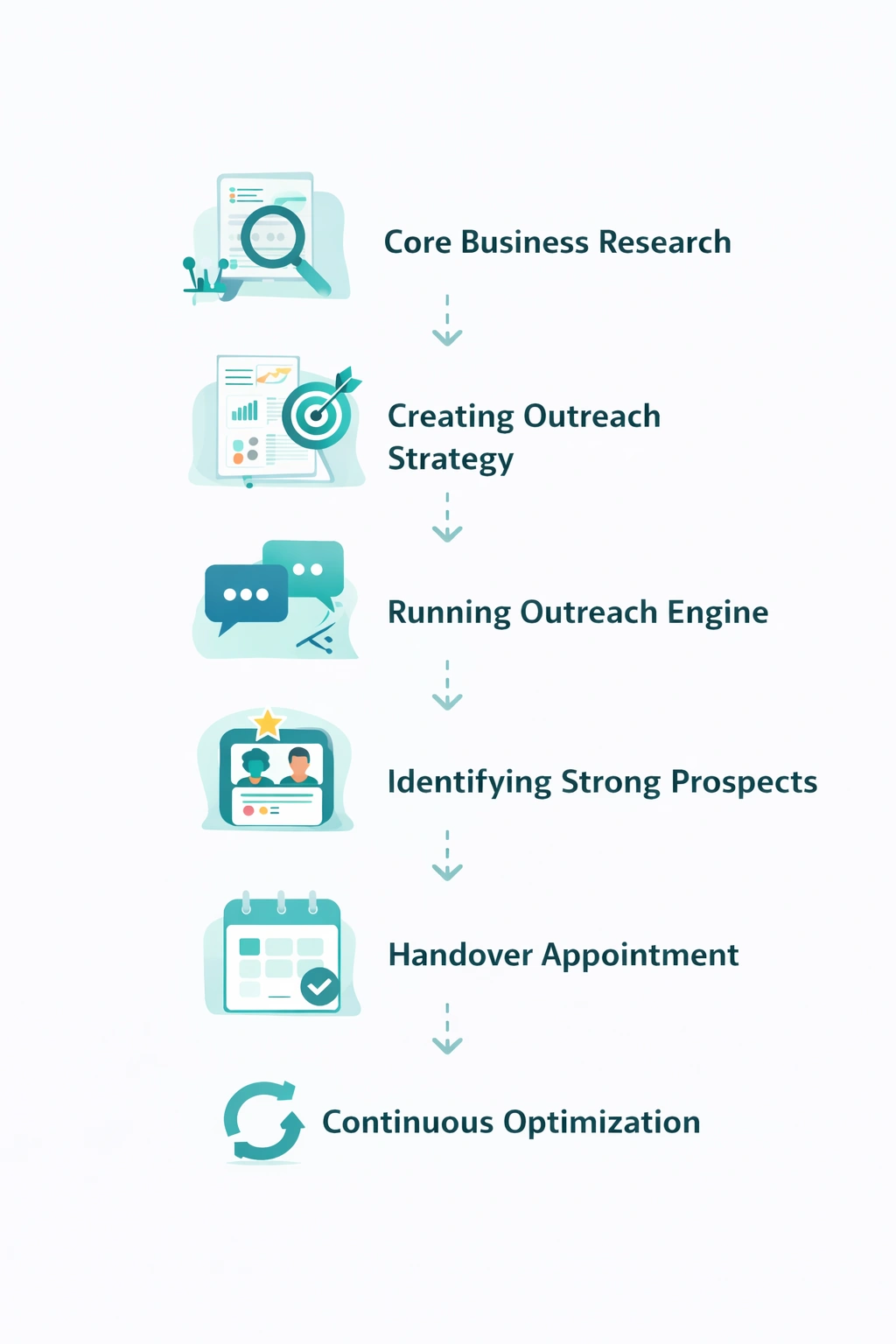
LinkedoJet runs a repeatable outbound engine for compliance consulting firms:
- Define segments tied to your actual offers. Separate SOC 2/ISO SaaS readiness from HIPAA/HITRUST programs, PCI scoping, SOX controls, and GDPR privacy work. Each segment gets its own qualifiers, disqualifiers, and angles.
- Build account lists that reflect compliance drivers. We set up Sales Navigator account filters (industry, geo, headcount bands, company type, growth spotlights) and convert them into maintained lists—not one-time exports.
- Map stakeholders and verify ownership with profile-reading rules. We validate who owns outcomes (look for “SOC 2 owner,” “ISO program,” “vendor risk,” “privacy program,” “SOX,” “internal controls”), check tenure (new in role = change window), and map the internal committee so you don’t get stuck with a polite non-owner.
- Activate signal-based outreach + follow-up workflows. AI-assisted personalization is used to anchor each message to a real trigger and a credible next step. Then we run follow-up sequences, handle replies, and keep warm leads moving until there’s a clear yes/no/next date.
What you get (operationally)
- Segmented account + lead lists by compliance driver, with saved searches and refresh routines
- A title library (and negative title exclusions) that matches how companies actually staff GRC, privacy, and internal audit
- A buying-signal checklist with prioritization guidance (what to work first, what to ignore)
- An angle bank tied to triggers (enterprise reviews, hiring, funding, tooling, audit windows) so outreach stays specific
- Outreach execution, reply handling, nurturing, and warm-lead tracking so opportunities don’t evaporate in someone’s inbox
- Dashboard visibility: what’s being sent, what’s getting replies, what’s turning into meetings—and what we’re changing next
The outcome isn’t “more activity.” It’s earlier entry into deadline-driven buying cycles—before the auditor selection and platform decision have already defined the project.
A repeatable, auditable process for high-consideration compliance services
Compliance consulting isn’t an impulse buy. Your best deals happen when a company is trying to protect revenue, reduce audit risk, and keep delivery teams moving. That requires a process you can inspect—what you targeted, why you targeted it, who you contacted, what signal you saw, and what happened next.
That’s the standard we build to: a system that makes your pipeline less dependent on referrals and less vulnerable to timing luck. Responsible outreach, clear qualification, and disciplined follow-up—without spamming regulated industries or torching your brand.
From identifying the right decision-makers to starting meaningful conversations and turning them into qualified appointments... LinkedoJet manages the entire outbound engine for your business.
Speak to our Experts Create my Roadmap to Success
No spam. Signal-based targeting. Built around your frameworks, delivery motion, and audit-timeline reality.
Questions compliance consulting leaders ask before they commit to LinkedIn outbound
Can this work if we sell multiple frameworks (SOC 2 + ISO 27001 + HIPAA/HITRUST)?
Yes—if you don’t treat it as one market. We split your outbound into segments by compliance driver and buying context. A SOC 2/ISO SaaS buyer responds to enterprise security review pressure; HIPAA/HITRUST often involves privacy/compliance leadership and PHI handling realities. Different stakeholder maps, different triggers, different angles.
How do we avoid targeting companies that already achieved SOC 2 Type II or ISO 27001 recently?
We build negative filters and disqualifiers into the list-building process: keyword exclusions, account-level screening (trust center/certification posts), and lead-level checks (profiles announcing “Type II achieved”). If you offer maintenance/continuous compliance, we keep them but change the angle to ongoing evidence ownership, remediation backlog, and renewal readiness.
Who should we message first: CISO/Head of Security vs Compliance/GRC vs Finance/Internal Audit?
Start with the person who owns the next action for that driver. For SOC 2/ISO, that’s often GRC/Security Program leadership (champion) with a CISO/VP Security as sponsor. For SOX, the Controller/Internal Audit lead is commonly the champion with CFO/VP Finance as sponsor. We typically run a tight, coordinated sequence across champion + sponsor so replies don’t stall in “sounds good, not my area.”
What headcount ranges tend to fit best for SOC 2/ISO versus SOX/internal controls engagements?
SOC 2/ISO commonly fits 20–500 headcount when there’s real enterprise motion (security reviews, procurement). SOX/internal controls tends to fit 200–10,000 or pre-IPO/high-growth where finance is building formal controls and audit readiness. HIPAA/PCI can span wider depending on transaction volume, PHI exposure, and customer requirements.
How do you use hiring signals (GRC Manager, Compliance Officer, SOX Manager) without being creepy?
We reference the business reality, not the individual. The message is: “This role usually appears when the program is being formalized; here’s a practical way to de-risk the next 30–60 days.” We avoid quoting the job post, avoid over-specific assumptions, and keep the ask small and relevant (readiness sprint, scoping call, evidence ownership map).
See what LinkedoJet would run for your compliance practice (and what you’ll get after onboarding)
This isn’t a generic “strategy call.” We’ll show you, concretely, how we’d build segmented lists, verify stakeholders, and run signal-based outreach for SOC 2/ISO, HIPAA/HITRUST, PCI, SOX, and GDPR—then how we track warm leads through to booked meetings.
What LinkedoJet operationally provides: we set up your targeting system, build and maintain Sales Navigator account + lead lists, apply AI-assisted personalization to outreach tied to real triggers, execute LinkedIn outreach, handle replies, nurture warm leads, and support appointment generation—visible in dashboards so you can audit what’s happening.
How targeting and prospect list building works: we segment by compliance driver (SOC 2/ISO vs HIPAA/HITRUST vs PCI vs SOX vs GDPR), apply headcount/industry/geo qualifiers, add disqualifiers (competitors, too small, recently certified where inappropriate), then build saved searches and living lists that refresh as companies hire, get funded, or shift into enterprise motion.
How personalization works without sounding fake: AI helps draft first-pass personalization based on profile context and observable signals (hiring, posts, enterprise sales motion, trust center updates). We keep it grounded: one trigger, one credible reason to reach out, one next step.
How lead nurturing and follow-up works: we run structured follow-ups aligned to audit timelines and procurement reality. Replies are triaged, objections are handled, and warm leads are tracked so “not now” turns into a dated next step instead of a dead end.
How appointments and warm leads are tracked: you’ll see what segments are producing replies, which titles convert to meetings, which signals correlate with urgency, and what changes we’re making week to week.
Why this is different from ordinary LinkedIn automation tools: tools send messages. LinkedoJet runs the system—segmentation, list quality, stakeholder verification, signal detection, personalization, execution, reply handling, nurturing, and continuous refinement—so you’re not betting your quarter on a static list and a generic note.
Next step: build a qualified compliance buyer list and start booking conversations tied to real triggers
The objective is simple: stop guessing, stop arriving late, and run an outbound process that produces qualified discovery calls by targeting stakeholder maps and observable buying signals—then managing follow-up until a meeting is booked or disqualified.