
Most “cloud migration leads” lists are just cloud-shaped noise
Identify companies planning or funding cloud migrations, map the buying committee, and start conversations with real initiative context.
You already know the frustrating part: you can deliver. The problem is getting in early enough to matter—before wave planning is locked, the landing zone approach is picked, and an SI is already socially selected by a new CIO.
Meanwhile your best engineers bounce between bench time and low-margin staff aug because the next real program isn’t queued yet. That’s not a delivery issue. It’s timing and access.
- Find in-market accounts tied to real motions: data center exit, landing zone + governance, app modernization, FinOps mandates.
- Pull the correct committee by role (economic + technical + risk + program), not just “cloud architects.”
- Qualify fast by size, industry constraints, hiring clusters, leadership changes, and LinkedIn activity cues.
- Generate a prioritized lead list with reason codes and messaging triggers by migration stage.
Why cloud migration lead gen fails (even when you have a good offer)
The teams that win migration work don’t “find more CIOs.” They show up when the initiative is forming and they speak to the people who actually own it.
Most outbound fails because it treats lead gen as contact acquisition, then tries to force qualification through messaging. That’s backwards for migrations.
- Timing blindness: keyword lists mix pre-migration strategy chatter, active migration execution, and post-migration FinOps. Same titles. Totally different buying context.
- Wrong titles first: you hit architects who can talk for hours but can’t sponsor a program, or execs who own budget but don’t have the initiative detail. Either way, you get “interesting—send info.”
- No signal priority: the account with three cloud openings + a new VP IT is not the same as the account that posts a “cloud-first” thought piece.
- Already-migrated traps: you burn cycles on teams that just completed a migration, or built an internal migration factory and will only buy niche help.
The cost isn’t just a lower reply rate. It’s walking into deals late—after architecture decisions are made, risk posture is set, and your competitor is already embedded in the committee.
You don’t need more contacts—you need initiative intelligence.
Targeting criteria that actually predicts migration work
If you sell migration execution, your best accounts have two things at the same time: (1) real on-prem gravity and constraints, and (2) pressure to change—cost, risk, M&A, or modernization timelines.
Default sweet spot: 200–5,000 employees. Big enough to have legacy complexity, small enough to buy outside help without a year-long vendor process. Expand to 10,000+ when you’re built for enterprise programs.
| What to score | What it looks like on LinkedIn | Why it matters for migration services |
|---|---|---|
| Fit (complexity) | Infra / Platform Engineering / DevOps / SRE / EA presence; multi-site ops; regulated keywords | Budget and scope are real. You’re not “moving a few VMs.” |
| Stage | Pre-migration: landing zone, governance, roadmap. Active: wave plan, factory model, rehost/refactor. Post: FinOps, cloud ops | Your message and offer change. Stage mismatch kills replies. |
| Intent | Hiring clusters; new CIO/VP IT; posts about consolidation, reliability, cost controls; certifications | Signals that work is funded or about to be funded. |
| Disqualifiers | Competitor consultancies/MSPs/SIs; tiny teams; “completed migration” announcements; huge in-house migration factory hiring | Prevents wasted cycles and awkward outreach. |
Three ICP angles that consistently produce real conversations:
- Mid-market with legacy infra + growth: multi-site manufacturers, logistics/3PLs, healthcare groups, fintech, eCommerce.
- Enterprise modernization programs: insurance, retail, telecom, healthcare networks, public sector vendors (where governance and risk drive selection).
- PE-backed platforms/roll-ups: standardization pressure + cost control (FinOps) + timeline-driven integrations.
Quick disqualifier: if you can’t point to an on-prem reality (infra/network/security footprint) or a program driver (exit/modernize/standardize), it’s probably not a migration lead—just cloud interest.
A buying committee map that matches how migrations are actually run
Migrations don’t get bought by one title. They get approved by an economic owner, shaped by technical owners, blocked by risk, and executed through a program layer. If you only message “CIO,” you’ll miss the real operator. If you only message “architect,” you’ll miss budget.
Build every account with a committee map (you’ll use it later for sequencing and reply handling):
- Economic / executive sponsor: CIO, CTO, VP IT, VP Technology Operations.
- Infra / cloud owners (day-to-day authority): Head/Director Infrastructure, Director/VP Cloud, Head Platform Engineering, Head of DevOps/SRE.
- Architecture + program owners: Enterprise Architect, Principal/Lead Cloud Architect, Solutions Architect, Cloud Migration Program Manager, PMO Director, Program Director (Cloud Transformation).
- Security + compliance influencers: CISO, Director Cloud Security, Security Architect, GRC Director (regulated).
- Finance ROI gate (often late-stage, but decisive): Head of FinOps, Finance Director (IT), VP Finance (tech-heavy orgs).
- Data-heavy migrations: VP Data/Analytics, Head of Data Engineering, Data Platform Director.
Sales Navigator plays you can copy (account-first, signal-led)
Stop starting with a pile of leads. Start with accounts that show migration stage + pressure, then pull the committee inside those accounts.
Workflow (repeatable): Account search → save accounts → Lead search within saved accounts → save leads by role bucket.
Play A: In-market migration programs (broad but signal-led)
- Account filters: Geography (US/Canada/UK/EU/ANZ where you can deliver), Company headcount 200–5,000, 5–8 target industries, optional revenue band.
- Spotlights: Job opportunities, Headcount growth (past 6 months), Recently funded (for SaaS).
- Account keywords: “cloud migration” OR “data center exit” OR “application modernization” OR “landing zone” OR “CCoE” OR “cloud program” OR “wave plan” OR “FinOps” OR “VMware” OR “Kubernetes” OR “SAP S/4HANA” OR “Oracle”.
- Lead filters (inside saved accounts): Seniority CXO/VP/Director/Manager; Functions: IT, Engineering, Program/Project, Operations.
- Title picks: CIO/CTO/VP IT, Head/Director Infrastructure, Director/VP Cloud, Enterprise Architect, Cloud Migration Program Manager, CISO/Cloud Security Director, FinOps.
Play B: Data center exit / VMware-to-cloud (high-intent, high-budget)
- Account keywords: “colocation” OR “data center” OR “on-prem” OR “VMware” OR “vSphere” OR “Citrix” OR “Windows Server” OR “Active Directory” OR “NetApp” OR “SAN” OR “MPLS”.
- Lead titles to prioritize: Director Infrastructure, Head of IT Operations, Network Director, EUC lead, Enterprise Architect, Program Director.
- Qualification question: “Are they exiting facilities (cost/risk), or just rationalizing VMware licensing?” The first is a program. The second can be a trap.
Play C: App modernization / platform engineering (where engineering owns the pain)
- Account keywords: “microservices” OR “monolith” OR “Kubernetes” OR “platform engineering” OR “developer platform” OR “CI/CD” OR “SRE”.
- Lead titles: VP Engineering (SaaS), Director Platform Engineering, Head of DevOps/SRE, Principal Architect, Application Modernization Lead.
- Watch-out: if they’re already deep into cloud-native and hiring SRE heavily, you may be in post-migration optimization unless they’re migrating a legacy portfolio.
Play D: Regulated migrations (security/compliance-led buying)
- Industries: Financial Services, Insurance, Healthcare, Pharma.
- Account keywords: “ISO 27001” OR “SOC 2” OR “HIPAA” OR “PCI” OR “GDPR” OR “NIST” OR “Zero Trust”.
- Lead titles: CISO, Director Cloud Security, Security Architect, GRC Director + CIO/VP IT for sponsorship.
- Messaging angle: landing zone controls, identity, logging, data residency, auditability—reduce risk while moving faster.
Buying signals (and negative signals) that tell you when to reach out
Your goal is not “find cloud people.” Your goal is “find an initiative that is forming, funded, and politically real.” LinkedIn is noisy—until you know what to look for.
A) Initiative language (high signal)
- “landing zone,” “cloud governance,” “CCoE,” “cloud roadmap,” “reference architecture”
- “migration waves,” “factory model,” “rehost/refactor,” “app modernization,” “SAP/Oracle migration,” “mainframe modernization”
- “data center closure,” “exit plan,” “consolidation,” “VMware strategy”
- “FinOps,” “cost controls,” “unit economics,” “cloud spend governance”
B) Hiring clusters (often earlier than an RFP)
- Early-stage tell: first-ever Cloud Architect / Platform Engineer / Enterprise Architect hire.
- Program tell: 3+ cloud roles open at once (Cloud Engineer, DevOps/SRE, Security Engineer, Program Manager).
- Regulated tell: cloud security and GRC roles appear alongside platform hiring.
C) Leadership changes (re-selection window)
- New CIO/CTO/VP IT, Head of Infrastructure, or Director/VP Cloud within the last 6–9 months.
- Profiles that reference “modernization roadmap,” “standardization,” “operating model,” “reliability,” “cost governance.”
D) Activity cues (what they’re worried about)
- Exec posts about outages, resilience, security posture, audit findings, cost spikes.
- Employee posts about AWS/Azure/GCP certs, joining a new CCoE, “building the landing zone.”
- Company posts about cloud initiatives, consolidation, or cost optimization efforts.
Negative signals (save your team’s time)
- “We completed our migration to X” celebration posts (switch to FinOps/security/ops only if you sell it).
- Dozens of “Cloud Migration Lead/Manager” roles open at once (often an internal migration factory).
- They’re a cloud consultancy/MSP/SI (competitor) unless you’re doing channel partnerships.
Outreach trigger rule: don’t message because they match your ICP. Message because you can reference a specific initiative signal and tie it to a concrete risk reducer: wave acceleration, landing zone controls, cutover risk, identity/logging, or FinOps guardrails.
The LinkedoJet system: repeatable initiative intelligence → committee map → prioritized outreach
If your team is senior (and expensive), the most damaging thing you can do is feed them low-quality “interested in cloud” conversations. LinkedoJet is built to prevent that by making targeting and qualification the first-class work—not an afterthought.
How it works (4 steps)
- ICP + stage hypotheses: we define which migration motions you want (data center exit, landing zone + governance, app modernization, regulated migrations, FinOps-led optimization) and what “pre,” “active,” and “post” looks like for your offer.
- Searches + account lists by play: we build and validate Sales Navigator searches (Plays A–D), then save segmented account lists by region, size, and initiative type.
- Qualification scoring: every target account gets a fit score (size, industry constraints, tech reality cues) and an intent score (hiring clusters, leadership change, posts/activity). We also flag disqualifiers.
- Outputs you can act on: prioritized accounts, a buying committee map per account, and messaging triggers tied to stage and signal.
What you receive in plain terms:
- Top 50–200 accounts with reason codes (e.g., “3 cloud roles open + new VP IT + posts about consolidation”).
- Lead lists by committee role (exec sponsor, infra/cloud owner, architecture/program, security, FinOps/data) so your outreach hits the right mix.
- Stage-based talk tracks (landing zone governance, wave execution risk, VMware-to-cloud path, modernization sequencing, FinOps guardrails).
- Weekly signal refresh so your list doesn’t rot: new roles, new leaders, new posts, new certifications.
LinkedoJet is not “send 1,000 automated DMs.” It’s a managed outbound system that builds initiative intelligence, runs the outreach, handles replies, and keeps the pipeline honest.
FAQ
What company size is best for cloud migration consulting leads?
Most consulting firms see the best conversion at 200–5,000 employees: enough on-prem complexity and governance to need outside execution, without enterprise procurement dragging timelines. If you run true enterprise programs, expand to 10,000+ and focus harder on committee mapping (security, EA, PMO, finance) because that’s where deals get won or delayed.
How do you detect data center exit intent on LinkedIn (before an RFP exists)?
Look for combinations, not single keywords: infrastructure leadership changes, clusters of cloud/platform roles, posts about consolidation or facilities cost, and language like “exit plan,” “modernization roadmap,” or “platform standardization.” Sales Navigator account keywords around VMware/on-prem tooling (vSphere, NetApp, SAN, MPLS) paired with “cloud program” or “landing zone” is usually earlier than formal procurement.
Can I target AWS vs Azure vs GCP migrations without pulling irrelevant “cloud” lists?
Yes—by anchoring on motion + stack proxies. Example: Azure-heavy accounts often show Microsoft ecosystem roles (M365, Active Directory, Windows Server) and “Azure” language in profiles; AWS signals show “AWS” certs, re:Invent activity, and platform engineering language; GCP can show data/analytics emphasis. We build separate searches per motion and then filter committee roles inside the saved accounts so you don’t end up with generic cloud chatter.
How do you avoid accounts that already completed migration (or are running an in-house migration factory)?
We explicitly tag negative signals: “completed migration” announcements, heavy post-migration FinOps-only language, and large-scale hiring of migration leads/managers that indicates self-perform. When we still target those accounts, we change the offer framing to what they buy externally (specialized workloads, governance upgrades, security posture work, capacity relief) instead of pitching “we’ll migrate you.”
Who is the real buyer for migration work: CIO vs Head of Infrastructure vs Enterprise Architect?
All three matter, but they play different roles. The CIO/VP IT sponsors budget and vendor selection. Head of Infrastructure/Cloud owns delivery reality and usually drives shortlists. Enterprise Architecture shapes standards and can quietly kill vendors that don’t fit. That’s why we build a committee map and sequence outreach—so you’re not getting “looped in” after decisions are already made.
See the exact searches, signals, and target titles LinkedoJet will run for your migration pipeline
This isn’t a generic “discovery call.” You’ll walk away with a concrete targeting plan and a clear view of what we’ll deliver after onboarding.
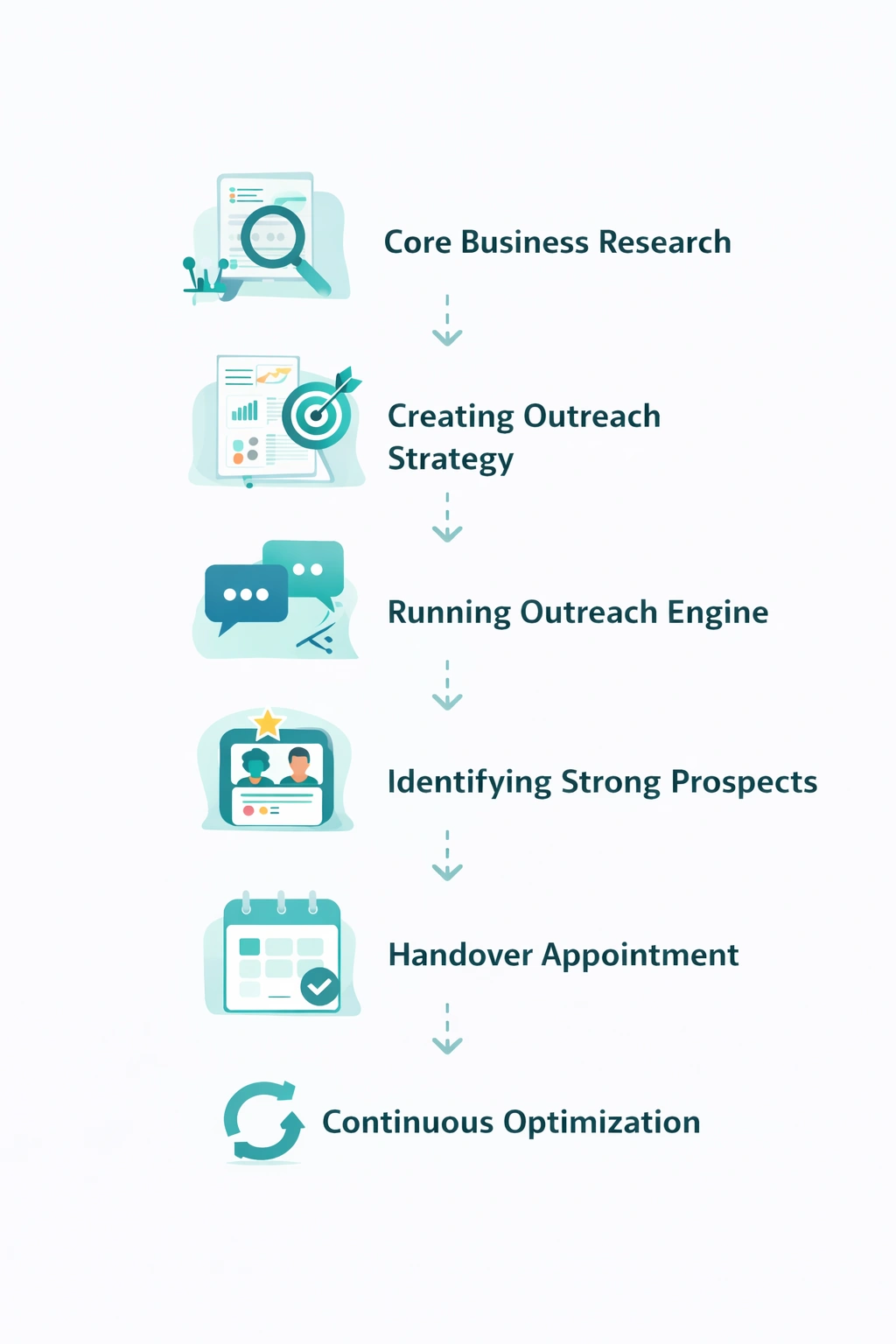
What LinkedoJet operationally provides: we set up your ICP and targeting system, build Sales Navigator prospect lists by migration motion, run AI-assisted personalization, execute LinkedIn outreach, handle replies and follow-ups, and track warm leads through to booked meetings with campaign visibility dashboards.
What happens after onboarding: we implement the Plays (in-market migration, data center exit/VMware-to-cloud, app modernization/platform engineering, regulated migrations), then apply fit + intent scoring so your team focuses on accounts that are actually entering a migration phase—not companies that already finished.
How targeting and list building works: we start account-first, save segmented account lists, then pull the full buying committee inside each account (exec sponsor, infra/cloud owner, architecture/program, security, FinOps/data). You’ll see the exact filters and keyword sets we’re using, tuned to your regions and delivery constraints.
How AI-assisted personalization is used: we don’t spray generic messages. We use AI to draft 1:1 context tied to real triggers—hiring clusters, new leaders, “landing zone” language, wave planning, data center exit pressure—then we QA for technical accuracy and tone before anything goes out.
How nurturing and follow-up works: most migration deals aren’t “yes/no” in week one. We run structured follow-up sequences, route replies, and keep committee members warmed with stage-appropriate angles (governance/landing zone, wave execution risk, cutover planning, security controls, FinOps guardrails).
How warm leads and appointments are tracked: every response is categorized (fit, stage, objection, next step), warm accounts are monitored for new signals weekly, and you get visibility into what’s running, what’s converting, and what’s being refined.
Why this is different from ordinary LinkedIn automation tools: tools send. LinkedoJet manages the system—targeting, signal detection, committee mapping, personalization, execution, follow-up, and continuous refinement—so your outreach is anchored in initiative intelligence instead of volume.
From identifying the right decision-makers to starting meaningful conversations and turning them into qualified appointments... LinkedoJet manages the entire outbound engine for your business.
Next step: get a vetted list of in-market migration accounts and the exact people to contact
If you’re tired of “cloud interest” conversations, we’ll help you build a repeatable engine that finds real programs early, maps ownership, and turns signals into meetings.
Request your Cloud Migration Lead List and see the exact filters, signals, and target titles LinkedoJet will use for your market.