
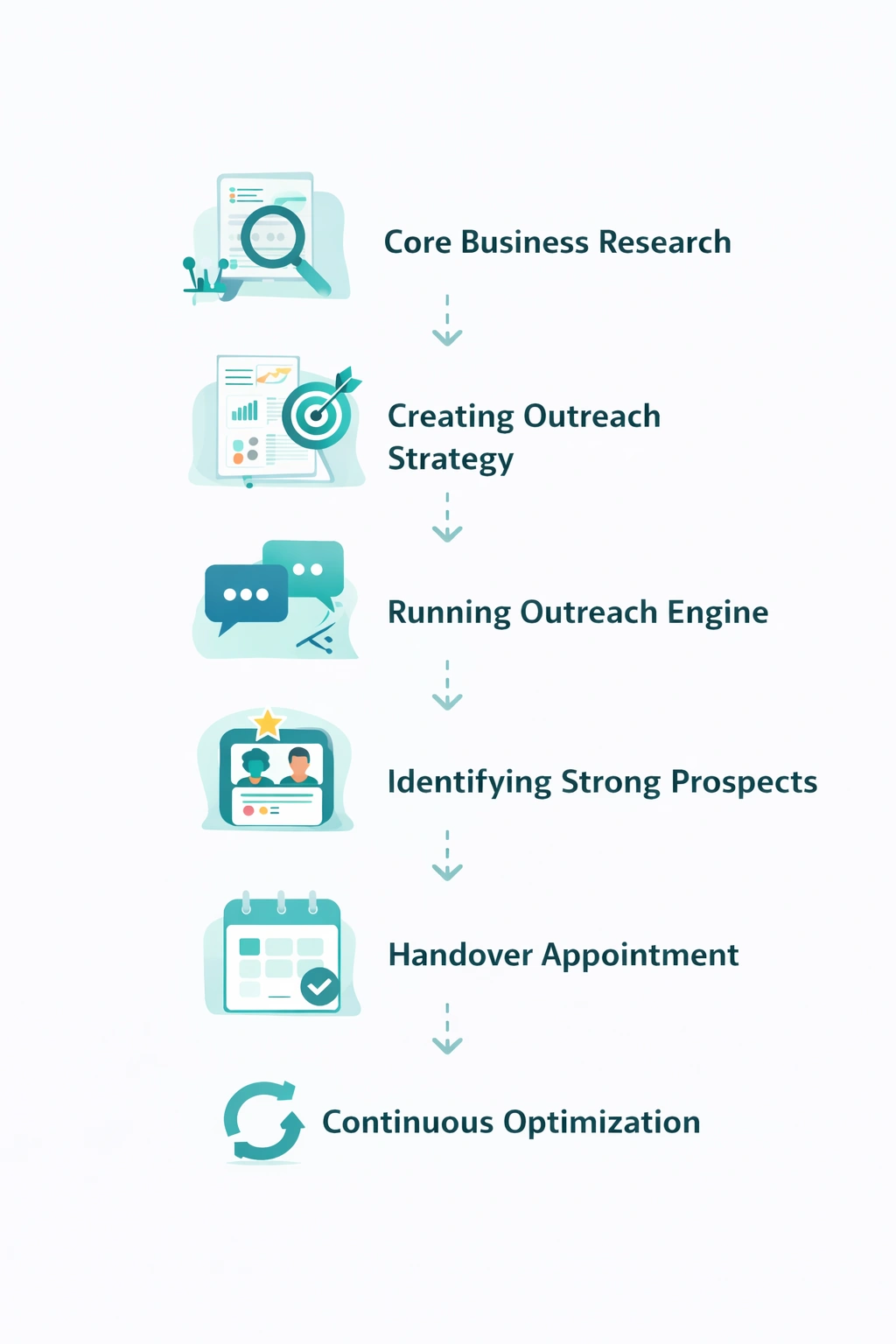
Expansion-intent lead generation (why you’re late to the deal)
Business setup pipelines don’t fail because companies aren’t expanding. They fail because intent is detected after legal, banking, or market-entry conversations have already started elsewhere.
Generic outreach to “founders in Dubai” underperforms because it’s not tied to an active trigger. It competes with every other firm using the same keywords, the same lists, and the same pitch.
The stronger approach is to treat LinkedIn as an intent and timing system. You’re looking for companies where international growth ambition is increasing faster than their entity, banking, tax, payroll, and compliance infrastructure.
| Common pipeline motion | What it produces | Expansion-intent motion | What it produces |
|---|---|---|---|
| Broad founder lists + mass messaging | Low reply rate, high churn | Signal → decision-maker → relevance | Higher-qualified conversations |
| Compete on generic “Dubai company formation” | Price pressure, late-stage calls | Detect market-entry prep | Earlier-stage advisory demand |
| Wait for inbound or referrals | Inconsistent pipeline | Account-based targeting | Predictable outreach cadence |
If your team sells entity setup, freezone/mainland structuring, offshore structures, banking support, visas/residency (including Golden Visa pathways), payroll, and ongoing compliance, timing matters. The objective is to appear when the expansion plan is being formed—not when the shortlist is already built.
Book a Strategy Call to map your ideal expansion signals and build a repeatable LinkedIn targeting architecture around them.
High-intent prospect types (who actually needs setup + banking + visa + payroll + tax + compliance)
Focus on categories where market entry creates operational requirements. Not every founder, not every small business, and not every “interested in UAE” profile is a buyer.
Prioritize prospect types where entity setup is a dependency for hiring, contracting, invoicing, banking, or compliance.
| Prospect type | Why intent is high | Typical downstream needs |
|---|---|---|
| Companies hiring in UAE/KSA/GCC | Local hiring often precedes local infrastructure | Entity setup, visas, payroll, bank account, contracts, compliance |
| SaaS/tech expanding internationally | Investor pressure + sales territory buildout | Cross-border structuring, finance ops, hiring support, tax/compliance coordination |
| Ecommerce/D2C entering GCC | Distribution, warehousing, marketplace operations | Local entity, customs/logistics alignment, VAT considerations, banking |
| Agencies/consultancies serving GCC clients | Invoicing and contracting friction without local presence | Entity or branch, billing structure, banking access, credibility/contracting |
| Funded startups (post-raise) | Funding triggers hiring + geographic expansion | Multi-entity governance, payroll setup, finance/legal ops |
| Founder-led groups, investors, family offices | Mobility and cross-border operations planning | Corporate structuring, residency pathways, banking readiness, compliance |
Signal detection: GCC hiring intelligence + serving GCC clients without local presence
Intent shows up first as operational behavior: job posts, territory hiring, regional announcements, partnerships, and leadership changes.
Start with hiring signals. Roles posted for Dubai/UAE, Riyadh/KSA, Abu Dhabi, Qatar, “GCC,” “Middle East,” or “MENA” typically indicate one of two situations: (1) formal market entry or (2) revenue in-region that now needs infrastructure.
High-signal roles often include Country Manager, Regional Director, Head of Middle East, Sales/BD Manager, Operations Manager, HR, Finance, or Legal/compliance coverage for the region.
Next, hunt for “GCC client without presence” signals. These companies can sell into the region, but hit friction on invoicing, contracting, local bank access, and credibility—especially when larger clients require local contracting entities.
| Signal on LinkedIn | What it can indicate | How to qualify quickly |
|---|---|---|
| Job posts in UAE/KSA for commercial roles | Go-to-market buildout | Check if they already list an office/entity in UAE/KSA; confirm regional leadership exists |
| Founder/executive post: “launching in Dubai/Riyadh” | Market entry planning | Look for timeline language (“this quarter”, “opening office”, “hiring locally”) |
| Company case study with UAE/KSA client logos | Revenue in-region without infrastructure | Verify no local address, no regional legal entity mention, and cross-border billing hints |
| Partnership announcement with GCC distributor/partner | Operational footprint forming | Check if partner is implementing, reselling, or providing local sponsorship/coverage |
Book a Strategy Call to define the exact signals your team will treat as “expansion intent” and the minimum qualification rules before outreach.
Sales Navigator targeting architecture: filters, keywords, and geography logic for UAE/GCC expansion
Your targeting should separate (a) where the company is based from (b) where they intend to expand. Most teams only filter by current geography and miss the intent layer.
Build two parallel targeting views: (1) company/account targeting to find expansion-ready firms, and (2) people targeting to find the operators who own setup-adjacent decisions.
| Sales Navigator lever | How to use it for expansion intent | Example configuration |
|---|---|---|
| Geography (company HQ) | Source markets with outbound expansion patterns | India, UK, Germany, France, Canada, South Africa, Australia, Singapore, US |
| Geography keywords (intent) | Detect destination intent even when HQ is elsewhere | Keywords: UAE, Dubai, Abu Dhabi, Saudi Arabia, Riyadh, GCC, Middle East, MENA |
| Industry | Prioritize sectors that expand and operationalize quickly | Software, IT Services, Ecommerce/Retail, Consulting, Logistics, Financial Services, Import/Export, Professional Services |
| Company headcount | Match your delivery and pricing model | 11–50, 51–200, 201–500, 501–1000 |
| Seniority + Function | Find budget owners and implementation owners | Seniority: CXO/VP/Director/Partner/Owner; Function: Operations, Finance, Legal, HR, Sales |
| Posted on LinkedIn (last 30 days) | Prioritize active executives (better personalization + timing) | Filter for recent activity; cross-check for expansion posts |
| Years in current position | Catch newly appointed expansion owners | 0–1 years for new COO/CFO/Regional Head appointments |
| Hiring growth / headcount growth | Focus on companies entering a scale phase | Positive growth bands; validate with job posts and org chart changes |
Keyword layer (people + company): expansion, market entry, international growth, regional office, Middle East, MENA, GCC, Dubai, Riyadh, “hiring in UAE”, “opening office”, “country manager”. Keep keywords tight; don’t flood searches with broad terms.
Book a Strategy Call to translate your service mix (freezone vs mainland vs offshore, banking support, visas/residency, payroll, compliance) into a filter set that consistently returns expansion-ready accounts.
Decision-maker & title intelligence: who to approach (Founder vs COO/CFO/expansion leads)
The right contact depends on what’s driving the market entry: revenue, hiring, compliance pressure, or investor reporting.
Founders can be the sponsor, but operators often run the project. In expansion cycles, the COO/CFO/Head of International Growth may be closer to entity setup, payroll, banking readiness, and compliance coordination than the CEO.
| Target title | Why they matter for setup decisions | What to reference in outreach |
|---|---|---|
| Founder / CEO / Managing Director | Strategic approval and prioritization | Expansion timeline, strategic rationale, speed to market |
| COO / Global Operations Director | Operational owner of hiring + setup dependencies | Hiring in UAE/KSA, operational readiness, entity-to-payroll sequence |
| CFO / Finance Director | Banking, tax posture, governance, reporting | Bank account readiness, invoicing flow, multi-entity controls |
| Head of Expansion / International Growth | Market-entry execution owner | Territory launch, local contracting, timeline, resource plan |
| Legal Director / Compliance Head | Structuring constraints and risk controls | Entity options, compliance requirements, contracting approach |
| HR Director / People Ops | Visa and hiring execution pressure | Local hires, sponsorship/visa timelines, payroll setup sequencing |
Profile reading framework (fast): (1) Is there a clear expansion trigger? (2) Do they own operations/finance/legal for the region? (3) Do they reference UAE/KSA/GCC in role scope, posts, or achievements? (4) Are they new in seat (0–12 months) with a scaling mandate?
Titles to avoid unless you’re mapping influencers: junior coordinators, assistants, interns, admin-only roles with no budget or project ownership.
Company & experience intelligence: qualification rules, negative signals, and named-account list building
Title + keyword matches are not qualification. You need rules that confirm the business can and will execute a cross-border setup.
Use a simple qualification stack: Trigger (signal) → Capacity (scale) → Owner (decision-maker) → Sequence (why now) → Fit (your service mix).
| Qualification rule | What “good” looks like | Negative signal (deprioritize) |
|---|---|---|
| Trigger present | UAE/KSA job post, expansion announcement, GCC partnerships, regional revenue indicators | No cross-border activity; no hiring; no regional references |
| Capacity to execute | 11+ headcount, growth hiring, or funded stage; clear go-to-market motion | Micro team with no growth; inconsistent operations; unclear product/service |
| Decision owner identifiable | COO/CFO/Expansion lead/Regional head visible | No identifiable operator; only generic “Founder” with no expansion scope |
| Sequence is plausible | Hiring/contracting needs imply entity/banking/visa timing | “Exploring someday” language; no timeline; no operational dependency |
| Fit to your offer | Freezone/mainland/offshore need aligns; banking/visa/payroll/compliance needs match | Requirements outside your delivery scope or jurisdiction focus |
Named-account list building: maintain lists such as “Hiring in Dubai (30 days)”, “Hiring in Riyadh (30 days)”, “GCC client logos but no regional office”, “Funded startups with headcount growth”, and “SaaS building Middle East sales teams”. Assign a primary decision-maker and a secondary influencer per account.
Frequently asked questions
How do business setup consultants find leads on LinkedIn without mass messaging random founders?
Run an intent-first workflow: identify expansion triggers (UAE/KSA hiring, market-entry posts, GCC partnerships, regional revenue indicators), map the operator who owns execution (COO/CFO/Expansion lead), and personalize to the specific signal and timeline. This produces fewer outreaches, but materially higher relevance.
What are the best Sales Navigator filters for company formation and corporate services firms targeting UAE/GCC expansion?
Use company headcount (11–50, 51–200, 201–500), industry (software/IT, ecommerce, consulting, logistics, professional services), growth signals (hiring/headcount growth), and people filters (seniority CXO/VP/Director/Owner + functions operations/finance/legal/HR). Add an intent layer using keywords like UAE, Dubai, Riyadh, Saudi Arabia, GCC, Middle East, MENA, market entry, and regional office.
What hiring signals indicate a company is preparing for UAE, Saudi, or wider GCC market entry?
Job posts for Country Manager, Regional Director, Head of Middle East, sales/BD roles, operations, HR, or finance roles located in UAE/KSA (or explicitly covering GCC/MENA) are strong indicators. Hiring locally often creates immediate dependencies: visas, payroll setup, banking readiness, and compliant contracting.
Who should company formation firms approach inside expanding companies (Founder vs COO/CFO/Expansion Director)?
Approach the person who owns execution. Founders/CEOs often sponsor expansion, but COOs manage sequencing (entity → hiring → payroll), CFOs manage banking/tax/governance, and Expansion/International Growth leads run the market-entry plan. Start with the operator closest to the trigger you observed.
How can LinkedoJet identify founders and executives showing UAE setup, residency, or cross-border structuring intent without making personal assumptions?
By relying on observable business context: public posts about relocation or international expansion, company hiring into UAE/KSA, market-entry announcements, and role responsibilities tied to finance/operations/legal. Targeting is based on professional signals and expansion activity—not on sensitive personal characteristics or inferred private intent.
Map your UAE/GCC expansion-intent targeting system
Use this session to align signals, targeting, decision-makers, and outreach sequencing for your corporate services pipeline.
We’ll review your ideal prospect types (freezone/mainland/offshore, banking support, visas/residency, payroll, compliance), define the signals that indicate active market-entry work, and outline a named-account approach your team can run weekly.
If you already use Sales Navigator, bring one example list and two recent deals (won or lost). We’ll reverse-engineer what the intent looked like before the prospect engaged providers.
Choose your next action
If you want earlier conversations with companies planning UAE/GCC expansion, start with a signal-first system.