
Find seller mandates and qualified buyers on LinkedIn—without spraying generic outreach.
LinkedoJet is a prospect intelligence + client acquisition system built for business brokers. We help you build segmented lists (sellers, real acquirers, referral partners), spot timing signals that most brokers miss, and run discreet outreach that reads like a professional note—not a mail merge.
Most owners will never post “thinking about selling.” But they telegraph it anyway: long tenure, “second generation” language, a new GM/COO hire, a controller posting, a quiet shift toward succession and legacy.
The cost of missing those signals isn’t just a thin pipeline. It’s watching a mandate get sourced quietly by someone else while your calendar stays empty—and knowing you can’t afford to look spammy in a reputation-driven market.
Book a Demo or Get a Sample Lead List.
Trust line: Signal-based targeting, Sales Navigator list workflows, manual verification before messaging, and fewer wasted conversations with non-owners or mismatched “buyers.”
Why broker outreach fails on LinkedIn (hidden intent, buyer noise, reputation risk)
You can do everything “right” on volume—connects, follow-ups, daily activity—and still end up with nothing but silence and awkward replies. Not because LinkedIn doesn’t work, but because most broker outreach is built on the wrong assumption: that intent is obvious.
- Owner intent is private. Exit timing shows up in tenure, hiring, and language—rarely in a post that says “for sale.” Owners behave like owners: discreet, busy, allergic to pitchy messages.
- Buyer lists are polluted. For every serious acquirer, there are ten profiles that “sound” like acquirers—operators daydreaming, advisors calling themselves sponsors, people with no thesis, no capital, no focus.
- Generic automation creates quiet brand damage. A broker who looks like a mass sender becomes someone CPAs and attorneys stop introducing. Owners remember the tone—even if they never reply.
What you actually need is not “more business broker leads.” You need a repeatable way to detect signal, verify fit, and route the right talk track—seller, buyer, or referral—without crossing the line on confidentiality.
Three segmented pipelines (and why mixing them kills response)
If your list is a blend of owners, corp dev, and CPAs—and your message tries to cover all three—you’ll get the worst of everything: low replies, wrong calls, and a “broker spam” reputation you can’t unwind.
| Pipeline | Who you’re targeting | What “qualified” means in practice |
|---|---|---|
| Seller mandates | Owner / Founder / President / CEO / Principal (often 11–200 employees) in your target industries and geographies | True owner-operator confirmed, tenure signal (often 7–10+ years), business type matches your deal box (home services, light manufacturing, specialty distribution, logistics, IT managed services, etc.) |
| Qualified buyers | Search funds / ETA, independent sponsors, PE add-on teams, corp dev leaders, roll-up platforms | Clear thesis + focus (industry/geography/EBITDA range cues), recent activity, credible role/company context (not a vague “investor” headline) |
| Referral partners | CPA partners, wealth advisors (RIA), commercial bankers, M&A/estate attorneys, fractional CFOs, EOS implementers | Local relevance, right seniority, aligned client base, and a relationship-first intro path (not a “send me deals” demand) |
How LinkedoJet runs it: three separate lists, three separate qualification rules, three separate messaging angles. You stop forcing one outreach sequence to do three jobs.
Sales Navigator filter recipes brokers can copy (and how LinkedoJet turns them into clean lists)
Sales Navigator is powerful, but most brokers use it like a phonebook. The difference is treating filters as the start of an intelligence workflow—then cleaning, deduping, and prioritizing before a single message goes out.
Seller Exit Candidates (Owner Exit Candidates)
- Geography: your licensed states/provinces and/or metro radius
- Industry: home services (HVAC/plumbing/electrical/pest/landscaping), commercial services, light manufacturing, packaging, specialty distribution, logistics/trucking, B2B services, IT managed services, industrial services
- Company headcount: 11–200 (optionally 1–10 if you do smaller lifestyle deals)
- Seniority: Owner, CXO, Partner
- Title includes: Owner OR Founder OR President OR CEO OR Principal OR Managing Partner
- Years in current position: 7+
- Spotlights: Posted on LinkedIn in past 30 days
- Keywords (profile): succession, retiring, exit, second generation, family business, cash flow
Search Fund / ETA (Acquirer Demand — List A)
- Title keywords: search fund OR acquisition OR ETA OR EIR OR Entrepreneur in Residence OR Entrepreneur Through Acquisition OR Acquisition Entrepreneur
- Company headcount: 1–10
- Spotlights: changed job in last 90 days; posted in last 30 days
PE Add-on Teams (Acquirer Demand — List B)
- Industry: Financial Services (Private Equity), Investment Management
- Titles: Principal, Partner, VP, Director (Investments), Head of Business Development (PE), Platform/Portfolio Operations
- Keywords: add-on, platform, roll-up, buy and build
- Company headcount: 11–500
Referral Partners (Local introductions)
- Industry: Accounting, Banking, Legal Services, Financial Services (RIA)
- Titles: Partner, Managing Partner, Wealth Manager, Commercial Banker, Relationship Manager, Attorney, Fractional CFO
- Geography: local to your market
What LinkedoJet adds: we turn these into clean, deduped, prioritized lead lists with segmentation, notes, and a timing score—so your outreach goes to the right person for the right reason.
Timing + intent signals: what to look for, what to exclude, what to verify
Exit readiness rarely shows up as a single event. It’s a pattern. Same with buyer intent. Your advantage comes from noticing the pattern early and acting with discretion.
Seller signals (exit readiness without saying “exit”)
- Tenure tells the story: 10+ years in the seat; “since 19xx”; “second generation”; “family-owned” language
- De-risking hires: new GM/COO/President; hiring Controller/CFO/Finance Manager (cleanup before a process)
- Operational maturity: multi-location leadership hiring, HR/compliance, ERP/ops systems references
- Liquidity planning language: succession, valuation, ESOP, estate planning, “next chapter,” legacy
Buyer signals (real acquisition intent)
- Thesis clarity: specific industry + geography + deal size cues, not generic “looking for acquisitions”
- Momentum: fundraising/close announcements, add-on acquisition news, integration hiring
- Corp dev patterns: “tuck-in,” integration posts, M&A responsibilities in role description
Negative signals to exclude or de-prioritize
- “Not for sale,” “no brokers,” “do not solicit” language (hard stop)
- In-role < 2 years (usually wrong timing unless they explicitly mention succession/transition)
- Owner-like titles with no operating context (consultants, recruiters, vague “portfolio” profiles)
- Venture/startup ecosystem mismatch when you’re sourcing SMB cash-flow businesses
Verification before outreach (what we actually check): are they a true owner/operator, are they in your geography, does the business type match your deal box, and do they show any timing triggers worth a discreet note.
The LinkedoJet workflow for brokers: deal box → lists → timing score → discreet talk tracks → monitoring
This is where LinkedIn stops being “another channel” and becomes a dependable sourcing layer. Not because you send more messages—because you send fewer, better messages to better targets, with a system behind it.
1) Define your deal box (so the list isn’t lying to you)
We set the operating constraints upfront: industries, geography, headcount band, and what you consider a fit proxy for deal size. Then we split buyer demand by type (search fund vs sponsor vs PE add-on vs corp dev) so the messaging and follow-up match the buyer reality.
2) Build segmented lists in Sales Navigator (then clean them)
LinkedoJet builds and maintains separate lists for seller candidates, buyer candidates (by type), and referral partners. We remove duplicates, flag questionable profiles, and structure the data so it’s usable by a broker team—not just a CSV.
3) Prospect intelligence enrichment (manual-review-first)
Before outreach, we read profiles for confirmation: owner/operator reality, tenure, location, company context, and any timing triggers (hiring bursts, succession language, leadership changes). This is how you avoid the embarrassing “wrong person” messages.
4) Scoring and routing: Now / Soon / Nurture
We combine tenure + hiring + activity + keyword triggers to prioritize. “Now” gets a discreet, relevant note. “Soon” gets a lighter touch and a follow plan. “Nurture” is tracked without forcing a pitch.
5) Discreet talk tracks (different for sellers, buyers, referrals)
- Sellers: exit planning/value acceleration angle, confidentiality-forward language, market timing/valuation context without acting like you already know their plans
- Buyers: thesis alignment, geography/industry match, process expectations (what you bring vs what you won’t entertain)
- Referrals: reciprocity, client outcomes, co-branded education (succession/valuation) rather than “send me deals”
6) Monitoring and refinement
Signals change. We monitor for new posts, job changes, hiring bursts, and profile updates, refresh lists monthly, and adjust filters based on real reply quality—not vanity metrics.
Result: a calmer calendar, fewer dead-end calls, and a pipeline that doesn’t depend on luck or a single referral source.
See a seller + buyer list built for your market in 48 hours.
If you send us your geography, target industries, deal size focus, and preferred buyer types, we’ll build segmented lists and show you the timing signals we’d prioritize—so you can judge quality before you commit to volume.
Book a Demo or Get a Sample Lead List.
Expect a direct view of what you’d actually work: seller candidates with verified owner/operator context, buyer lists split by acquirer type, and referral partners mapped locally—plus the outreach angles we’d run without risking your reputation.
Common questions from brokers
Can you help me find owners likely to sell within 6–24 months?
Yes—by treating “likely to sell” as a score, not a guess. We prioritize tenure (often 7–10+ years), succession/legacy language, and operational triggers like hiring a GM/COO or controller/CFO. Then we verify owner/operator reality and local fit before outreach. It’s not perfect prediction, but it’s consistently better than title-only lists.
How do you separate real buyers (search funds, independent sponsors, PE, corp dev) from tire-kickers?
We split buyers into separate lists and qualify differently for each. Search funds get checked for thesis clarity and real momentum (new fund launch signals, consistent ETA content, credible background). PE add-on teams get validated by role, firm context, and add-on language. Corp dev gets validated by function/title and actual M&A responsibility. If the profile can’t explain what they buy and where, it gets deprioritized.
Does LinkedoJet replace Sales Navigator?
No. Sales Navigator is the data layer. LinkedoJet operationalizes it: we build and maintain the lists, add verification and timing notes, run AI-assisted personalization that still sounds human, execute the outreach, handle replies and follow-up workflows, and track warm leads through to booked conversations.
How do you handle confidentiality and reputation risk for seller outreach?
We keep it discreet by design: manual review first, smaller high-signal lists, and messaging that doesn’t assume intent. We also exclude profiles with “no brokers/do not solicit” language and avoid provocative language that invites forwarding. The goal is to sound like a professional peer reaching out privately, not a mass campaign.
What industries and geographies tend to work best for this approach?
It tends to work best where ownership is identifiable and operator-led: home services, industrial services, light manufacturing, specialty distribution, logistics/fleet operators, B2B services, and IT managed services. Geography works best when it aligns to where you can actually run a process—state/province coverage or a defined metro radius—because local proof and licensing reality matter in brokerage.
Walk away with a clear outbound engine—lists, timing signals, talk tracks, and tracking.
This isn’t a generic “strategy call.” We’ll show you how LinkedoJet would build your seller + buyer + referral pipelines, what we’d prioritize, and how we run discreet outreach and follow-up without damaging your name in the market.
What LinkedoJet operationally provides: ICP and targeting setup, Sales Navigator list building, manual verification, AI-assisted personalization, LinkedIn outreach execution, reply handling and lead nurturing, warm lead tracking, appointment generation support, and campaign visibility through dashboards—plus ongoing refinement based on actual conversation quality.
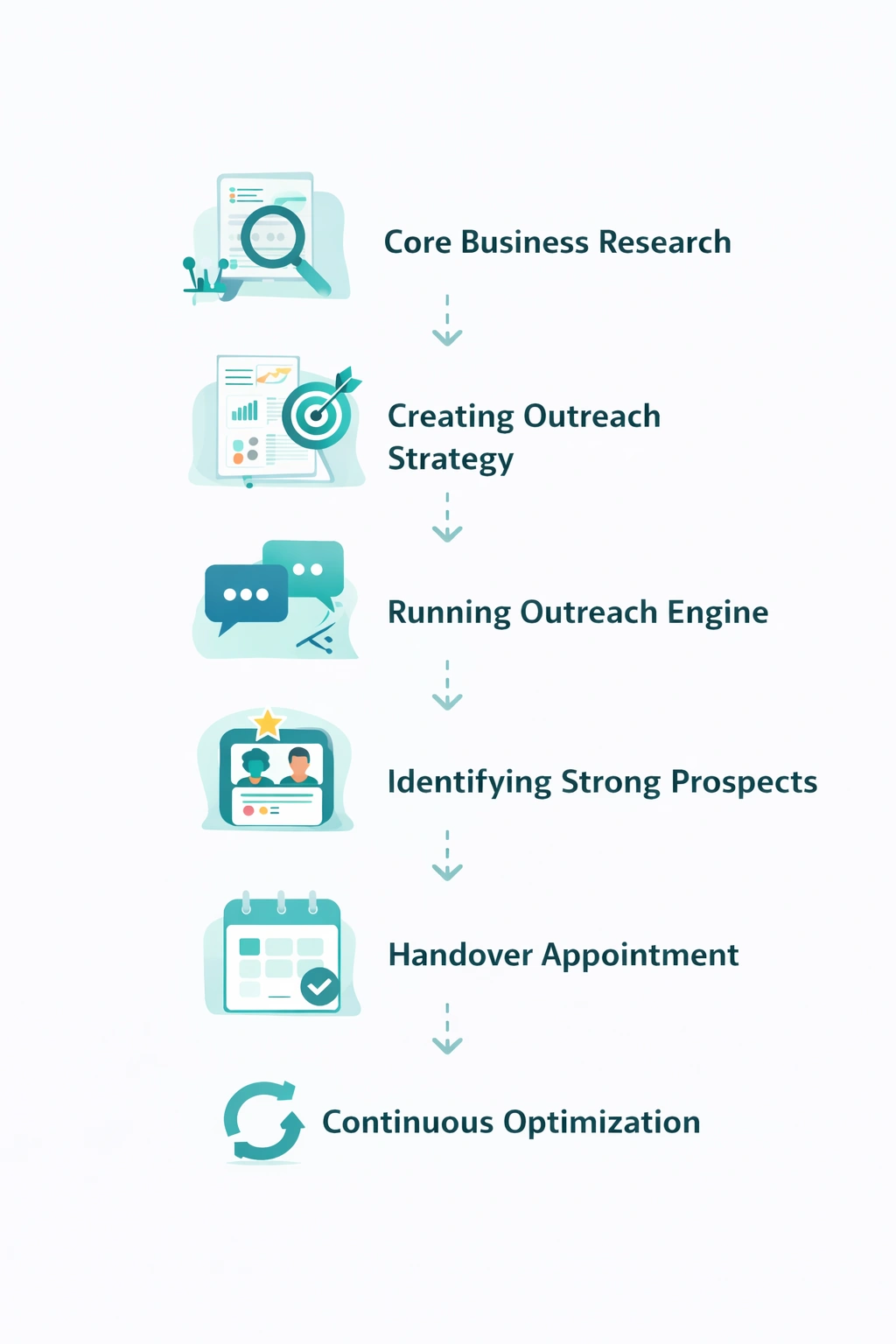
What happens after onboarding: we set up three segmented pipelines (seller mandates, buyer demand by type, referral partners). We build your initial prospect lists, score them using timing + fit signals, and launch discreet outreach with the right talk track per segment. Replies are handled inside a defined workflow: qualification questions, follow-ups, and handoff rules for when a conversation becomes a real opportunity.
What you receive: clean lead lists (deduped and prioritized), notes on the signal that triggered the outreach, message sequences tailored to sellers/buyers/referrals, a warm lead tracker, and a dashboard showing outreach volume, reply quality, and booked appointment outcomes.
How targeting and list building works: we start with your deal box (industries, geo, headcount band, buyer types). Then we build Sales Navigator filters and lists per segment—seller candidates aren’t mixed with acquirers, and referral partners aren’t treated like buyers.
How AI-assisted personalization is used: AI helps draft context from profile and activity signals (tenure, hiring, succession language, thesis posts). A human review step keeps tone clean and confidentiality-safe, so messages read like a broker-to-owner note, not automation.
How lead nurturing and follow-up works: “Now / Soon / Nurture” routing drives follow-ups. Sellers who aren’t ready aren’t pushed—they’re tracked and revisited based on new signals. Buyers are qualified for thesis fit and seriousness before you spend cycles.
How warm leads and appointments are tracked: we track responses, tag intent, and support the handoff into booked calls. You see what’s moving, what’s stalling, and why—so you’re not guessing where the pipeline went.
Why LinkedoJet is different from ordinary LinkedIn automation tools: tools send messages. LinkedoJet runs the system: segmentation, verification, timing detection, personalization, execution, reply handling, nurturing, and visibility—built for a relationship-driven, confidentiality-sensitive business.
From identifying the right decision-makers to starting meaningful conversations and turning them into qualified appointments... LinkedoJet manages the entire outbound engine for your business.
Your next step: stop guessing, start running a repeatable sourcing system.
If you want a steadier flow of seller mandates, qualified buyer demand, and referral introductions—without risking your reputation—LinkedoJet will build and manage the segmented lists, timing signals, outreach, and follow-up engine for you.